
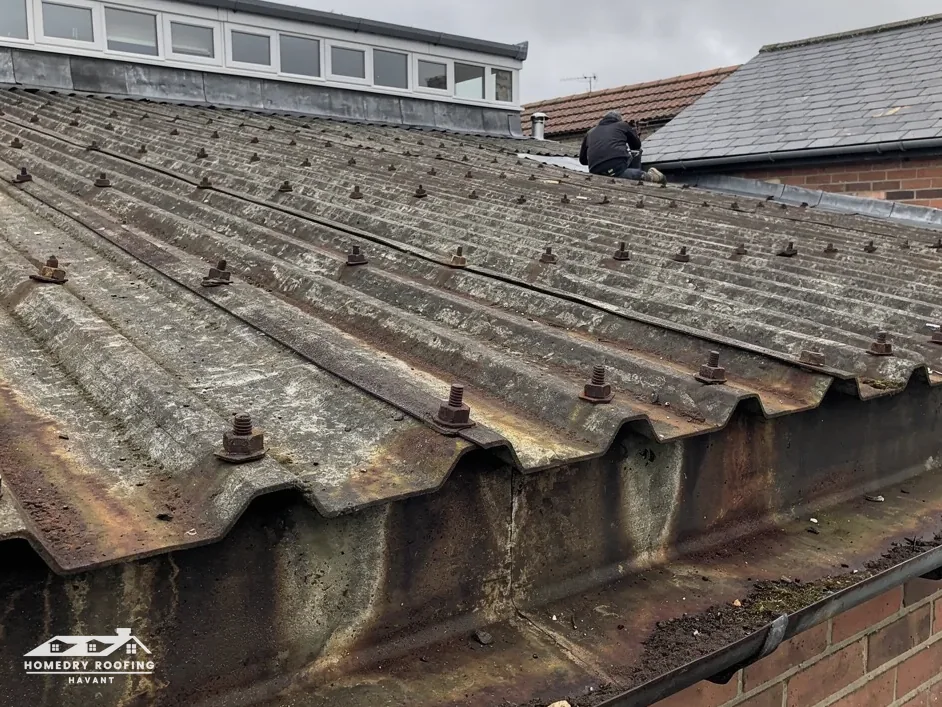
A roof on a warehouse, a shop or a block with a business owner is construction work in the eyes of the law, and the Construction (Design and Management) Regulations 2015, known as CDM 2015, set out who must do what before and during it. Those duties fall on the client first, and for a commercial building the client is the building owner or whoever commissions the roof work.
Here the two kinds of client part ways. A homeowner who orders a new roof passes most of the client duties on to the contractor. A business does not, and an owner who treats a commercial roof job like a domestic repair can end up with duties nobody has picked up.
This post is a plain guide to the main points: who counts as a commercial client, what arrangements the client must make, when a second contractor changes the picture, when a project has to be notified to HSE, and what asbestos, fragile roofs and energy rules add on top. It describes the rules as published. It is not legal advice, and where a project is large or unusual, the HSE guidance and your own advisers come first.
Who counts as a commercial client
HSE defines a commercial client as any individual or organisation that carries out a construction project as part of a business. A company that owns its premises, a landlord with a let unit, a trust running a hall and a sole trader with a workshop all fit that description when they commission roof work.
The difference from a domestic client is the whole point. HSE says that client duties apply in full to commercial clients, while for domestic clients the duties normally pass to other dutyholders. A domestic client is any individual who has construction work carried out on their home, or the home of a family member, that is not done as part of any business.
So the first question for an owner is a plain one: is this roof part of a business? If it is, the duties below belong to you.
- An owner-occupier running a business from the building is a commercial client for the roof.
- A landlord who commissions the work on a let building does so as part of a business.
- A homeowner who happens to run a business from a spare room still has a home with a roof, so the facts matter.
Those are examples of how the test works, not rulings on any one case. If the answer is unclear, ask HSE or a solicitor, not the roofer.
HSE's own page on commercial clients sets out the definition and the duties in full. Our short answer on who the client is under CDM takes the same question further.
Arrangements the client must make
The first duty is in regulation 4(1) of CDM 2015, and it is short:
"A client must make suitable arrangements for managing a project, including the allocation of sufficient time and other resources."
On a roof, that sentence has practical meaning. It covers how long the work is allowed to take, how the building will carry on in use while it is done, who has access to the roof, and what money has been set aside for the job. A client who squeezes the programme, or who refuses access for a survey, has not made suitable arrangements.
Information is part of it as well. A contractor can only plan safely if the client passes on what it knows about the building, which on a commercial roof can include:
- Where the roof is fragile, including any rooflights.
- Where services such as cables, pipes or extract ducts cross the roof.
- The roof's make-up, and anything known about asbestos in it.
- Any restriction on access, hours or noise.
Then there is the construction phase plan. The regulations leave the writing of that plan to others. With a single contractor, regulation 15(5) makes the contractor responsible for drawing it up or having it drawn up, and with several, regulation 12(1) hands the job to the principal contractor. Either way a plan exists for every project, and the client does well to read it before the first sheet comes off.
When a second contractor joins the project
The next step turns on a count. Regulation 5(1) is worded like this:
"Where there is more than one contractor, or if it is reasonably foreseeable that more than one contractor will be working on a project at any time, the client must appoint in writing"
two dutyholders, one to be the principal designer and the other the principal contractor.
On a roof project, the second contractor is easy to miss. The roofer may be the only firm on the contract, but the programme may also include:
- A separate firm fitting or replacing rooflights.
- An electrician moving cables or fitting solar panel supports.
- A scaffold or access firm appointed separately by the client.
- A specialist taking out asbestos cement sheets.
Any one of these can turn a one-contractor job into a project with several. The phrase reasonably foreseeable means a client cannot wait for the second firm to turn up on site. The question belongs at the planning stage, before the first contract is signed.
What triggers the extra appointments is the number of firms, not whether HSE has to be told. People often mix the two up. A small project with two contractors still needs both appointments made in writing, whereas a large project run by one contractor does not.
What each appointment does
The principal designer plans, manages and coordinates the pre-construction phase, and the principal contractor does the same for the construction phase. The client makes both appointments, in writing, and should check that each is competent for the work. Both appointments sit with the client, which is why the decision about how many contractors will be on the roof cannot be left to the roofer alone.
When a roof project must be notified to HSE
A project is notifiable only if it meets one of two tests in regulation 6. It will either last longer than 30 working days and have more than 20 workers working simultaneously at any point in the project, or it will exceed 500 person days. A person day is one person working one day on the project.
When a project is notifiable, the client must give notice in writing to the Executive, which means HSE, as soon as is practicable before the construction phase begins.
| Test | What the regulation says |
|---|---|
| Duration and workers | Longer than 30 working days, with more than 20 workers at once |
| Person days | More than 500 person days in total |
A small roof repair can fall well below both tests, but that is a comment on scale, not a rule, and the regulation applies to the project as a whole. A re-roof of a large unit, or work on several roofs under one contract, can reach the threshold, so the client should count from the programme, not from the size of the quote.
Notifying HSE changes nothing about who has to appoint a principal designer. That depends on the number of contractors. What notification adds is a notice sent to HSE, and the construction phase plan is still needed whether or not a notice goes in.
Our short answer on when a roof project is notifiable works through the two tests with examples of how the numbers are counted.
Asbestos and fragile roofs: the owner's other duties
CDM is only one set of rules for a commercial roof. Asbestos and falls from fragile surfaces sit alongside it, and both land on the owner.
On non-domestic premises, the Control of Asbestos Regulations 2012 place a duty to manage asbestos on whoever holds the maintenance or repair obligation or controls the premises. Regulation 4 says the dutyholder must ensure that a suitable and sufficient assessment is carried out as to whether asbestos is or is liable to be present. For a roof, that means knowing what the sheets are before a contractor arrives.
HSE advises assuming asbestos is present in any building built or refurbished before 2000. On the roofing side, HSE guidance sets out these points:
- Asbestos cement roof sheeting removed carefully without breaking it up is non-licensed work.
- Where the material has been substantially damaged or broken up, the work is notifiable non-licensed work.
- Asbestos cement roofs are always fragile.
- Asbestos waste goes in a lockable skip, never an open one, and whoever carries it must be registered as a waste carrier, either upper tier or lower tier.
On fragility, HSE's position is that no roof is safe to step on until a competent person has confirmed it is not fragile, and singles out rooflights that are fragile as a particular hazard. A commercial roof with old rooflights is a clear case for planning access before anyone steps onto it.
Our guide to the duty to manage asbestos on commercial roofs covers the survey and the management plan.
Energy rules, standards, wildlife and the price
Three more points belong in the planning of any commercial roof, and then comes the question of what it will cost.
First, energy. For a commercial building, until 24 March 2027, AD L Volume 2 sets 0.18 for a new flat roof and 0.16 for a new pitched roof. A renovated roof works to 0.18 for a flat roof or a pitched roof insulated at the rafters, and to 0.16 for a pitched roof insulated at the ceiling, where that is feasible and pays back within 15 years. From 24 March 2027 the 2026 edition applies for most work in England, and its roof figure is 0.18. The domestic figures in Volume 1 never apply to commercial work.
| Roof | New | Renovated |
|---|---|---|
| Flat | 0.18 | 0.18 |
| Pitched, ceiling insulation | 0.16 | 0.16 |
| Pitched, rafter insulation | 0.16 | 0.18 |
Second, standards. BS 6229:2025 is the current code for membrane flat roofs, meaning roofs covered with continuously supported flexible waterproof coverings. It replaces BS 6229:2018, which BSI lists as withdrawn, and it does not cover lead.
Third, wildlife. GOV.UK says activities such as repairing or replacing a roof can affect bats, whose breeding sites and resting places are fully protected, so a survey before a strip-out makes sense.
On price: a commercial roof is priced once it has been surveyed, since the roof, its access and its condition set the job. A figure given without a survey is only a guess, and the written total names what it covers. Our commercial roofing page explains how we survey and quote, and the phone and quote form are on every page.
Filed under Commercial roofing