
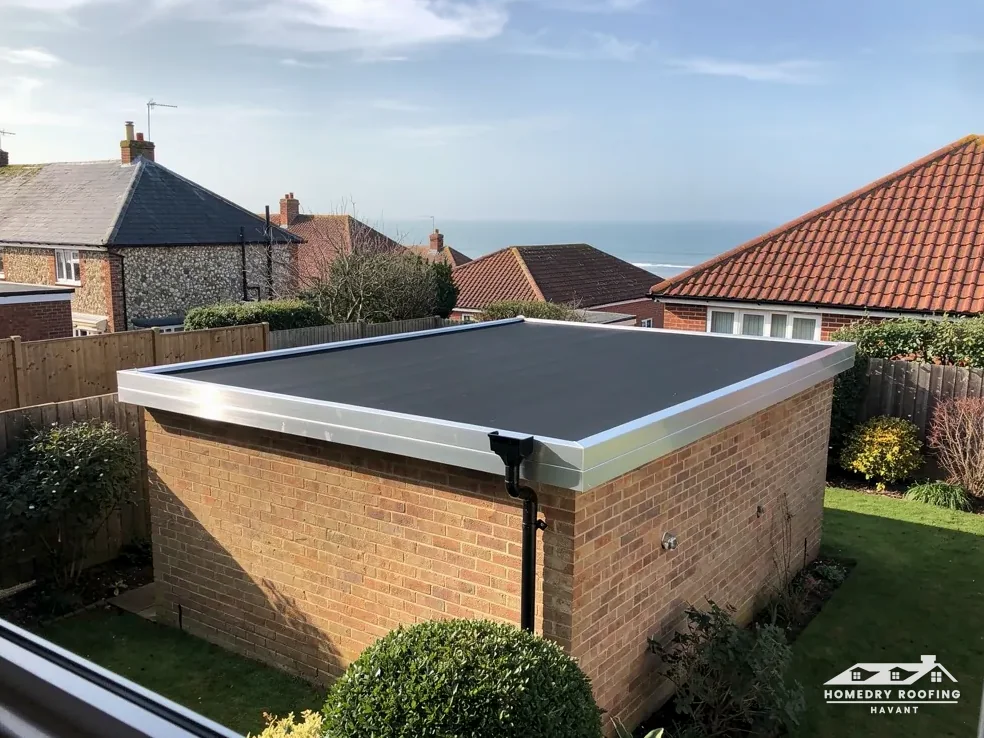
Stacks
The column of brick or stone that carries a flue up through the roof and out into the weather.
Its mortar joints and the lead around its foot are what a survey reads first.

Stedham, 16.8 road miles north-east of Havant, lies inside the South Downs National Park. Stacks, flashings and gutters there get a survey before any quote is written.
10-year workmanship guarantee, in writing
The column of brick or stone that carries a flue up through the roof and out into the weather.
Its mortar joints and the lead around its foot are what a survey reads first.
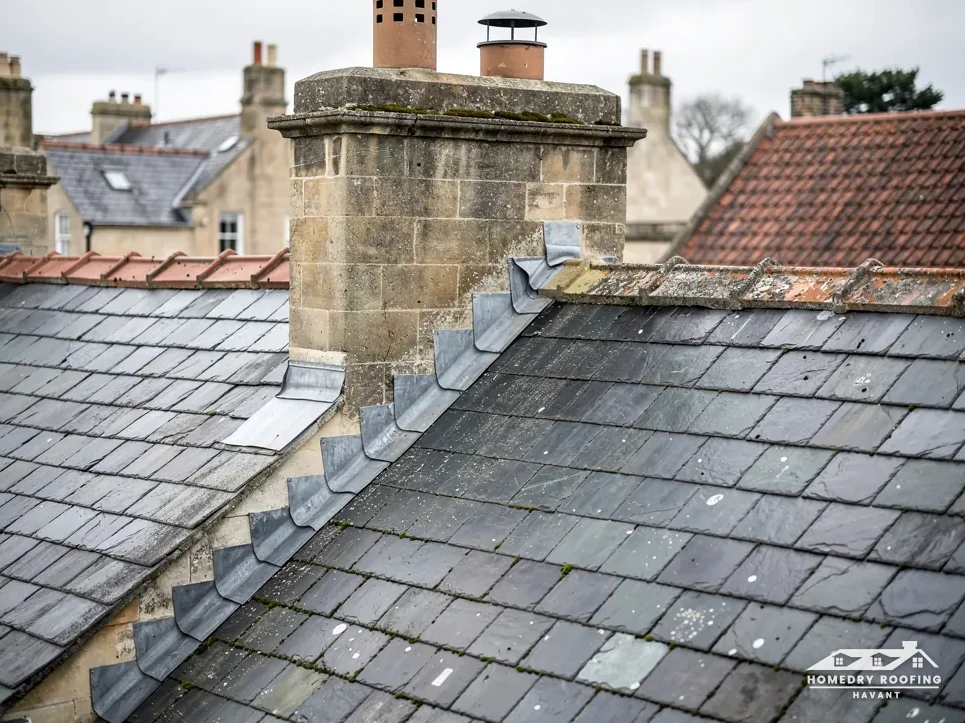
Strips of metal tucked into a wall or a stack to turn rain away from the join.
A lifted edge looks small from the ground and can pass water long before a stain shows indoors.
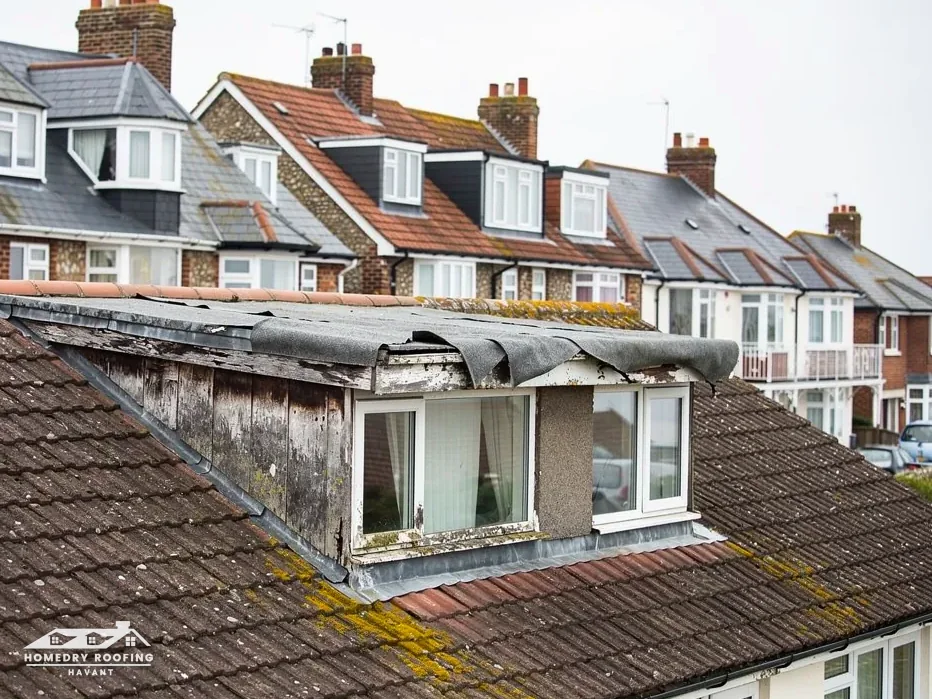
The lowest rim of the roof, where tiles overhang a gutter fixed to a fascia board.
A board gone soft at the rim holds the gutter badly and drips down the wall beneath.
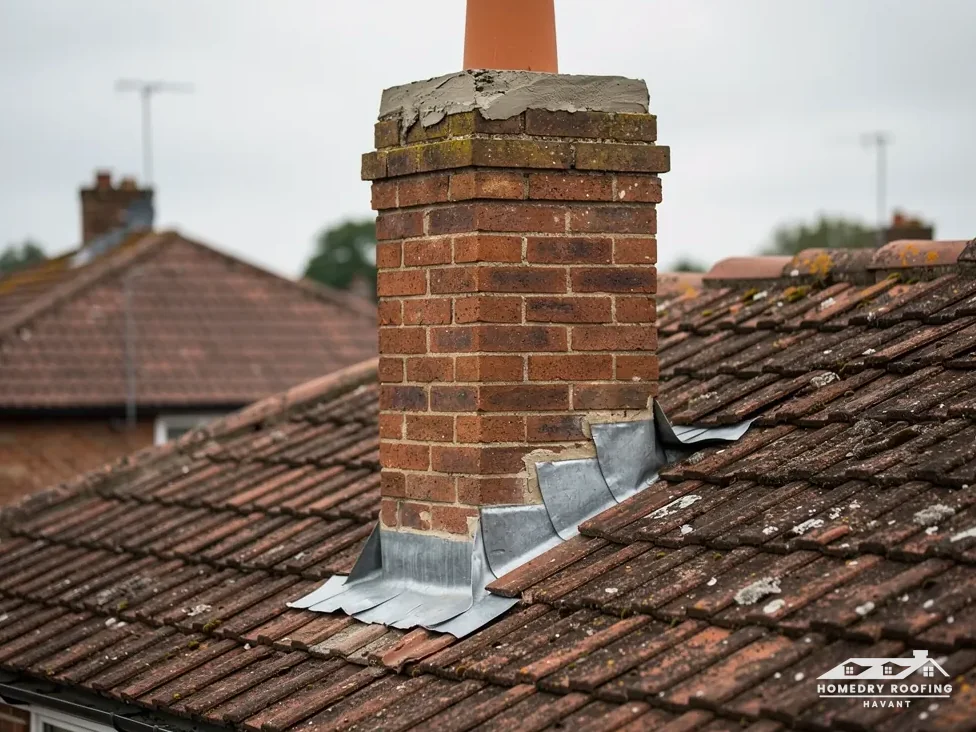
Rain can reach the brickwork from above, through failed pointing, a cracked cap or flashing that has lifted, and carry soot stains down with it. We trace the stain upward to the stack and read each joint on the way.
A chimney stack stands further into the weather than anything else on a house, so it is surveyed from pot to foot. On the ladder we check the cement that beds the pots, the pointing between the courses, any lean in the column, and the lead dressed round the stack's base. Indoors, a brown ring on the chimney breast can lead back to the same spot, and a torch held up in the loft reveals whether the brick above it is dark with damp. A stack that has lost its cement cap or its flashing is described on our chimney repairs page, and the metalwork is explained under leadwork.
Stedham sits inside the South Downs National Park, and for planning that places the decision with the National Park Authority, not with the district. Day to day, Chichester District Council deals with applications for Stedham addresses on the Authority's behalf, apart from any it calls in. Building control is not the Authority's job, so Chichester District Council's building control team is the contact for that. The planning guide for roof work explains what the Park changes for work beyond a plain re-roof.
The Parish Church of St James has a Grade II listing (list entry 1217264) and holds Church of England services, so works to the church are a matter for the Church of England's faculty system, not listed building consent. The Old Ale House (list entry 1275481) and The Old Rectory (list entry 1275482) are listed Grade II too, so listed building consent comes into play for roof work that would change what they are. Stedham has a designated conservation area, and Chichester District Council, as host authority, is where to raise it, together with any Article 4 direction, before you commit to a covering.
The tallest thing on the roof gets the most rain on its sides.
Taking a chimney stack down or shortening it is a different job from repairing it, and the paperwork differs too. A repair to the pointing, pots or flashing leaves the stack as it is. Removing a breast brings in building regulations and sometimes a party wall notice. We say at the survey which of the two your stack needs, in writing, and we price only the work you have chosen.
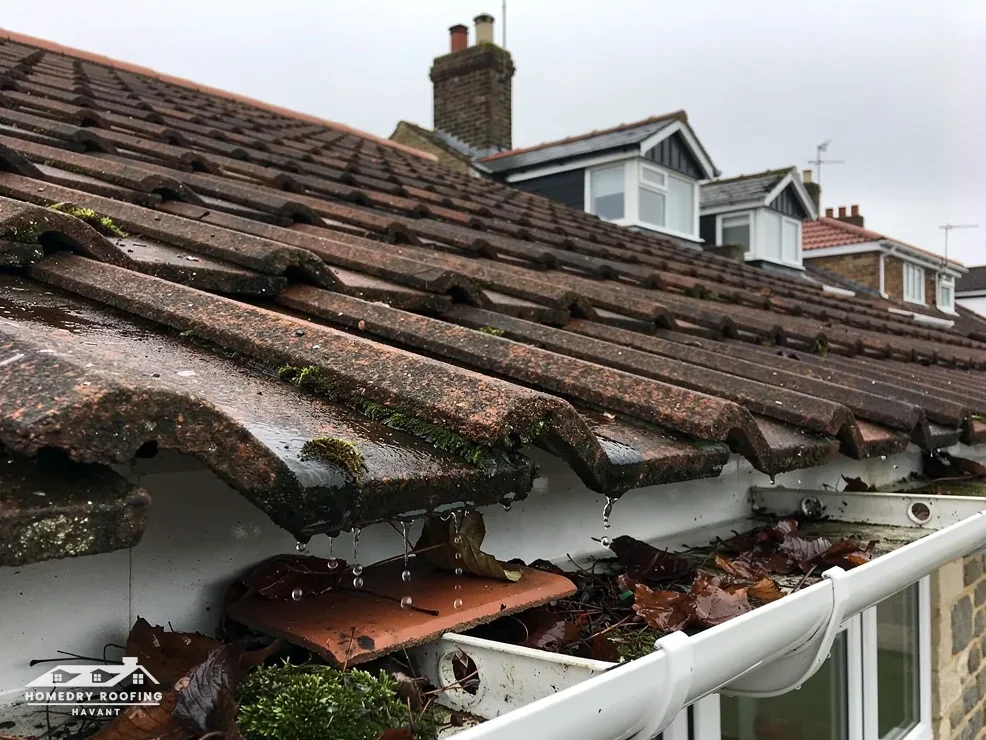
A roof is only dry if its water has somewhere sensible to go.
Rain that has run down the slope reaches the eaves, so the last stretch of a Stedham roof gets its own look. The gutter should lean gently towards the pipe, hang from firm brackets and meet its neighbouring length without a drip. Where it does not, the water goes down the wall or into the fascia board behind, and over a wet season that adds up to softened timber and stained render. We press that board, and the soffit beneath, with a thumb, because timber that gives under pressure has been wet for a while. Our gutters, soffits and fascias page covers repair and replacement.
Next the survey follows the pipe to the ground where the water lands. A downpipe whose foot stops short of a drain wets the base of the house. On Environment Agency flood mapping, land near Stedham falls in Flood Zone 3. That is a fact about land nearby, and roof drainage is a separate matter, although a pipe that discharges clear of the house is sensible anywhere.
A few rules are worth knowing before the poles go up, and each is a question for the right desk, not a guess. The Planning Portal puts the re-roofing line at under 25 per cent of the building envelope and under 50 per cent of the roof, below which a building regulations application is not normally needed; a covering 15 per cent or more heavier is the trigger for approval. West Sussex County Council sets the scaffold licence fee for the highway here at £266 for one month, with at least 10 working days' notice. When a roof needs the poles, we arrange the licence with our scaffolder and fix the dates with you beforehand. If the pavement is narrow, the survey notes it, because that changes how the scaffold is stood.
A gutter is only half of a drainage run. The other half is the ground at the foot of the pipe, and that ground needs to carry the water away from the wall, not hand it back. We make a note of where each downpipe ends, whether a gully is waiting to catch it, and whether the wall behind shows damp, and those notes go into your findings beside the gutter itself.
A green streak below a joint on the wall, or a damp patch at skirting height beside the downpipe.
A leaking gutter joint or a pipe ending at the wall, which throws water on the brickwork for as long as the rain lasts.
Map of Stedham and the places around it, with the dashed line of our 30-mile service area from Havant. The same places are listed below the map.
From a ladder, then from the loft, with a torch for the timbers. Outside we look at the cement bed round the pots, the pointing between courses, any lean in the column and the lead flashing at its foot. Inside we look over the chimney breast and the timbers around it for staining. A stack that needs only fresh pointing is not offered a rebuild, a sound one is left standing, and one that leans or has lost courses is described plainly, with photographs. The findings reach you in writing before a price is quoted, so you can see what each recommendation rests on.
Stedham is inside the South Downs National Park, which means the Park's own planning body makes the decisions. In practice Chichester District Council handles applications from Stedham for the Authority, though a case can be called in and kept by the Authority. Re-roofing a house stays under the ordinary rules. Because it is your own address that counts, ask Chichester District Council for the route in writing before a contractor orders materials, and file the reply with the deeds or the survey, so it can be found years from now. The planning guide shows what the Park changes for other jobs.
No, the Authority does not provide building control, which remains with the district side. Under the Planning Portal's test, a re-roof touching under 25 per cent of the building envelope and under 50 per cent of the roof would not normally need a building regulations application, while a covering 15 per cent or more heavier needs a go-ahead beforehand. We compare your roof with both limits, then write to Chichester District Council's building control team to check which route applies, before any work begins, so nobody is guessing about a start date. Whichever way the reply falls, it is passed to you on paper.
Section 169 of the Highways Act 1980 is the law on scaffolding that obstructs the highway, and a licence is what it asks for. Highway licensing at Stedham falls to West Sussex County Council, which lists £266 for one month and asks for at least 10 working days' notice. Alongside that, we arrange the licence with our scaffolder, and pole dates are fixed jointly before anything is booked. Its cost is one of the things that sets the total, so it is built into the quoted figure instead of arriving as a surprise once the street is waiting.
Both are listed Grade II, and listed building consent covers work that would change the character of a listed building, which a new covering or an altered chimney can do. A listed house needs that consent on top of anything else. Read the list entry for your property, ask Chichester District Council before any price is agreed, and keep its answer, because the work should not wait on a guess. We then plan the survey and the programme around what is allowed, and nothing starts until the reply is in your hands.
Yes, the two are treated differently. The Parish Church of St James carries a Grade II listing and hosts Church of England services, so works to the building go through that church's faculty system and not the council's listed building consent. A house holding its own listing has no such route and needs the consent. Living close to the church changes nothing for your own roof unless your address carries an entry too, and a quick search of the national list will show whether it does. We would rather you checked than assumed.
No. Environment Agency flood mapping lists land near Stedham as Flood Zone 3, yet that describes ground and water, and a flashing, a tile or a gutter is mended the same way regardless. Should flood risk bear on a policy or a purchase, your insurer or solicitor can explain what the zone means for your address, since the answer depends on your policy and your plot. We stay with the roof and its drainage, which is the part we can survey, and we write down what we see, with photographs, so you hold the evidence if anyone later asks for it, whether that is an insurer, a buyer or a neighbour.
Look for one total price, written once a surveyor has been on the roof. The page should state the job, name the covering, and spell out where VAT and scaffold fall in the sum, with the findings that justify it printed alongside. Ours is built that way, and where the repair would hold, it takes precedence over a replacement, with reasons for any replacement set out in the same document. The totals are good and fair. When two quotes differ, put one question to both firms: what is left out? Then get the reply on paper.
You'll get one written total price.
Fill in what you like. It opens WhatsApp with your message ready to send.