
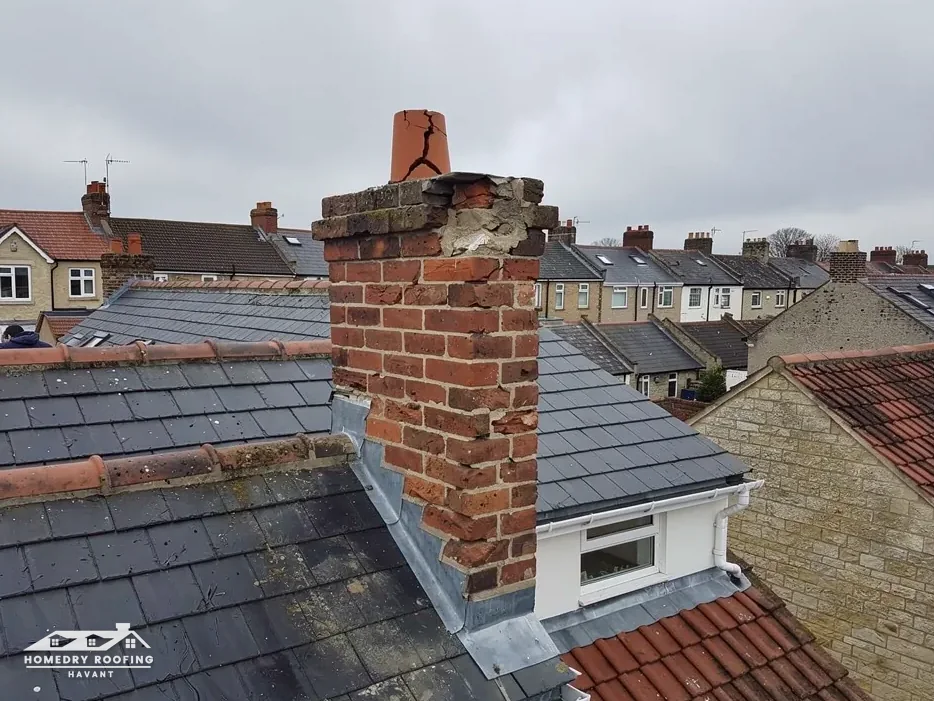
Stacks
Where a brick chimney leaves the slope and its base is dressed with lead.
A cracked cap or a lifted apron sends rain down the breast into the room.

Chimney stacks, eaves, gutters and re-roofs in Fernhurst, 28.4 road miles north-east of Havant, inside the South Downs National Park, with a survey ahead of the one written total.
10-year workmanship guarantee, in writing
Where a brick chimney leaves the slope and its base is dressed with lead.
A cracked cap or a lifted apron sends rain down the breast into the room.
Where the first course of tiles hangs out past the wall above the gutter board.
A slipped course there throws roof water behind the gutter onto timber.
Where the underside of the covering shows daylight, staining and damp rafter feet.
Marks on the timber tell us which slope has been passing rain.
A stain on the breast starts higher up the stack than it appears.
Few parts of a roof meet the weather from as many sides as a chimney stack, and none carries more joints. We begin at the pots and the cap over the flue, then work down the brickwork, looking at the pointing, at any lean to the stack, and at the flaunching, the mortar bed that holds each pot upright. At the base, lead is tucked into the brick courses and dressed over the slope as an apron, with stepped pieces rising up each side. The shoulders, where the brickwork steps in, hold rain against the face, so we look for brick that has flaked there, and we check how any cowl has been fixed to its pot. If any of those edges has opened, rain runs down inside the breast and appears as a brown mark on a bedroom wall, a mark that may sit well away from the stack itself. From the loft we follow the breast upward too, because a stack can be wet on its inner face while the outside looks dry. Our chimney repairs page covers rebuilding and repointing, and our leadwork page explains how flashings are cut, dressed and fixed.
Planning in Fernhurst belongs to the South Downs National Park Authority, because the village sits inside the Park and the Authority holds the planning role there. Applications for Fernhurst addresses are processed by Chichester District Council acting for the Authority, a called-in case goes to the Midhurst team, and building control remains a district council matter. The Fernhurst conservation area sits in the Authority's area as well. Chichester District Council is the first office to ask whether an Article 4 direction reaches your road, and the question comes before any work is planned. Our planning guide for roof work holds the rules, and we point you to it in place of repeating them here.
A stain on a chimney breast is traced from the top down, because the cap, the brickwork and the lead can each be the way in. We photograph all three, so the findings show which one let the rain through. A repair that rebuilds courses when only the apron had lifted costs more than the fault deserves, and one that patches the apron while the cap is cracked leaves the cause in place.
A brown patch on a chimney breast in an upstairs room, spreading after wind-driven rain, or paint flaking beside the flue.
A cracked cap, a perished flaunching bed, or lead at the base that has lifted away from the brick courses.
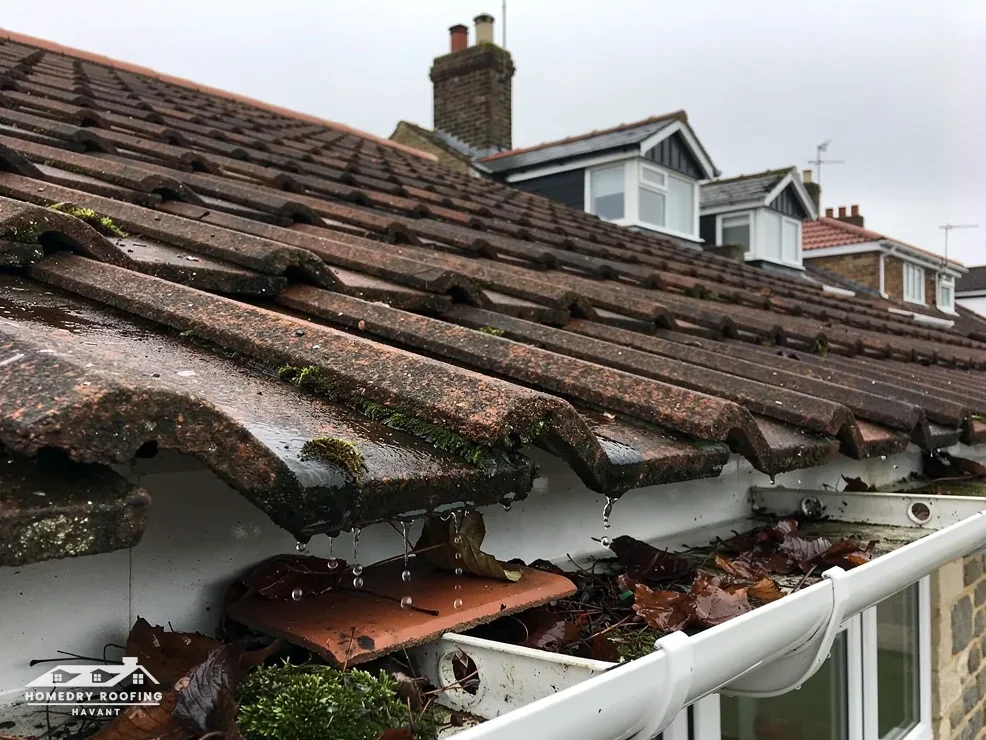
A slipped eaves course or a dropped gutter can send roof water behind the board instead of into the run. We look at the board, the soffit and the brackets together, then trace the stain back to the course above.
At the wall the roof stops, and the first course of tiles hangs out past the brickwork so that rain falls clear of it and into the gutter. Four parts have to cooperate for that to work: the eaves course itself, the fascia timber that bears the gutter, the soffit tucked beneath it and the brackets that hold the run at its fall. We examine each from a ladder, pressing the fascia timber for softness, and from the loft we check the rafter feet for staining where the roof meets the wall plate. A slipped course, a soft fascia or a bracket that has let a run sag will each send roof water behind the gutter, where it soaks timber instead of reaching the downpipe. Staining on the soffit tells us how long that has been going on. Where the roof turns a corner at a gable or a porch, the same course carries on and finishes against the masonry, so we follow the line round and trace the downpipe to its shoe at the drain. Our gutters, soffits and fascias page describes how the pieces are renewed, and when a section can be refixed instead.
The National Heritage List holds Grade II entries in Fernhurst for The Parish Church of St Margaret and for Park View Cottage, and The White House is listed Grade II*. St Margaret's is a working Church of England church, so repairs to it are put to the Church of England's faculty system and not to the council for listed building consent. A listed house or cottage takes the other route, since a change that touches its character needs listed building consent, and Chichester District Council can say what applies at your address. Our survey notes describe each junction with a close photograph, so the same findings serve whichever route you need.
The first course of tiles decides whether rain reaches the gutter or the board.
Damp that appears on a wall under the eaves is easily blamed on the wall. Roof water that has run behind a sagging gutter can soak the board, the soffit and the wall plate before it shows anywhere, so we press the timber and check the brackets before suggesting more than a refix. If the board is sound, the run is lifted back to its fall and the joints are re-sealed.
The cap and the pots are the first thing rain reaches on a stack, so a fault there can show as a stain two floors below. We check the cap for cracks, the flaunching, which is the mortar bed under the pots, and the pointing on the way down. At the base we study the lead apron and the steps up each side. Inside, the stain on the breast is compared with what we saw outside, so the repair targets the real point of entry and not the nearest damp patch. If the stack is sound and the lead is the fault, the repair is limited to the lead.
Fernhurst lies inside the South Downs National Park, so the planning role sits with the South Downs National Park Authority. In the Chichester part of the Park the district council usually processes applications on the Authority's behalf, and called-in cases go to the Authority's Midhurst team. Building control is separate and stays with the district. Ordinary re-roofing keeps to the normal rules, which our planning guide sets out in full, with the source of each. For your own address, put the question to Chichester District Council with your full postcode before work is booked, and keep its reply with the survey.
The Planning Portal gives two tests. No building regulations application is normally expected when the work affects less than 25 per cent of the building envelope and less than 50 per cent of the roof; the exception is a covering 15 per cent or more heavier, which needs approval. Building control is carried out by the council's team or by a registered building control approver. For a Fernhurst address we put the route to Chichester District Council's building control team ahead of any strip-off, along with anything the Portal test leaves open, so the route is settled in writing before the work is priced.
A scaffold that stands on or over a public road needs a licence, set by section 169 of the Highways Act 1980. The body that licenses it in Fernhurst is West Sussex County Council, and its page lists one month of scaffolding at £266 and asks for a minimum of 10 working days' notice between application and erection. We arrange the licence with our scaffolder. Because the notice runs before any scaffold stands, it is counted into the start date you are given, so the first day on site is a date that can be kept, and the start is not pushed back by paperwork.
Listed Grade II on the National Heritage List, The Parish Church of St Margaret still holds Church of England services. A Church of England church in use goes through the faculty system rather than listed building consent, so the council's listed building route does not cover the church itself. That exemption belongs to the church alone, and it does not pass to nearby houses. A house or cottage that has its own entry on the list needs listed building consent for a change that touches its character, so find your address on the list before you commit to materials or a start date.
Park View Cottage is Grade II and The White House is Grade II*. Listed building consent is required for work touching the character of the building, so ask Chichester District Council before changing any visible part of the roof. Whether a like-for-like repair counts is a judgement for the planning authority, reached through that council in Fernhurst, and it is better asked early than after the work is done. We survey the roof as found, with photographs, so that any application starts from facts and not guesses.
The Fernhurst conservation area is on the South Downs National Park Authority's list. Ordinary re-roofing is normally permitted development even in a conservation area, but an Article 4 direction can remove further rights. Whether one reaches your road must be settled with Chichester District Council, acting for the Authority, before work starts, since no roofer can say what a direction covers at a given address. Our planning guide shows where each of the roof rules comes from, and reading it before you ring helps, so that your question to the council is a short and exact one.
It should describe the work and the covering, show whether the total takes in VAT and scaffold, and follow a visit in which somebody has been up on the roof. Ours is a single figure, with the findings next to it in plain words, and any sound repair is put first and the replacement second, so you can weigh the two. If another quote is silent on scaffold or VAT, get both answered in writing, and the totals can then sit level. On a stack, look for the quote to say whether the pots, the flaunching and the lead are part of the work.
You'll get one written total price.
Fill in what you like. It opens WhatsApp with your message ready to send.