
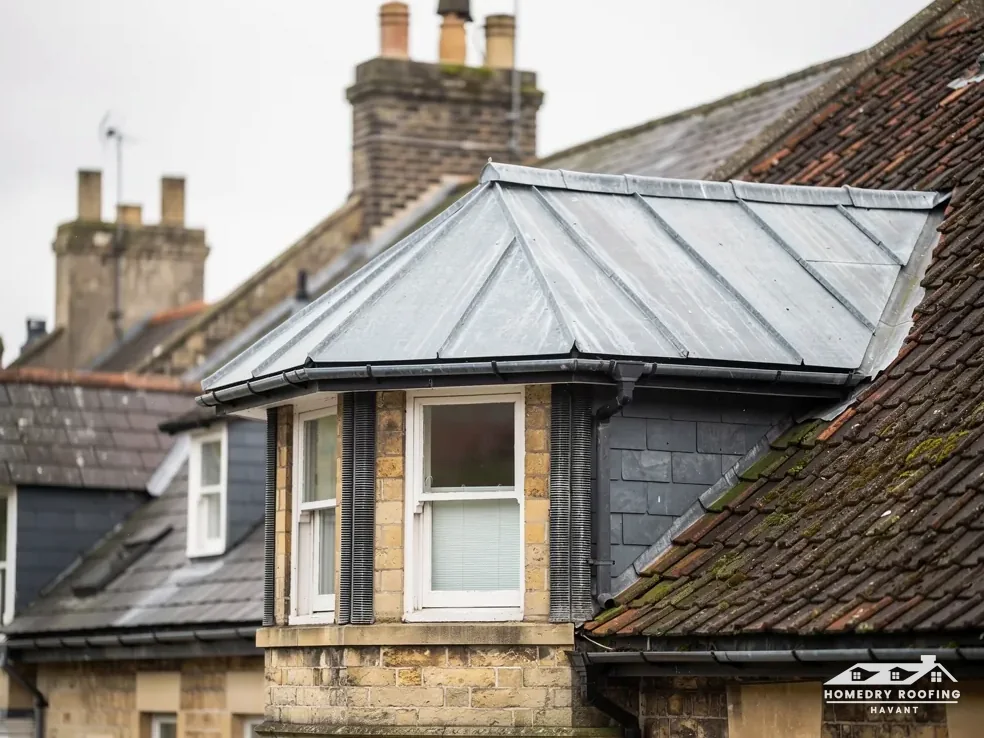
Flashings
Strips of lead bridging the gap where a slope meets a wall, tucked into the brickwork course by course.
A strip lifted at one corner gives the rain a ready way in behind it.

Haslemere is 28.4 road miles north-east of Havant, and a roof there is read at its joins first: lead, stack and gutter, before any covering is judged.
10-year workmanship guarantee, in writing
Strips of lead bridging the gap where a slope meets a wall, tucked into the brickwork course by course.
A strip lifted at one corner gives the rain a ready way in behind it.
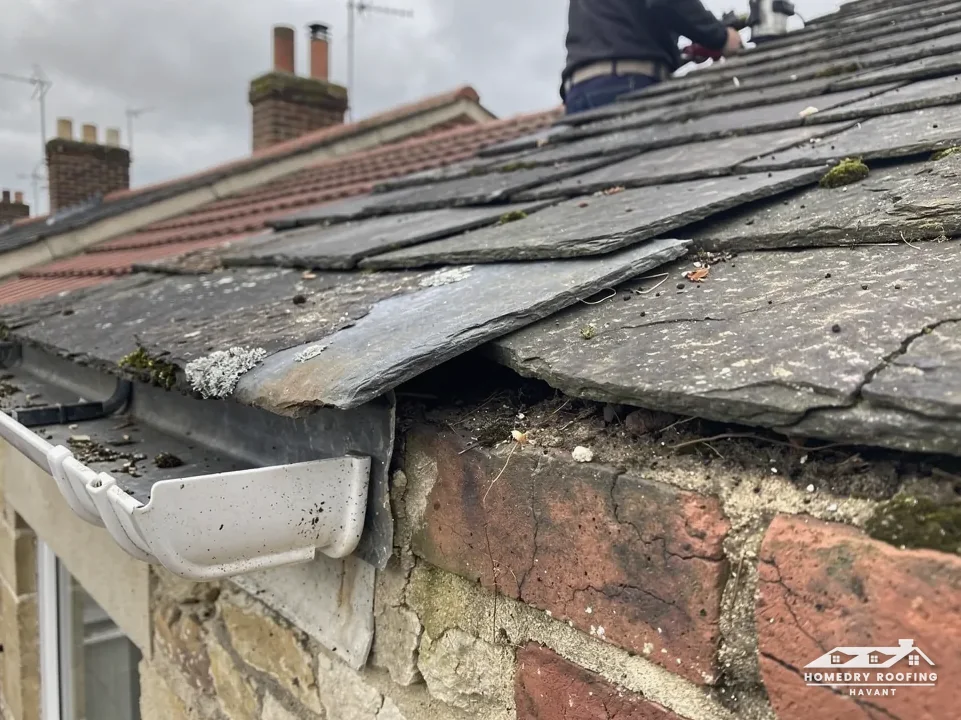
The lined trough where two slopes meet, carrying the rain of both toward the gutter below.
A thin patch in the lining, or a drift of leaves, sends water beneath the neighbouring tiles.
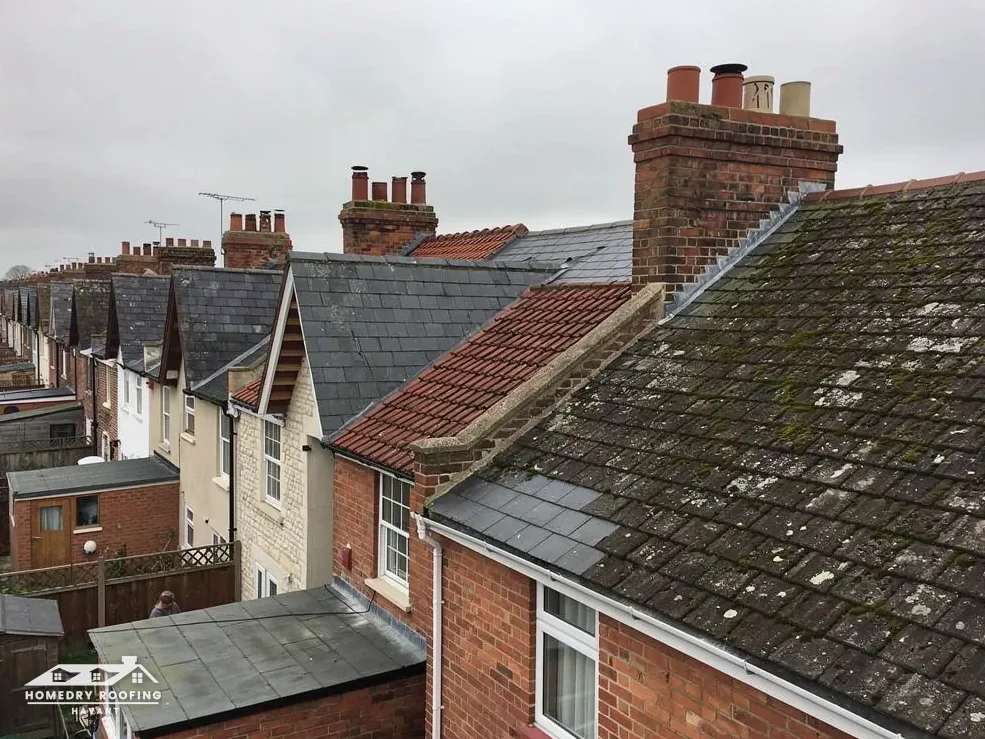
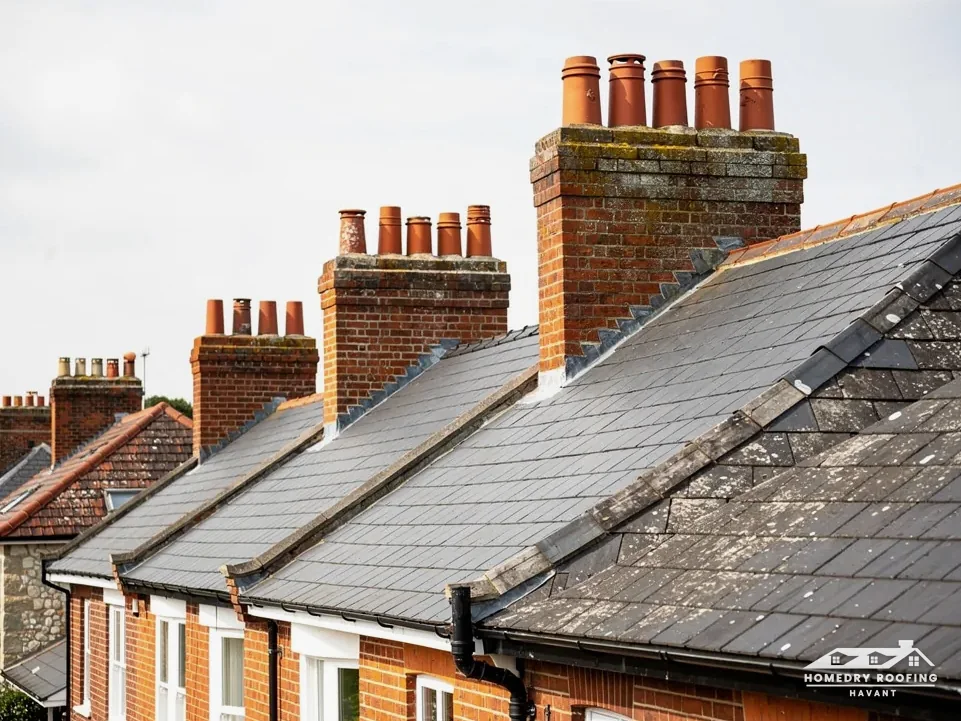
A stack rising through a Haslemere roof, with its own flashing, its own mortar and its pots on top.
Crumbled joints high up let rain in long before a stain appears on the breast below.
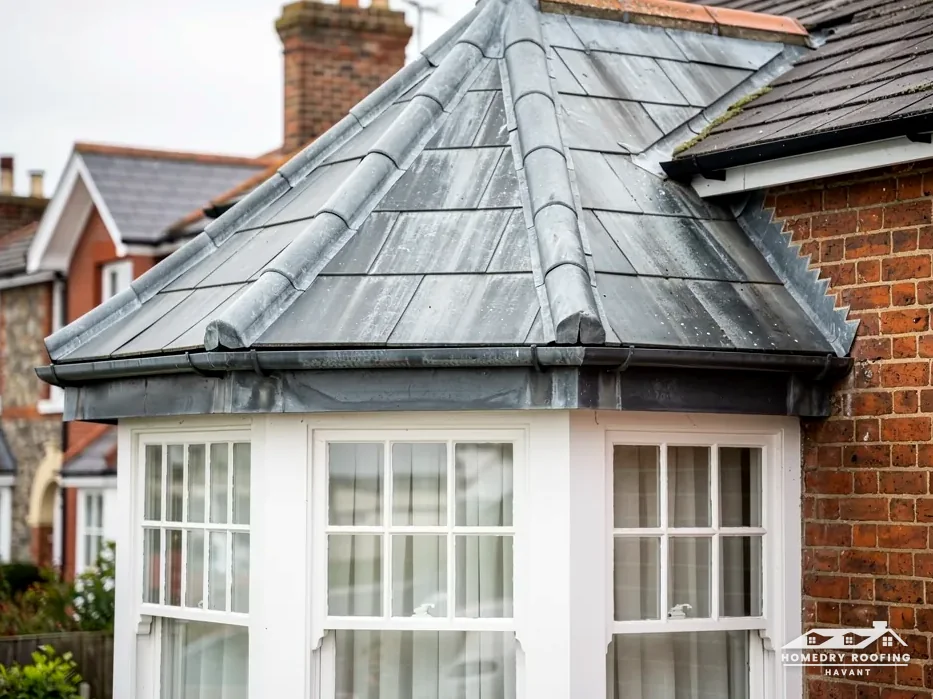
Lead closes the joins, and the joins are where rain tries.
Lead is the metal that closes a roof where it meets a wall, a chimney or its own other half. A Haslemere survey follows each run of it: the flashing that steps up beside a wall, the soakers beneath the tiles next to it, which are the small lead sheets that tuck under each course, and the lining of the valley, the trough where two slopes join. We photograph any lifted corner or gap along the wall edge before anything is touched. We check that every edge is tucked into the brickwork and not merely resting against it, that the metal has not split along a fold, and that no stretch has worn thin. Where lead meets a chimney, the apron at the front and the steps at the sides are checked separately, since each is fixed in a different way. Sound lead is left alone; a local fault is mended, and lead failing along a run is replaced. Our lead roofing page describes the work, and our roof repairs page covers a smaller fix.
The Church of St Bartholomew carries a Grade II listing, and Town House and Broad Dene are Grade II*, with each entry published by Historic England. St Bartholomew's holds Church of England services, so its roof comes under the faculty system rather than listed building consent. A house in private hands that is listed follows the other route: listed building consent has to be granted before anything touches its character, and the survey notes record which parts of the roof the entry covers.
Haslemere also has a conservation area. Waverley Borough Council holds its boundary, so ask it whether your address sits inside. Our planning guide for roof work covers what that means for the roof, so it is left out of this page. The survey adds photographs of your own joins.
Soakers are the small lead sheets that sit under the tiles beside a wall, one to each course, and they are what actually turns the water away. They cannot be seen from the ground, so where the flashing above looks doubtful we lift a tile at the edge and check them. If a soaker has split or slipped, the repair goes to that spot and not across the whole run.
Only when the stack is being rebuilt or capped. Otherwise we check that each pot is bedded firmly and the mortar around it is sound, and the findings say which applies.
A chimney stack is a small building on top of the roof, and it has its own ways of letting rain in. We look at the pots and whether they are bedded firmly, at the flat cap of mortar across the top, since a cracked cap lets rain into the head of the brickwork, at the brickwork and its joints on all four faces, and at the flashing where the stack leaves the slope. Pointing is judged by pressing a joint with a tool: mortar that crumbles under light pressure has gone past the point where it can keep water out. A joint that has crumbled high up can admit rain for a long time before a stain shows on the breast below, which is why we also look from the loft. Our chimney repairs page covers repointing, rebuilding and capping.
Haslemere's planning layers sit on top of that work. An Article 4 direction named Lythe Hill Estate, Haslemere (1976), reference A4D-13, is recorded near the town, and such a direction can remove further permitted development rights, so check with Waverley Borough Council before you plan anything. The Surrey Hills National Landscape, formerly an AONB, lies near Haslemere. A National Landscape is a label for the land and decides nothing; planning stays with Waverley Borough Council, and the published boundary shows whether a given address is inside it.
If the stack needs a scaffold on the street, we arrange the licence with our scaffolder; the highway authority is Surrey County Council. Afterwards you receive one written total price, with the findings and photographs laid out in plain words: the pots, the pointing, the cap and the flashing each described in turn, so you can see what is wrong before you agree to pay for it. When the work ends, the scaffold comes down and the street is left as it was found.
A chimney stands alone up there, exposed on all four faces.
A stack has two faces: the one visible from the garden and the one inside the roof. The breast in the loft shows damp, dark joints, or crumbled mortar dropped onto the timber below. We photograph both faces, and the findings give each fault its position on the stack, so the person doing the repair knows exactly where to look and what to bring up the ladder.
A stain that climbs the chimney breast upstairs and returns after each wet week.
Crumbled joints, a cracked cap or a lifted flashing high on the stack, where rain has been entering unseen.
Each run of lead is followed from one end to the other. We check that its edges are tucked into the brickwork, that it has not split along a fold, that no stretch has worn thin, and that the soakers beneath the tiles are in place. The findings say whether the lead can be mended where it is, or whether it has to be replaced along its length, and the reasons sit beside the one written total price. Where the lead is thin all the way along, patching is not recommended, because the next patch would sit on metal that is already worn.
Check the Planning Portal's two limits first: less than 25 per cent of the building envelope, and less than 50 per cent of the roof. A Haslemere re-roof inside both would not normally need a building regulations application, but a covering 15 per cent or more heavier is another matter, since that calls for approval. The question goes to your building control body before any order is placed, and the reply reaches you in plain language. A copy can be sent with the survey notes if you want it, and we can put the question in writing on your behalf, so there is a dated record of what was asked and answered.
Section 169 of the Highways Act 1980 governs scaffolding on or over a highway, and the licensing body for Haslemere is Surrey County Council. We arrange the licence with our scaffolder. The council sets its own terms, which decide how soon a scaffold can stand, so we settle the date with you only once those are known, and the scaffold is included in the written quote. Nothing about the licence is left in your hands, and no form arrives in your post for you to complete or return. Waiting for the licence is part of the plan, not a surprise partway through.
The Church of St Bartholomew carries a Grade II listing and is still in use for Anglican worship. The faculty system, not listed building consent, is the route for a Church of England church in use, so that is how its roof is handled. For a private house that is listed, the rule runs the other way and listed building consent is needed where a job changes what makes it special. Historic England publishes each entry in full, which makes it simple to see what a listing at your own address covers, and what it leaves alone. The details of any listing are then easy to set beside what the survey finds on the roof.
Town House and Broad Dene are both Grade II*. For a listed house, listed building consent must be granted before any change that bears on its character, and our planning guide covers the rules beside it. The entry names what the listing covers. How it applies to a particular roof is a question for Waverley Borough Council, and we read the entry before the survey and mention it in the findings, so that you are not surprised later. If the entry refers to the roof covering, the findings say so and note it.
Haslemere has a conservation area, and Waverley Borough Council holds its boundary, so ask it about an address near the line. An Article 4 direction named Lythe Hill Estate, Haslemere (1976), reference A4D-13, is recorded near the town. An Article 4 direction can remove further permitted development rights, so check with Waverley Borough Council about your road, quoting the reference, which points the council to the right file. How conservation areas bear on roof work is covered in our planning guide. Keep the council's reply with the survey notes for later, and mention it to anyone else who quotes for the roof, so their figures rest on the same facts.
The Surrey Hills National Landscape lies near Haslemere; it used to be labelled an Area of Outstanding Natural Beauty. A designation of that kind does not decide planning applications, and Waverley Borough Council does. Look at the published boundary to see whether your own address is inside it, since nobody should assume either way. The planning guide explains what the designation changes for work on the roof, so the surprises are removed before work starts. Mending a slipped tile is the same job wherever the boundary falls.
Royston Lead's brochure lists code 4 lead, 1.80 mm, for flashings, soakers, pitched valley gutters and dormers, and code 5, 2.24 mm, for flashings, pitched valley gutters, parapets and dormers. Which code applies is set per detail by the specification, and we choose it at the survey. MyJobQuote says correctly installed lead flashing can last for over 80 years. That is a can, not a promise, and it rests on correct fixing, which is exactly what the survey checks, so the findings describe the fixing as well as the metal, and name the code and the detail it is meant for, so a second roofer reading the findings could price the same lead.
You'll get one written total price.
Fill in what you like. It opens WhatsApp with your message ready to send.