
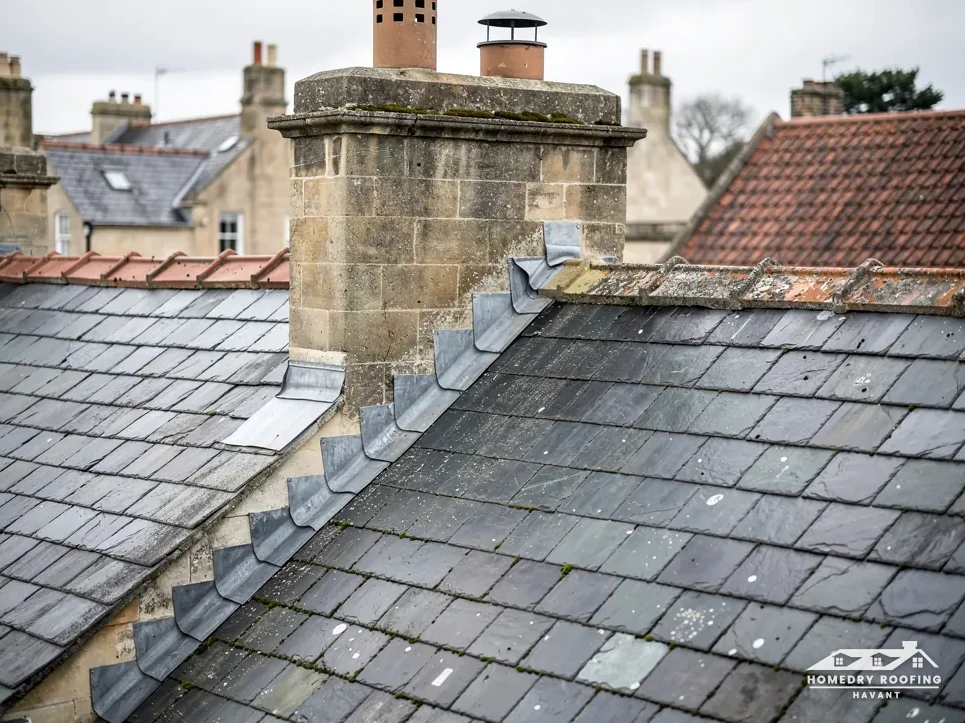
Slates
Overlapping slates or tiles, each hooked or nailed to a batten and each covering the join below.
One that has slipped leaves a gap the width of a hand for rain to drive through.
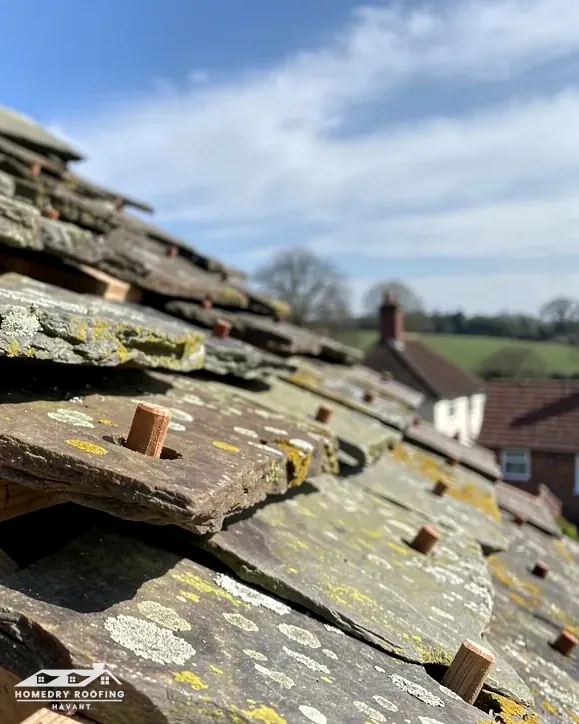
Hindhead is 27 road miles north-east of Havant. A roofer goes up the ladder, then into the loft, and only after both does a figure come into the conversation.
10-year workmanship guarantee, in writing
Overlapping slates or tiles, each hooked or nailed to a batten and each covering the join below.
One that has slipped leaves a gap the width of a hand for rain to drive through.
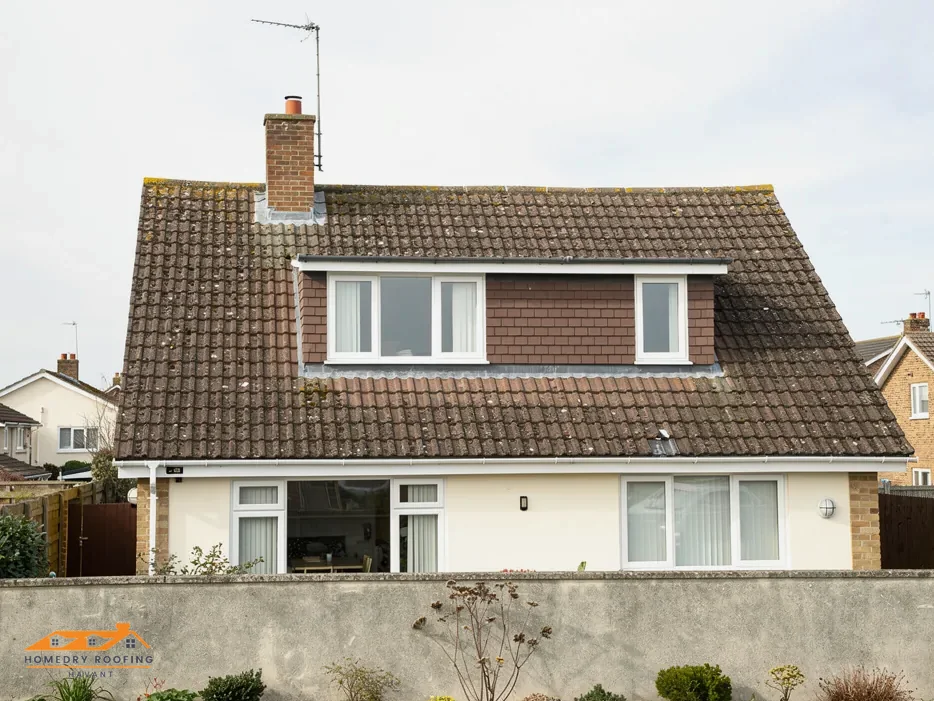
The roof space under a Hindhead slope, where rafters, battens and the back of the covering are in plain view.
Daylight, damp timber or a darkened patch of underlay tells you what the tiles hide.

The run along the eaves that collects what the slope sheds and hands it to the downpipe.
A gutter joint gone slack drips onto the brickwork, and a green streak follows.
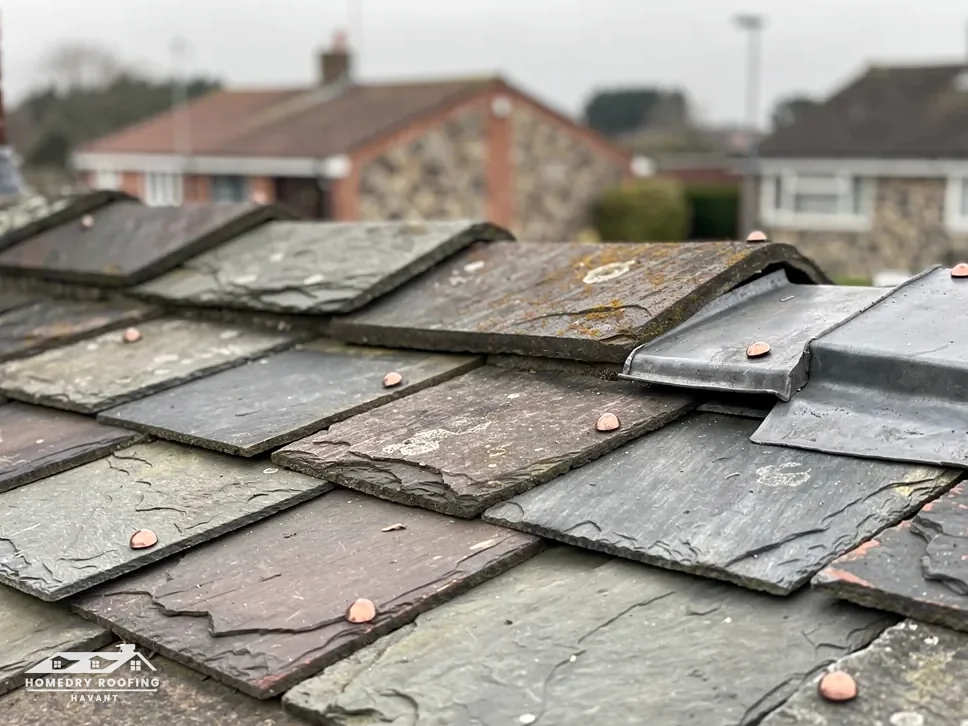
A piece that slips was let down by what held it.
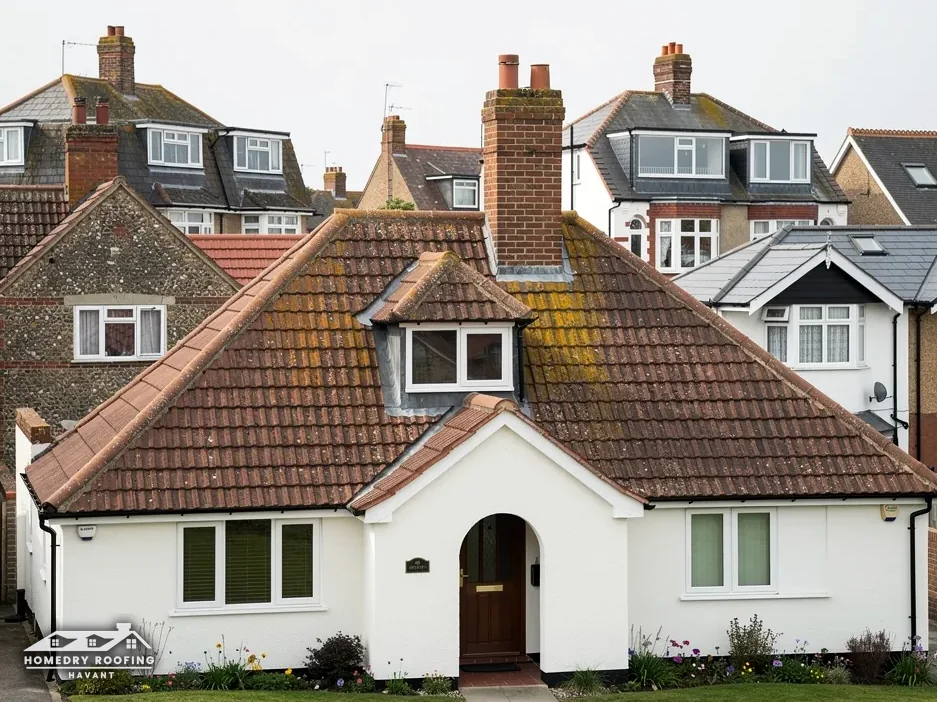
A Hindhead survey reads the covering one course at a time. Whether it is slate or tile, each piece overlaps the one beneath and is held by a nail or a hook onto a batten, the timber strip that runs across the rafters. We look for pieces that have slipped, cracked or snapped at the fixing, and for the gap where one is missing. A slate that has dropped along its course may be sound and merely unfixed, which tells us the nail failed, not the slate. Hips, ridges and the courses beside a chimney get the same slow pass, because a gap there is as open to rain as one in the middle of a slope. Our slate roofing page covers re-slating, and our roof repairs page covers the smaller job of replacing a few pieces.
Undershaw and Hindhead House are among the Hindhead entries on the National Heritage List, both at Grade II. Historic England publishes each entry. A listed house needs listed building consent ahead of changes that touch its character, even where a re-roof would otherwise be routine, so the entry is read before anything is ordered. In the wider area, the Haslemere conservation area is held by Waverley Borough Council and Grayshott by East Hampshire District Council, so anyone unsure which side of a line they live on should ask the council that holds it. The Surrey Hills National Landscape, formerly an AONB, lies near Hindhead. It decides nothing itself; planning stays with Waverley Borough Council.
Our planning guide for roof work explains what those designations change, so it is not repeated here. Any Article 4 direction on your road is for Waverley Borough Council to confirm, and the survey notes can hold its answer beside the photographs, so the file for your roof is complete before work starts.
Blame falls on the piece that moved. We look at what held it: a nail that has loosened, a batten gone soft, a hook opened out. Replacing a slipped piece without curing its fixing sets it up to slip again. The findings name the cause before they name a remedy. Where several pieces have slipped in a line along one course, the fixing along that line is the first thing we check, with a photograph.
A damp ring on the ceiling below the slope, darker after a spell of rain and paler after a dry week.
A slate or tile that has slid out of place, exposing the gap between two courses to the rain.
No. A leak leaves marks that line up with the rain, directly under or beside a fault. Damp that appears in cold spells without rain may be condensation, which needs better ventilation and not a new covering. The survey separates the two.
From the loft the same roof looks different. The rafters, the battens and the underlay beneath the covering are all in view, and they carry evidence a ladder cannot reach. We look for daylight where none should be, for timber that is dark or soft, and for a patch of underlay that sags between rafters. Where insulation lies across the joists, we lift a corner to see the timber and the edge of the underlay, because damp can hide beneath it. A mark on one rafter directly beneath a slipped tile is a straight answer; a mark that runs along the timber for some distance says the water travelled before it fell. Our roof inspections page describes the whole visit.
Dampness has more than one cause, and the loft helps to separate them. A stain that grows after rain is a leak. Damp that builds in cold weather on the underside of the covering, with no rain involved, can be condensation, which is cured by ventilation and not by new tiles, so the eaves are checked for clear air paths. The findings say which you have, and a re-cover is not recommended for a ventilation fault.
A scaffold on the pavement or the road needs a highway licence, and in Hindhead the licensing body is Surrey County Council. We arrange the licence with our scaffolder, and the scaffold sits inside the written quote, which is one written total price handed over after we have been up the ladder and into the loft. Once the last ladder is down, the drive and garden are swept. The loft is also where we judge how big a job there is: a roof that is dry on the inside is a different order of work from one with a damp rafter in every bay.
A rafter holds the history of every wet spell.
A rafter is a record of what the roof has done. Dark tide lines show where water has run along it, a pale patch shows where it has dried, and a soft end shows where it has stayed wet too long. We photograph the timber we can reach and show you each mark, so the case for a repair or a re-cover rests on what is in the roof and not on a guess.
We count and map them. A few slipped or cracked pieces scattered over a slope, with sound battens and a sound underlay beneath, point to a repair. Failures that spread across a whole slope, battens that have gone soft, or an underlay that has perished mean each repair would sit beside the next one waiting to fail, and a slope patched in many places is a poor substitute for a covering done once. The findings lay out both readings with photographs and say which fits your roof, offering the repair first where it will hold. Nothing is recommended that the photographs do not support, and then comes the one written total price.
Two Planning Portal limits set the test: less than 25 per cent of the building envelope and less than 50 per cent of the roof. Hindhead roofs that stay under both are not normally caught by a building regulations application, yet a covering 15 per cent or more heavier needs approval even for a small patch. Our first step is to ask your building control body, before any work is booked; its reply is relayed in ordinary language, and the notes and photographs stay on hand in case an application is requested. A copy is yours on request.
Highways Act 1980 section 169 is the law behind scaffold licences: anything put up over a public road or pavement needs one, and Hindhead's comes from Surrey County Council. We arrange the licence with our scaffolder. The council's own terms decide how soon a scaffold can go up, so the date is fixed with you only after those are known, and the written quote has the scaffold built into it. Dates, notice and the scaffold's position are all settled before the quote is written, so what you read is the whole job. No form lands on your doormat.
Undershaw and Hindhead House each carry a Grade II listing. For a listed house, listed building consent is a separate requirement on top of the usual rules, as our planning guide explains. Historic England publishes each entry in full, so the details for an address are there to read, and nobody needs to guess what a listing covers. At the survey we note what the entry covers, and where it is unclear, the answer to that sits with Waverley Borough Council, which can say how the listing applies to the roof.
Haslemere and Grayshott are conservation areas in the wider Hindhead area, and each has its own council: Waverley Borough Council for Haslemere, East Hampshire District Council for Grayshott. The council holding a boundary can say which side of it an address sits. For a Hindhead address, Waverley Borough Council is also the body for any Article 4 direction, a council order that can remove permitted development rights. The planning guide covers what a conservation area changes for roof work. Keep the council's reply with the survey paperwork, so the later stages follow what was said and nobody has to rely on memory or on what a neighbour was told years ago.
Near Hindhead lies the Surrey Hills National Landscape, which used to be called an Area of Outstanding Natural Beauty. Being a designation, it makes no planning decisions of its own; those belong to Waverley Borough Council. Whether a house sits inside its edge can be read off the published boundary, address by address, so check before assuming either way. Putting back a slipped tile is no different on one side of the boundary than on the other; larger changes are where it begins to matter. The planning guide spells out how the designation alters other kinds of roof work.
A loft can run damp in cold weather without any leak: warm, moist air from the house meets the cold underside of the covering and condenses there, and the cure is ventilation, not new tiles. With a high-resistance underlay in a cold roof, Marley gives 25 mm of eaves ventilation at 15° or less and 10 mm above 15°. We check whether the eaves keep their gaps clear, and where something blocks them, the findings show where, with a photograph taken from inside the loft, so you can see the blockage and not just read about it.
These are national guide figures, not local ones. HomeBuilding gives approximate lifespans of 100+ years for Welsh slate, 60-80 years for clay tiles and 40-50 years for plain concrete tiles. Such figures are ranges, not promises, and the real life of a covering depends on how it is fixed and what lies beneath it, which is why the survey looks at battens and underlay as well as the visible pieces. A covering near the end of its range may still be repairable, and one at the start of it can fail early if the fixings are poor, so the findings say whether yours has years left, and why.
You'll get one written total price.
Fill in what you like. It opens WhatsApp with your message ready to send.