
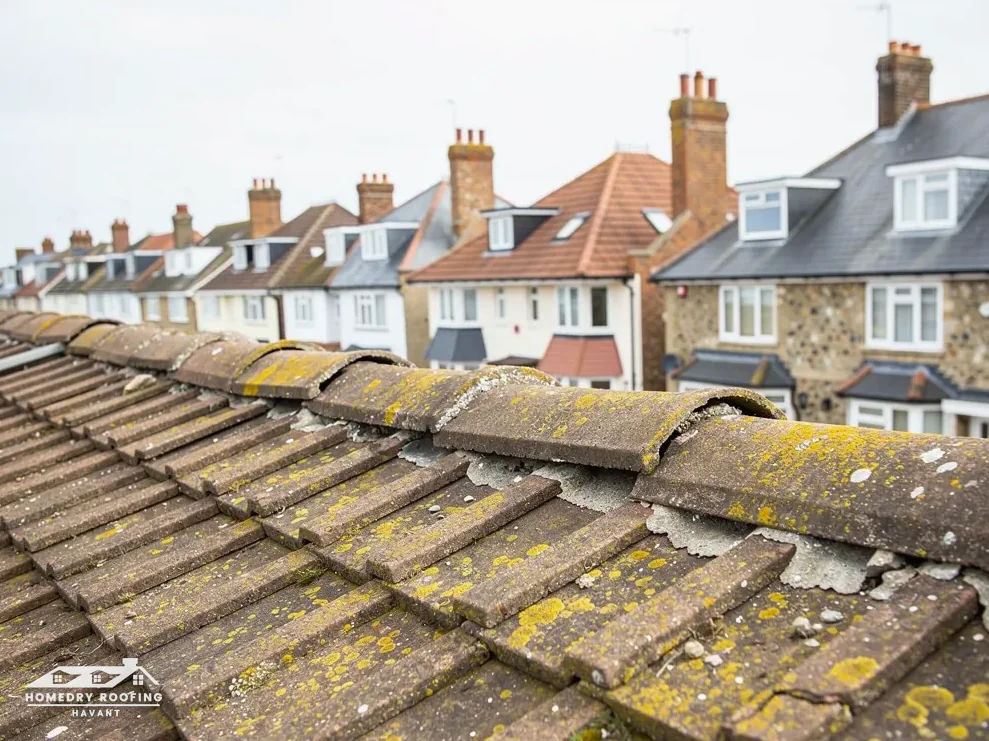
Ridges
The crest of a Rowledge roof, where capping tiles sit over the meeting line of two slopes.
Once a cap works loose or its bedding cracks, a thin opening runs along the loft ceiling.

Rowledge lies 29.4 road miles north of Havant. A survey climbs from the crest to the eaves boards, and a total price in writing follows it.
10-year workmanship guarantee, in writing
The crest of a Rowledge roof, where capping tiles sit over the meeting line of two slopes.
Once a cap works loose or its bedding cracks, a thin opening runs along the loft ceiling.
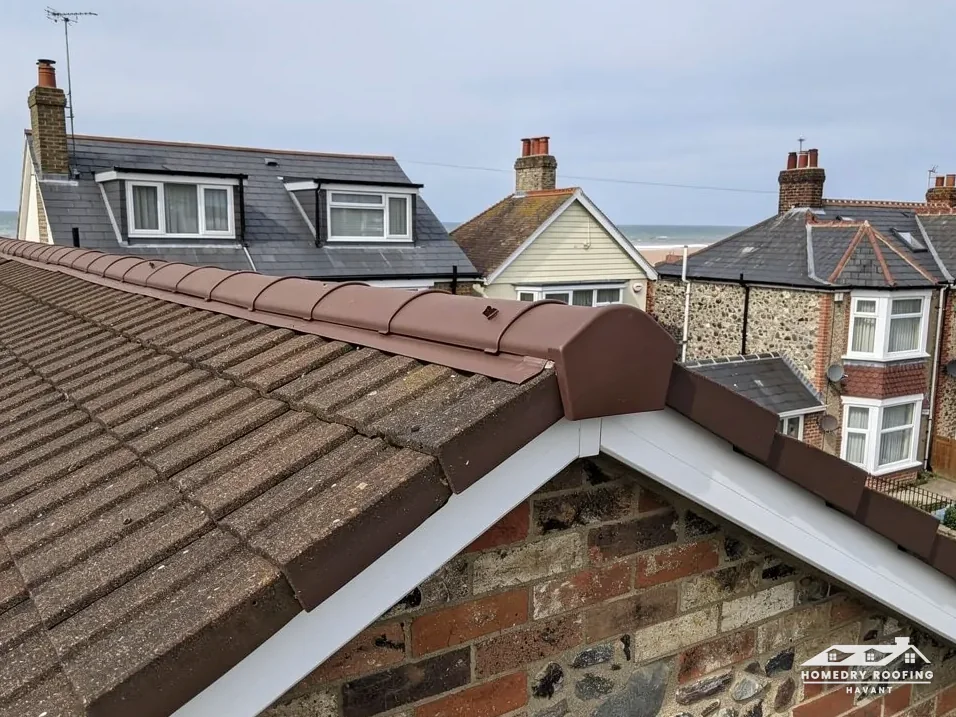
The outward corners of a roof, with tiles cut to run diagonally from crest to eaves.
Each cut tile hangs on its fixing alone, and when one slips the gap beneath is exposed.
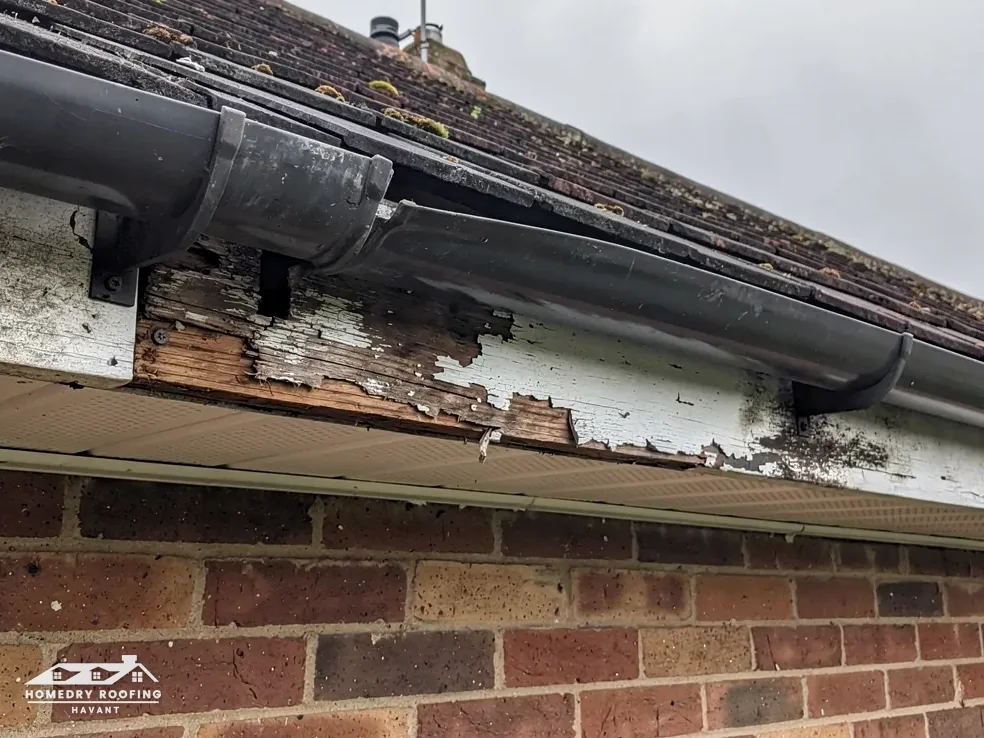
The boarding that closes the underside of the eaves between the house wall and the fascia.
A stain or flaking patch there tells of damp coming from a gutter joint above it.
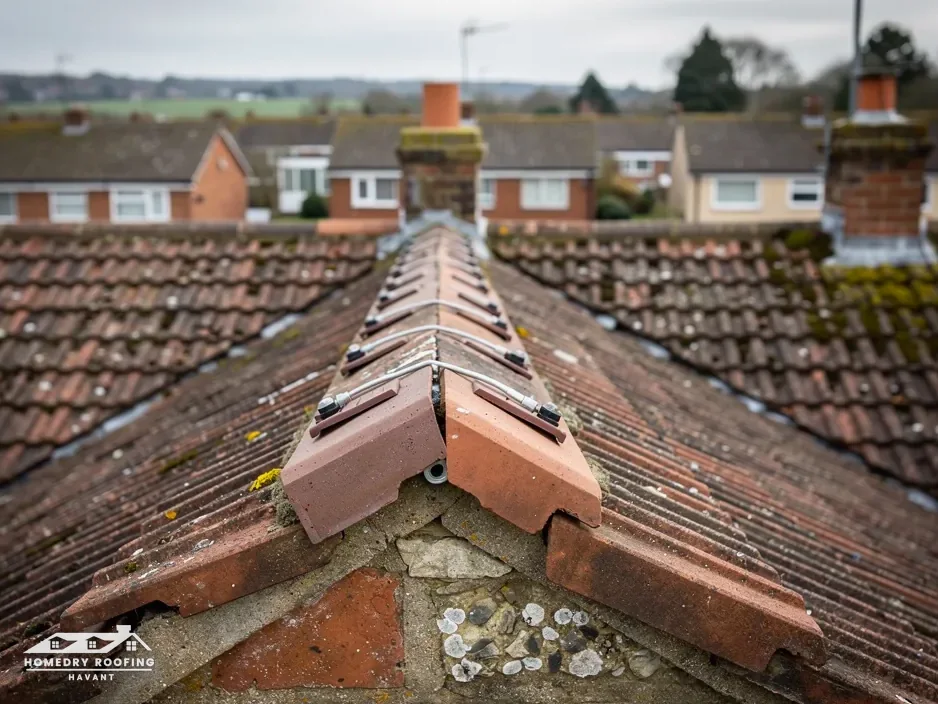
A loose cap can shift further in the next gale and leave a wider opening, so a look sooner is wiser. A temporary fix may hold, and the survey says whether the bedding needs renewing or a refix will do.
Think of the ridge as the roof's spine and each hip as a rib sloping away from it. A survey of a Rowledge roof begins at that spine and moves downhill, matching the order in which rain meets the building. Capping tiles are rocked gently to see whether they have shifted, the bedding under them is read for cracks and gaps, and the fixings are checked one at a time. Any slipped or chipped tiles on the slopes just beneath are noted on the same visit, so a single climb covers the whole top of the roof. From the loft, a torch held along the underside of the ridge shows daylight wherever an opening has formed. Marley says BS 5534 requires mechanically fixed ridge and hip tiles, and BS 8612:2018 is the specification for dry-fixed ridge, hip and verge systems. How that method works is on our dry ridge and verge page, and pitched roofing is the page for replacing the covering of a whole slope.
Rowledge belongs to Farnham parish and lies in Waverley Borough Council's area. Waverley Borough Council's conservation areas in the wider Rowledge area include Wrecclesham Farnham, Millbridge Frensham, Great Austins Farnham, and Old Church Lane, Farnham. Whether your road falls inside any boundary is a question for Waverley Borough Council, which holds them. What an area of that kind changes for roof work is explained in the guide linked below.
Article 4 directions can take away rights that would otherwise exist, and an answer for your own road has to come from Waverley Borough Council; assume nothing before it replies. We write its reply into the survey notes. The planning guide for roof work carries the detailed rules, which is why this page leaves them out. A roof window, a dormer or a loft conversion changes the picture again, and the guide says how.
Rain that gets past the cap runs down both slopes beneath it.
Everything below a ridge depends on what happens at it, since rain that gets past a cap travels down the underlay of both slopes. That is why the loft check comes with the roof check: daylight at the apex, a damp timber or a stained rafter can confirm what the tiles suggest. The notes and pictures reach you in plain language, with the sound parts named alongside the loose ones.
A hairline crack across the loft ceiling, or a damp bloom beneath the apex that comes back after every wet fortnight.
A loose cap along the ridge, or a hip tile whose fixing has gone, and rain gets beneath the tiles lower down.

The boards at the eaves show what the gutter above has been doing.
A roof comes to rest at its eaves, and the timber there is easy to judge. Underneath the overhang runs the soffit; in front of it stands the fascia, which carries the gutter; and between the two a gap lets the loft breathe. With a high-resistance underlay in a cold roof, Marley gives 25 mm of eaves ventilation at 15° or less and 10 mm above 15°, so a new covering must leave that gap open. We press the boards with the tip of a screwdriver, test whether screws still bite, and trace any staining back to the joint that has been dripping. A gutter that has pulled away from the fascia shows as a dark tidemark on the board; so does a downpipe that stops at the wall instead of reaching a drain. The gutters, soffits and fascias page lists the replacement options.
A two-storey eaves line may call for scaffold, and scaffold that overhangs a pavement or verge brings a licence requirement. In Rowledge that licence comes from Surrey County Council, under section 169 of the Highways Act 1980. We arrange the licence with our scaffolder and give you the working dates beforehand, so nobody at the house is left chasing paperwork.
On building regulations, the Planning Portal's first test is less than 25 per cent of the building envelope and less than 50 per cent of the roof. Where a job sits near either limit, we ask your building control body how it wants the work handled and report back to you before a price is fixed. The reply reaches you in ordinary language and the decision stays with you. That keeps the final total free of surprises, whichever route the council points to.
Once a fascia has gone soft, brackets lose their grip, the gutter sags out of line and begins to spill at the joints, wetting the soffit under it. Swapping a short stretch of gutter will not cure that while the board behind is rotten. The timber gets probed before anything is recommended, and the written findings say whether the board can be mended or the whole run should come off.
Beginning at the summit, we walk the ridge line and rock each capping tile to see whether it has shifted. The bedding underneath is checked for hairline cracks and gaps, then the hips are followed diagonally, because a cut tile hangs on its fixing alone. From the loft we shine a torch up the underside of the same line, since a thread of daylight is a plain sign of an opening. Photographs and short notes reach you in writing, saying whether the line wants refixing, rebedding or no work at all. A tile that is only dirty or mossed is described as that and left alone.
Building regulations come first. The Planning Portal's test measures how much of the building envelope and the roof is affected: below 25 per cent of the envelope and below 50 per cent of the roof, an application is not normally required. Where a replacement covering carries 15 per cent or more extra weight over what it replaces, approval is needed. Planning is a separate matter, and our planning guide covers it. We ask your building control body which route suits your roof, and send photographs of the covering and rafters if it wants more detail.
Section 169 of the Highways Act 1980 says scaffolding that obstructs the public way needs a licence; in Rowledge the body that grants it is Surrey County Council, which looks after the local highways. We arrange the licence with our scaffolder, with working dates agreed between us before it goes in. If rain delays the start, the dates are reset with you rather than guessed at. A scaffold standing wholly on your own land needs no highway licence. At the survey we study the frontage, note whether a pavement or verge is involved, and tell you in writing which case applies to your house, so you know the position early.
Waverley Borough Council's own areas around here include Wrecclesham Farnham, Millbridge Frensham, Great Austins Farnham, and Old Church Lane, Farnham. Those are names, not a ruling on your road, so ask Waverley Borough Council whether your address lies inside one. Boundaries can run along a lane or cut through a garden, and each of those areas has a line of its own, which is why only the council's own answer is worth relying on. What a conservation area changes for roof work is explained in our planning guide. We note the council's reply in the survey papers so the work follows it.
It can. Where an Article 4 direction is in force, the rights a dwelling normally enjoys can be removed for the work the direction names, so an application may be needed for something that elsewhere needs none. We cannot tell you whether a direction touches your particular road, and nobody should assume it does not, so check with Waverley Borough Council before ordering anything. A short message with your road name and house number gets the question to the right desk, and once you have the reply we plan the job around it and record it in the survey notes.
A cold roof needs air moving through the loft, and a new underlay can change what the eaves have to supply. Marley gives 25 mm of eaves ventilation at 15° or less and 10 mm above 15°, with a high-resistance underlay in a cold roof. Boxed-in soffits, thick paint and insulation pushed hard against the eaves can each close the gap. When a Rowledge slope is stripped we check how air will enter, so the new covering does not trap damp air in the loft. Where the gap has been closed, the photographs show it and the reopening is priced into the work.
A brown or flaking patch under the eaves points to damp from above, so the gutter is the first thing we check. A downpipe emptying onto the wall below instead of into a drain leaves a similar mark, so we follow the pipe down as well. We look for a dripping joint, a sagging length or a blocked outlet, then press the fascia and the soffit for soft timber. A rotted board is cut out and renewed, and the gutter goes back on sound wood. If the board is firm, the fault lies in the joint, and a mend is far smaller than a replacement, which the findings make plain.
One total price, in writing, arrives when the survey has ended, with the covering and the work set out in plain terms. Test the figure for VAT and scaffold, since a smaller-looking sum might omit either. A sound roof gets a repair quoted ahead of a replacement, and the survey notes travel alongside the figure, letting each part of the job be compared against what the roof actually showed you. Good and fair prices are what we set out to give, and you can ask about any part of the total before agreeing to it, whether they concern the scaffold, the VAT or the covering itself.
You'll get one written total price.
Fill in what you like. It opens WhatsApp with your message ready to send.