
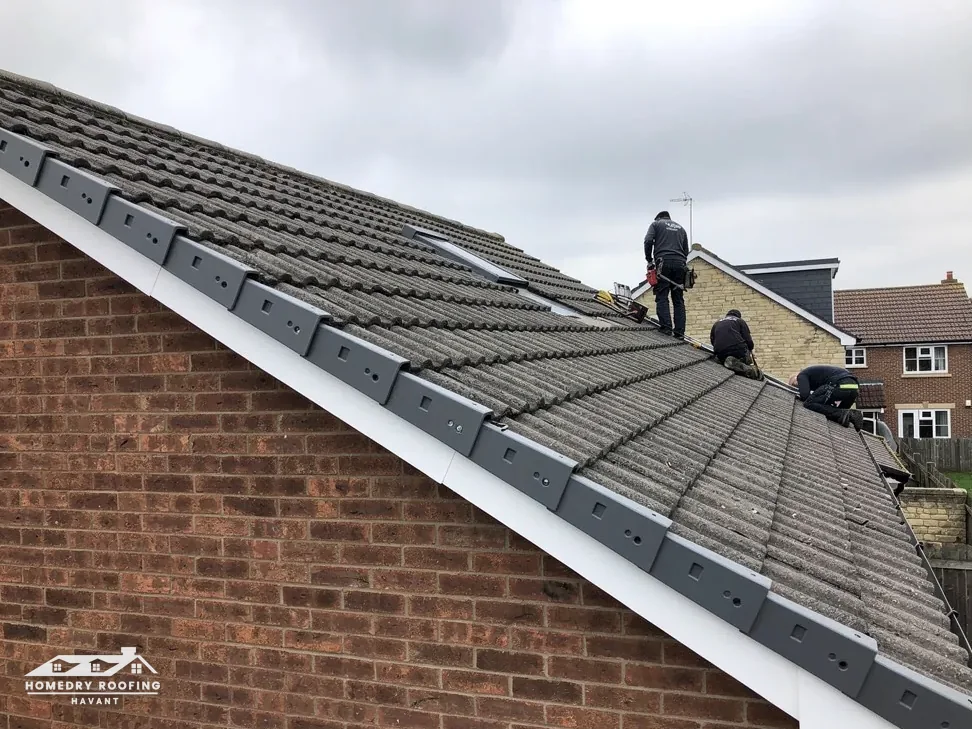
Verges
Where a gable wall at Frensham stops the slope and the end tiles hang out past the brick.
Bedding that has crumbled under those tiles lets them shift and leaves a gap into the loft.

Frensham is 29.4 road miles north of Havant. Verges, chimney flashings and the last metre of each downpipe are checked in turn, and one written total price follows the survey.
10-year workmanship guarantee, in writing
Where a gable wall at Frensham stops the slope and the end tiles hang out past the brick.
Bedding that has crumbled under those tiles lets them shift and leaves a gap into the loft.
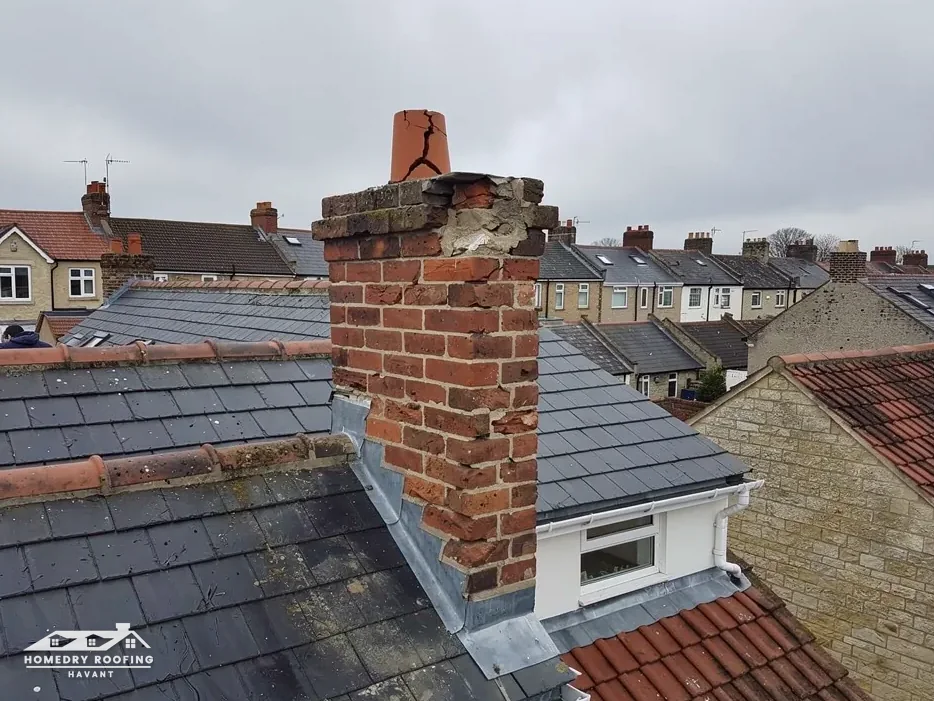
Where a stack climbs out of the Frensham slope with a stepped lead collar up its sides.
If one edge of that collar lifts, rain runs behind the brick and stains the room below.
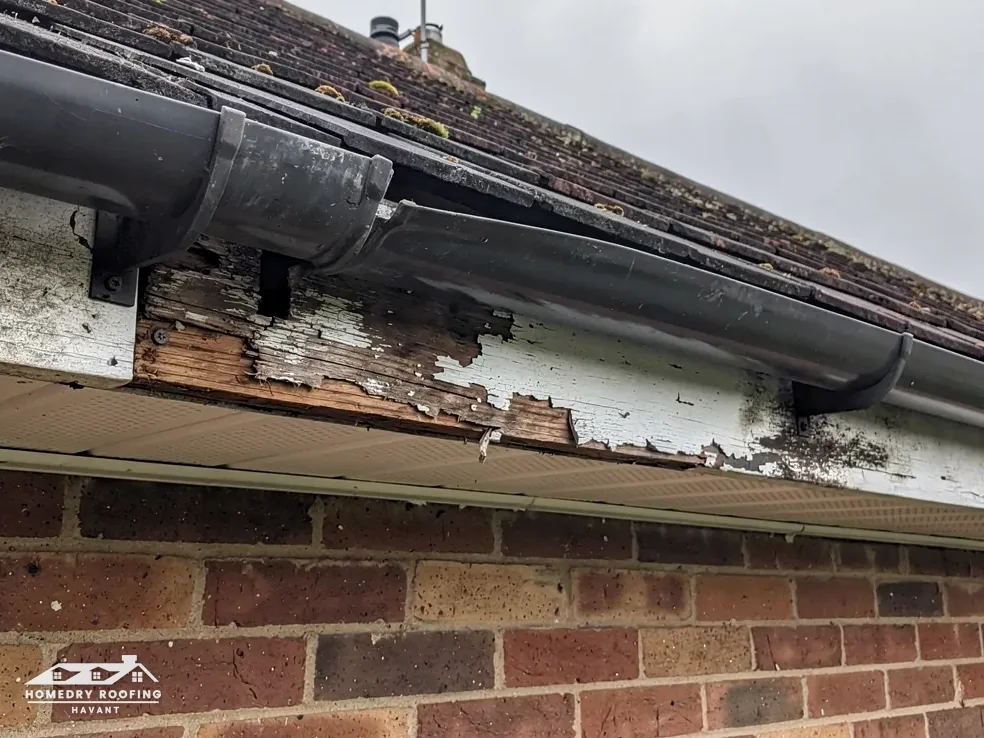
Where the gutter ends in an outlet and a pipe takes the flow down to ground level.
A bracket worked loose, or a bend choked with leaves, throws that flow against the wall.
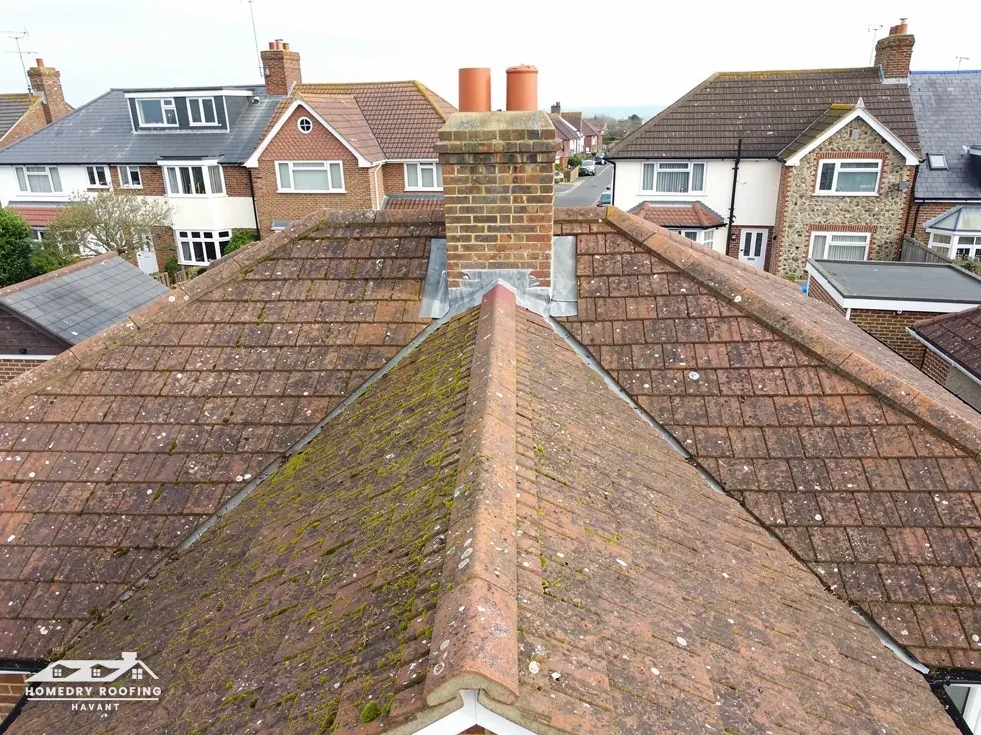
A roof is sound or not at its edges, where brick takes over from tile.
A pitched roof stops in two places that a survey treats apart. One is the verge, where the outer tiles overhang a gable wall; the other is the stack, where a chimney climbs out of the slope. At a Frensham verge we read the bedding beneath the end tiles, make sure every one is still held, and look along the slim gap between tile and wall for daylight. At a stack we read the stepped lead up its sides, the mortar bedding that lead into the brick, and the flaunching, the mortar crown that keeps the pots seated. Our chimney repairs page describes that work, and roof repairs covers what a mend involves once the cause is traced.
Frensham's Church of St Mary the Virgin is listed Grade II*, with the Davison Vault listed Grade II a short way east of it. The church still serves as a Church of England place of worship, so its repairs take the faculty route rather than listed building consent. A listed house is different: listed building consent must come before any work that would affect it as a building of special interest, which can include a repair, and the council is the body to ask.
Millbridge Frensham and Frensham are the two conservation areas here, with boundaries from Waverley Borough Council. The Surrey Hills National Landscape covers the village as a designation, not a planning body, so Waverley Borough Council is the one that decides. Article 4 directions can take away further rights, and Waverley Borough Council is the one to ask; its own Article 4 list shows one near Frensham, named "Land encompassing Lane End and Millbridge (1958)". Our planning guide for roof work sets out the rules for dormers, conservation areas and National Landscape land, so we leave them there.
A verge or a stack is a join between roof and masonry, so the seal depends on mortar and lead keeping their grip on brick. Those joins are looked at first and up close, since a small failure there lets rain slip behind the tiles where nobody can see it. Photographs taken on the roof go into the written findings, so you can see which parts are sound and which are not before deciding anything.
A brown stain on the plaster beside the chimney breast that fades in summer and darkens again after the next wet week.
A corner of lead lifted at the stack, or a split in its mortar crown, letting rain slip down behind the brickwork.
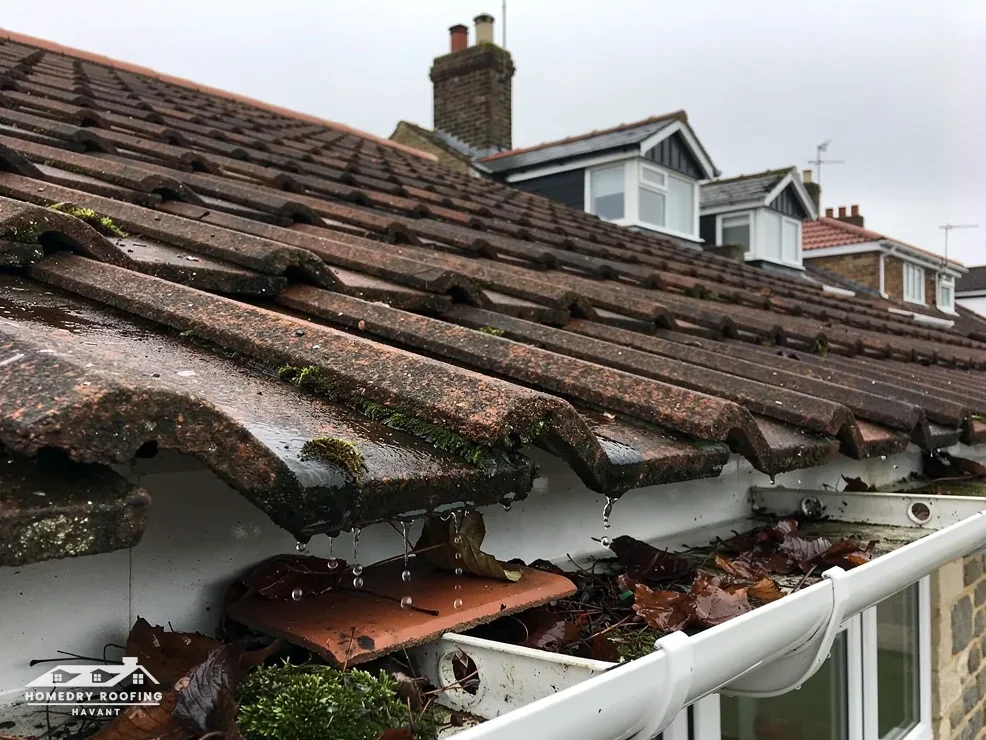
A sagging section or a blocked outlet holds the flow back until it tips over the edge. We check the fall along each run, clear the outlet first, and then say whether a reset or a new length is the better answer.
The route finishes at the gutter, the pipe and the drain, so the survey finishes there too. From a ladder we read each gutter joint, the brackets that carry the run, and its fall. Brett Martin advises a fall of 1 mm for every 600 mm towards the outlet, and a run that has sagged below that holds a pool, then tips it over the front edge. After the gutter we follow every downpipe to the ground, because a bend choked with leaves, or a pipe that discharges beside the footing, hands the rain back to the house it left. The frontage is also looked at from the road, so the notes can say which pipes show. Sections that are loose at the socket are pushed home and refixed, and a joint that has opened is renewed before the pipe is judged sound. Our gutters, soffits and fascias page covers the repair and replacement work in full.
Work above ladder height needs access, and on a frontage that faces the road that can mean scaffolding on the public highway. Highway licensing in Frensham sits with Surrey County Council, and under section 169 of the Highways Act 1980 a licence is needed for any scaffolding on or over the public way that obstructs it. We arrange the licence with our scaffolder, after settling the dates with you.
Flood Zone 3 covers land near Frensham, according to the Environment Agency's map. The zone speaks about ground and sets no rule for what covers a roof. A downpipe has the same job wherever it stands: deliver the roof's rain to a drain or a soakaway, clear of the footings. Where the earth by a wall stays soaked after a shower, the survey records where each pipe empties and whether that outlet runs clear, and reports it in plain words.
Rain that leaves the roof cleanly can still do harm at the wall.
A gutter that looks tidy from the lane can still be failing where nobody looks, behind a bracket or at the foot of a pipe. We trace each run from the roof edge to the ground and note where the rain goes when it arrives. A tilted section is reset or replaced along its length, since the fall is lost across the run and not at one point, and the written findings say which case yours is.
The survey begins at the gable end. We read the bedding under the end tiles, test that each tile is held, and look down the narrow gap between tile and wall for daylight. At the stack nearby we study the lead and the mortar crown above it, because one lifted corner lets rain run behind the brickwork and mark the ceiling underneath. Photographs are taken from the roof and then explained in plain language: what is loose, what is sound, and whether the roof calls for a repair or a replacement. A repair is put ahead of a replacement when the present covering is sound, and the reasons are written down.
Re-roofing normally needs no building regulations application under the Planning Portal's guide when it affects less than 25 per cent of the building envelope and less than 50 per cent of the roof; separately, approval is needed when the new covering raises the weight of what it replaces by 15 per cent or more. Envelope here covers the walls, floor, roof, windows and doors together, so the test reaches beyond the slope alone. Before work starts on a Frensham roof, we ask your building control body which route applies and report back in plain terms, leaving the decision with you.
Section 169 of the Highways Act 1980 requires a licence for scaffolding that blocks the public way, and in Frensham the licensing body is Surrey County Council. We arrange the licence with our scaffolder, so no form lands on your doormat. The dates are settled with you before that request goes in. If the scaffold can stand wholly on your own drive or land, the highway licence does not arise, and the survey records which situation your frontage is in after the road-facing side of the house has been seen.
The Church of St Mary the Virgin is listed Grade II* and still serves as a Church of England place of worship. Churches of that denomination in use are exempt from listed building consent, so repairs go through the Church of England's faculty system. The Davison Vault just east of the church is listed Grade II. A house on the list takes the council route instead: consent under the Planning (Listed Buildings and Conservation Areas) Act 1990 must be in hand before work that alters its character. Search the list entry for your address, and ask the council whenever it leaves you in doubt.
Two conservation areas lie at Frensham, Millbridge Frensham and Frensham, and Waverley Borough Council holds the boundaries, so ask it about your own road. An Article 4 direction takes away some of the rights a house would otherwise have, so the council is asked first. Its list shows one near Frensham, named "Land encompassing Lane End and Millbridge (1958)". Our planning guide lays out where the roof rules come from, and the survey notes keep whatever the council tells you, so a road name and house number is enough to start your enquiry.
No. The Surrey Hills National Landscape, which carried the older AONB label until it was renamed, is a designation, and Waverley Borough Council stays the planning authority. What the designation alters for roof work is set out in our planning guide. Whether a particular address sits within the boundary is for the map to show, so check it instead of assuming, though a slipped tile is mended the same way on either side. Anything you learn from the council is recorded in the survey notes, so the paperwork then matches the job.
Land near Frensham sits in Flood Zone 3 on the map the Environment Agency publishes. That speaks of the land, so it is no roofing rule and it leaves the choice and fixing of a covering as they were. It does make the far end of the roof's route worth a look. The survey notes where each downpipe empties, whether the outlet and any drain below it run clear, and whether the rain is led away from the wall. Questions about flood risk to the house itself belong with the flood map and your insurer, and the survey will not guess at them.
It should be one total price, given once someone has climbed onto the roof, with the survey notes beside it. Check the total for VAT and for scaffold: it should say plainly whether each is in or out, and it should describe the covering and the work in words you can follow. Where both a repair and a replacement are possible, we describe each and put the repair ahead of the other when the present work is sound. A good and fair price is the aim, and when a rival total leaves out scaffold or VAT, that firm should say so on paper before the two figures are treated as comparable.
You'll get one written total price.
Fill in what you like. It opens WhatsApp with your message ready to send.