
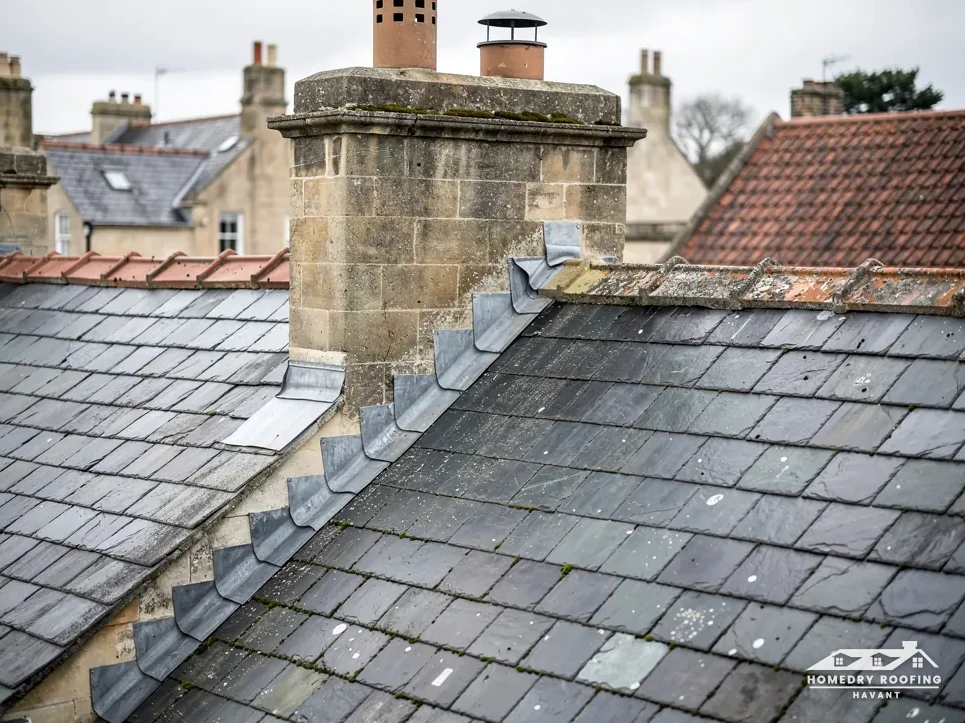
Flashings
Where lead or another metal is dressed across the meeting of a slope with a chimney stack.
Water that slips behind a raised edge reaches the timbers below.

Roof repairs, re-roofs and gutter work in Rowlands Castle, 3.2 road miles north of Havant, starting from where the rain gets in and following it down to the drain.
10-year workmanship guarantee, in writing
Where lead or another metal is dressed across the meeting of a slope with a chimney stack.
Water that slips behind a raised edge reaches the timbers below.
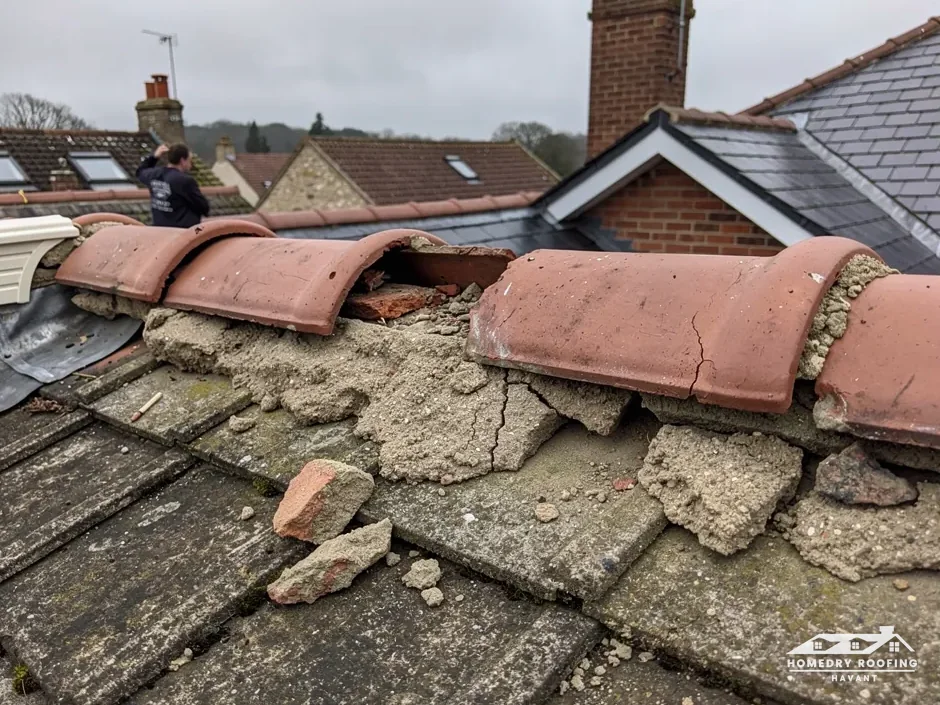
Where the two top courses of a pitched roof meet along its highest line.
Cracked bedding or a slipped ridge piece opens a path for rain from above.
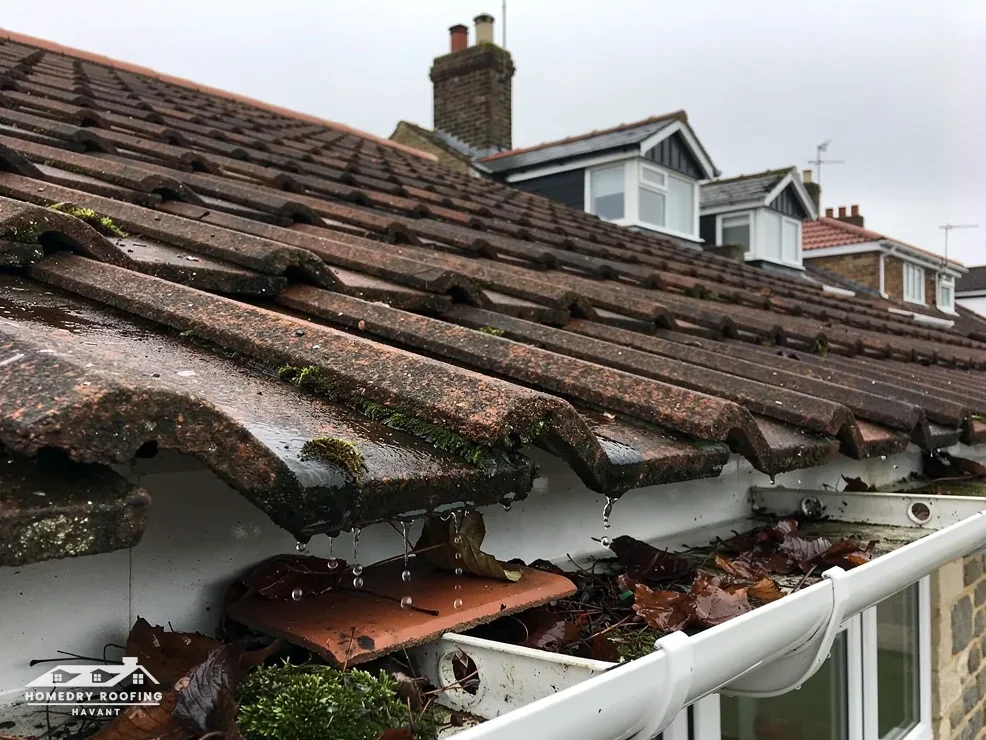
Where a gutter or a flat roof hands its water on to the downpipe.
A clogged throat makes the water back up and spill over the edge.
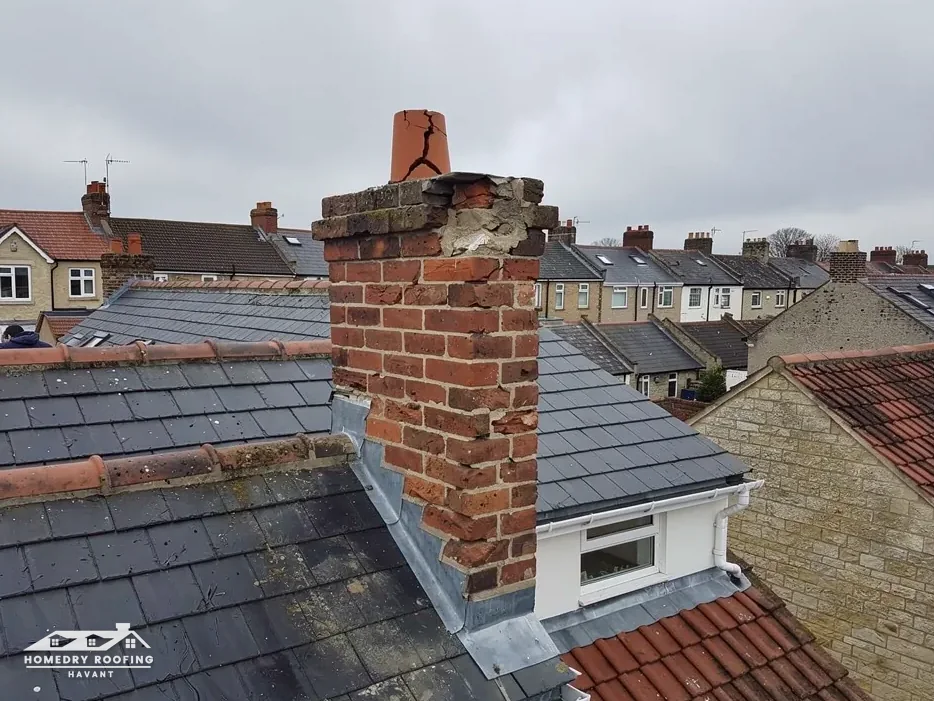
The fillet is the mortar bed that holds the lower edge of the metal against the stack. Once it cracks, the edge lifts and rain gets behind the lead, so we press and look at the fillet before judging the metal itself.
A roof is largely a set of junctions, and a Rowlands Castle survey spends most of its time at them. Where a slope butts against a chimney stack or some higher wall, a strip of lead called a flashing is dressed from the masonry down over the covering, and a mortar fillet beneath it keeps the lower edge pressed in place. We look for lead that has curled up at a corner, split along a fold or been smeared with bitumen in an earlier patch, for fillets that have cracked away from the brick, and for pointing round the stack that has opened. When a stain shows on a bedroom ceiling, the water has travelled along a timber before it dropped, so we climb into the loft and follow the tide marks upward until they point at a single junction.
The National Heritage List holds Grade II entries for The Castle Inn and Station in the village, and for The Lodge, on the Chichester District side of the boundary. Where a house is listed, listed building consent is needed for works that affect its character, whatever the permitted development position for roofs. East Hampshire District Council answers for the Rowlands Castle conservation area, and Sir George Staunton, which also touches the village, appears on both its list and Havant Borough Council's. The rules for roof work in those places are set out in our planning guide for roof work, and this page sticks to what the survey looks at.
If a stack needs new lead or a repoint, our chimney repairs page describes the job from scaffold to final pointing. Before we call old metal worn out we check its fixings and its laps, because sound lead sitting on a failed fillet needs a different repair from lead that has simply run its course.
A stain beside the chimney breast can begin outside, at the lead or the mortar.
Who has to agree to roof work depends on the building and not on the fault in the roof. A listed address brings listed building consent into the picture, a conservation area brings the council's planning team, and an ordinary house in neither needs only the usual checks. We write the survey findings so you can hand them to whoever must consent, and we name the route that applies before any tile or lead is lifted.

Every drop of roof water has to arrive somewhere, and the survey follows it there.
Rain leaves a roof by only a few routes, and the survey finishes where each of them finishes. Along the eaves we look at how far the lowest course overhangs the gutter, because a short overhang lets water curl back under the edge and soak the board behind it. Then the gutter itself: sagging between brackets, a joint that has opened, a stop-end that drips, a hopper choked with moss. A green fan of staining on the brickwork under a joint is a reliable pointer, and a soft fascia board behind a long drip tells us how long the fault has been there. Where the board is sound we leave it, and where it has softened we say how far the rot has travelled before the quote is written. Our gutters, soffits and fascias page lists the repairs available, and a blocked outlet gets cleared ahead of any talk of replacing a run that still works.
Flat roofs over extensions and garages finish at an outlet of their own. We look at the upstand where the membrane climbs the house wall, at laps and seams, and at whether the surface holds a pond after rain. The flat roofing page describes the coverings we lay; when the visit is finished, the verdict is either a repair that will last or a fresh membrane, and the reason is given.
The Environment Agency's flood map puts some land close to Rowlands Castle in Flood Zone 3. The zone concerns flooding at ground level and imposes no roofing requirement of any kind, so the roof specification is left alone. Its practical use comes at the bottom of the run: we note where each downpipe discharges, whether into a drain, a soakaway or the foot of a wall, since roof water left standing against masonry starts a second set of problems.
A survey that stops at the gutter misses half the story. Water leaves a roof through a few narrow points, and each of them can back up, overflow or discharge against a wall. We walk the run from the last tile to the ground, photograph each joint and bracket, and record where the water goes after it leaves the pipe. The pictures arrive with the findings, so you can judge where the problem lies and how much needs doing.
Green streaks down the brickwork below a joint, a damp patch inside an outside wall, or water standing at the foot of a downpipe.
A seam that drips, a bracket that has come away so the run sags, or an outlet clogged until the gutter overflows behind.
Map of Rowlands Castle and the places around it, with the dashed line of our 30-mile service area from Havant. The same places are listed below the map.
Work begins in the loft, where the rafters and the underside of the covering show the tide marks left by water. We follow those marks uphill to the junction or the slipped tile that let it in, then check the same spot from outside with a ladder and a camera. Chimney, wall junction, valley and ridge are looked at in that order, since each sits above the one before. The photographs come to you with the findings. A stain that proves to come from a tank or a pipe in the roof space is reported as that, and no roof work is priced for it.
Under the Planning Portal's guide, re-roofing does not normally need a building regulations application if it affects less than 25 per cent of the building envelope and less than 50 per cent of the roof; a new covering 15 per cent or more heavier does need approval. East Hampshire District Council's building control service takes application queries and inspections on 01730 234207, and we put the route to them before any work starts. Should you choose a heavier covering, a word with a structural engineer or surveyor is advised.
Poles and boards that reach over a footway or out into a road call for a licence under the Highways Act, and in Rowlands Castle the highway authority is Hampshire County Council. Hampshire County Council licenses scaffolding on the highway at £211.90 on application for the first 2 weeks and £72 for each additional 2-week period, needs ten clear working days' notice, and says scaffolding companies must apply on behalf of their customers; we arrange it with our scaffolder. Your programme already makes room for that notice. A scaffold confined to your own plot raises a separate question.
Only a list entry settles it, and one entry says nothing about the buildings either side. You can look an address up on Historic England's National Heritage List. The Castle Inn, Station and The Lodge are each Grade II, The Lodge being on the Chichester District side of the boundary. In East Hampshire the district council deals with listed building consent, which a listed house still needs for work touching its character, even though its permitted development rights for roof work are kept. We read an entry with you before the survey, so the findings record what an application would need, and we explain the steps in plain terms before you commit to anything.
East Hampshire District Council answers for Rowlands Castle conservation area, and Sir George Staunton sits on both its list and Havant Borough Council's. Ordinary re-roofing is normally permitted development even in a conservation area. A further layer exists in the form of the Article 4 direction, which can remove rights, so put your own address to East Hampshire District Council ahead of any booking. The council's Article 4 list names a site east of Mays Coppice Farm, which is one named parcel of land and says nothing about village streets. Our planning guide carries the wider rules.
Land near Rowlands Castle sits in Flood Zone 3 on the Environment Agency map. That describes flooding at ground level, while rain entering through a roof has other causes, so the specification stays as it is. We use the zone for one practical purpose, which is to check where the downpipes discharge so roof water is not left to pool against a wall. Every other finding comes from looking at the roof itself, ridge to gutter. Whether your own plot lies inside the zone is a question for the map.
A mend suits a roof whose battens are sound and whose trouble is confined to one detail: a flashing, a valley lining, a run of ridge bedding or a handful of slipped tiles. We say which of repair or replacement the roof calls for, with the reason, and a sound repair is put first. Where an entire slope has gone, a patch only relocates the leak, and we show you the photographs that prove it before quoting. Where the mend is the right answer, the sound parts of the roof stay exactly as they are, which saves you money and mess.
After the survey you receive a single figure in writing for the whole job, alongside notes on the job, the chosen covering and the finish. When you set it beside another firm's quote, ask of both if VAT and the scaffold sit inside the figure. We keep our pricing good and fair, and we tidy the site before we go. The survey findings come with the price, so each stage of the work traces back to something we found on your roof, and you are free to ask us about any of it before you agree.
You'll get one written total price.
Fill in what you like. It opens WhatsApp with your message ready to send.