
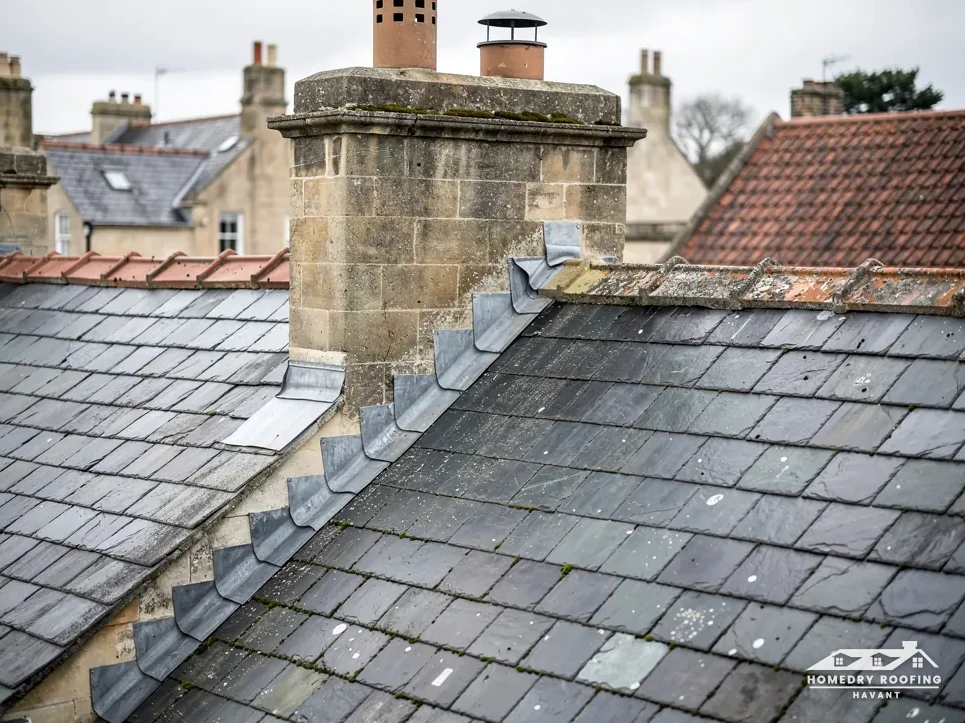
Valleys
The trough along the inward corner where one slope runs into another.
A worn lining, or a drift of leaves, turns rain back under the covering.

Ropley is 23.8 road miles north of Havant, where valleys, eaves and gutters are surveyed from ladder and loft and one written total price follows the findings.
10-year workmanship guarantee, in writing
The trough along the inward corner where one slope runs into another.
A worn lining, or a drift of leaves, turns rain back under the covering.
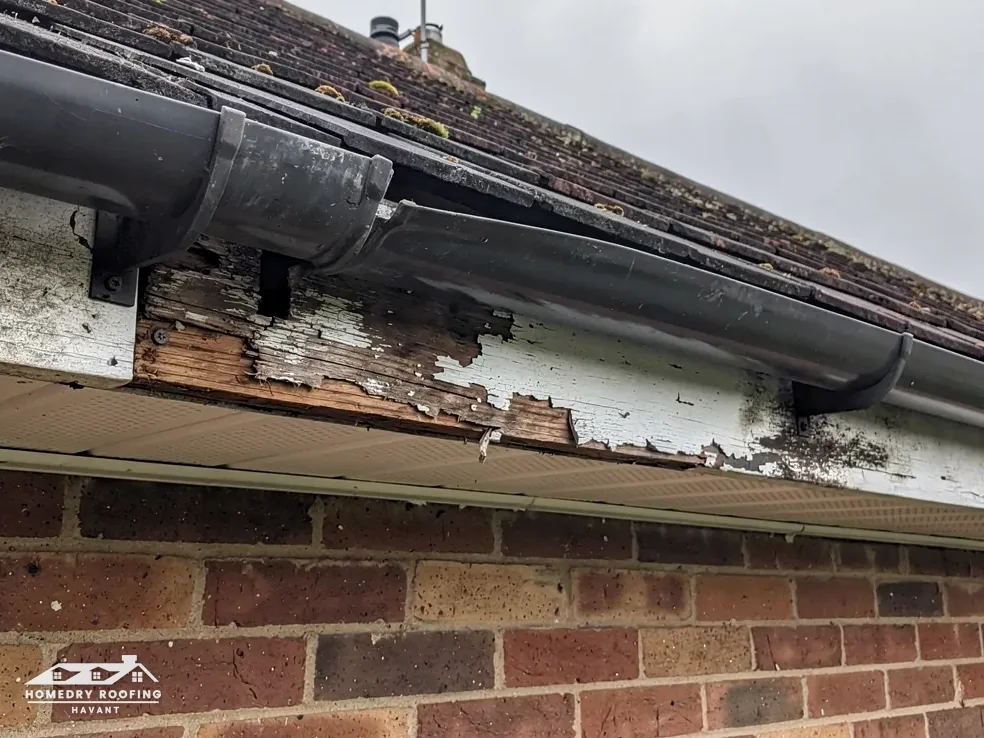
The boards that fill the space beneath the overhang of the eaves.
Rot or an open joint there lets damp reach the timber just behind them.
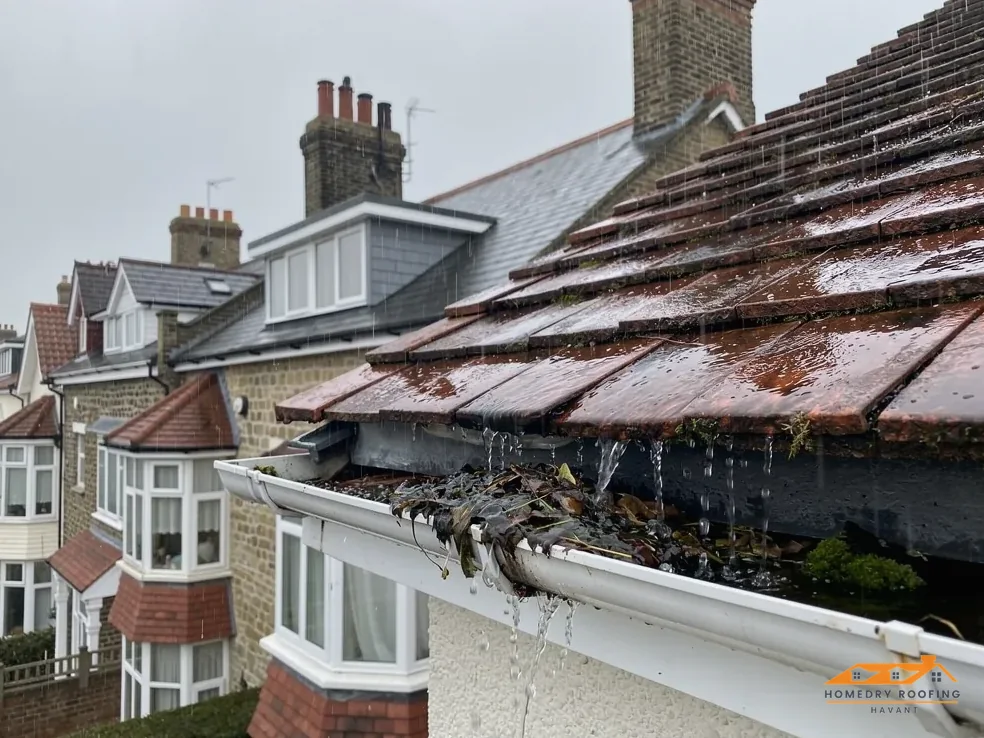
The run that catches the rain of a slope along its lower edge.
A parted joint, or a bracket that has worked loose, drips straight onto the wall.
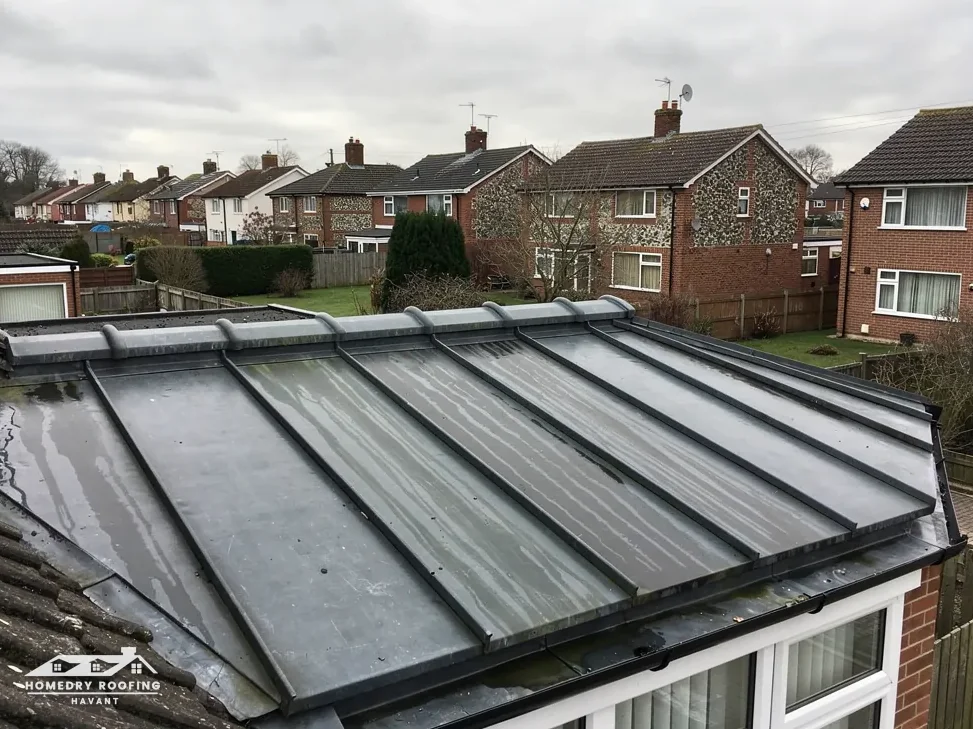
Two slopes, one trough: the valley has the most to carry.
A valley forms wherever one slope runs into another at an inward corner, and everything both slopes shed runs down the trough between them to the gutter. Since so much water travels one way, a small defect in the trough costs more than a cracked piece on a plain slope. At Ropley we start by sweeping the trough clear of leaf litter, then look closely at its lining for splits and worn patches, at the cut pieces along each side for cracks, and at the timbers in the loft directly beneath for stains. A valley is also easy to misjudge from the ground, so we always look from above. If the lining is lead, our leadwork page explains how it is formed; our pitched roofing page covers the slopes that deliver to it, which is where a valley fault sometimes begins. Where the cause is a slipped piece higher up, the valley is left alone and the slope is put right.
Ropley is home to Grade II listed buildings including Church of St Peter, The Forge and The Old Parsonage. Church of England worship continues at Church of St Peter, which brings repairs to the church under the faculty system rather than under the council's listed building consent. Any house listed in its own right needs listed building consent for any work that alters its character, and roof work to it can remain permitted development alongside that consent.
A conservation area covers part of Ropley as well, and it is East Hampshire District Council that you would ask about its edges. Re-covering a house normally falls within permitted development even there. Should an Article 4 direction apply to your address, rights are withdrawn only to the extent it says, so check with East Hampshire District Council. The planning guide for roof work sets out the other rules.
Where two slopes meet in a valley, it collects the rain from both at once, so a fault along that line takes the water of two slopes. Leaves settle there and hold damp against the lining, which hastens wear. We lift the litter out, photograph the lining where it lies, and report whether it is sound, worn at a single point or tired along its length, so the repair matches the fault.
A mark high up the side wall of an upstairs room, or a damp patch that returns to the same corner after wet weather.
A split or thin patch in the lining, or leaves packed along the trough so rain is held back under the cut pieces.
Sometimes. A stain alone is not rot, so we press the timber and look at its joints. If it is firm once dried and the leak above has been stopped, it can stay; if it gives under the thumb, it is renewed.
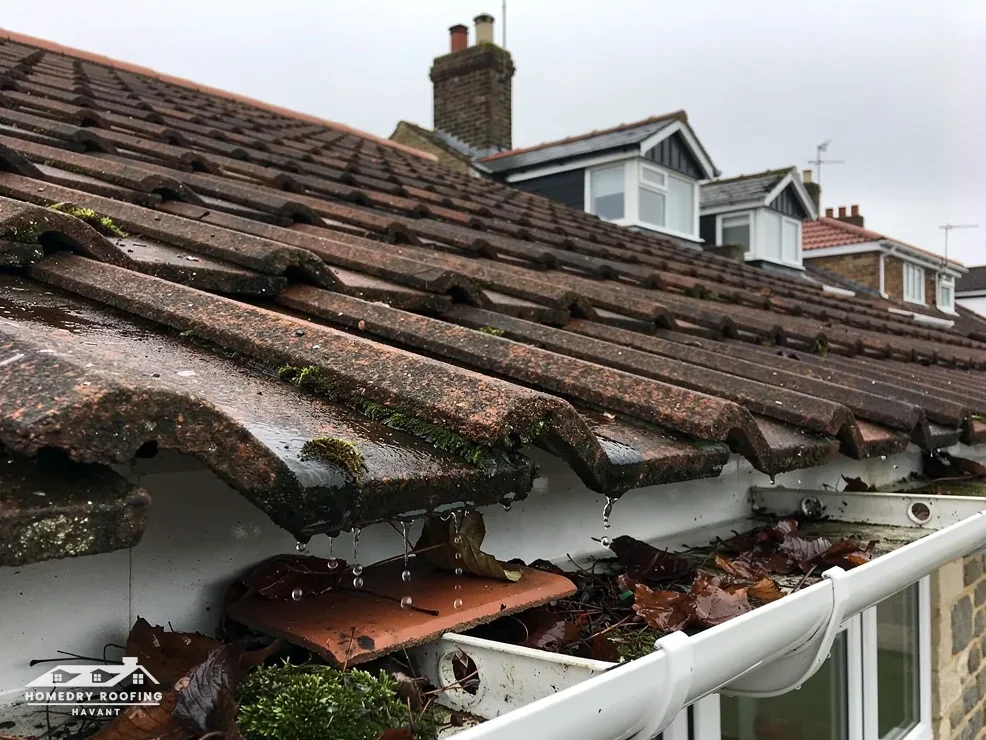
Beneath the overhang at the eaves, a soffit board closes the gap from the wall out to the roof edge, while the fascia is the board on the outer face that carries the gutter. On every Ropley survey we press both boards with a thumb for softness, look along their joints, and shake each gutter bracket for movement. Dark streaking down a fascia, or flaking paint under a joint, can point to a gutter leaking above it, so we trace the mark upward to its source, and we note any board that has been painted over a soft patch, which hides rot for a while. Our gutters, soffits and fascias page lists the work, which runs from resealing one joint to fitting a complete new run.
In the list of Article 4 directions published by East Hampshire District Council, Home Farm and Lyeway Farm appear as named sites near Ropley. Because the entries name sites and not streets, they say nothing about a village house. Only the council can say whether a direction reaches your address, so ask East Hampshire District Council before booking, and file its reply with your survey papers.
For a re-roof in the village, building control means East Hampshire District Council's service, and 01730 234207 is its line for application queries and inspections. Eaves work beside a village road may need scaffold on the highway, which brings in a licence from Hampshire County Council. The answers below give the fee, the notice and who applies, so the dates in your written price are ones that can be kept. A scaffold that is not needed is left out of the quote, and one that is needed is named in it. Send a picture of the eaves if you have one, taken safely from the ground.
The eaves keep a record of every drip that got past the gutter.
A fascia that gives under the thumb, or a soffit stained beside a joint, shows which part of the gutter run has been leaking and for how long. We follow each mark up to its cause, then say whether the board can be dried and kept or must be replaced, and the photographs sit beside that answer so you can judge it for yourself.
A tide mark on the wall below the gutter, or flaking paint on the fascia directly above a joint.
A parted gutter joint, a sagging run that holds water, or a soft board that no longer sheds it clear of the wall.
Map of Ropley and the places around it, with the dashed line of our 30-mile service area from Havant. The same places are listed below the map.
We clear the trough first, because a drift of leaves can look like damage and can cause it. With the trough bare, the lining shows its real condition: splits, thin patches, lifted edges, or nothing wrong at all. The cut tiles beside it are checked for cracks, and in the loft the timbers below the valley are examined for staining. If debris alone was the fault, you are told the lining is sound and the clearing was all that was needed. If the lining has worn, the report says where, and shows it in photographs.
It can be. The Planning Portal sets two limits. Work staying inside both, under 25 per cent of the building envelope and under 50 per cent of the roof, calls for no building regulations application in the normal way. A covering that adds 15 per cent or more to the weight is approved separately. For Ropley the contact is East Hampshire District Council's building control service, on 01730 234207 for application queries and inspections. We put the question to the service ahead of any booking and relay its answer to you in plain words, so nobody has committed to a date, a material or a cost before the position is clear.
A licence is required under section 169 of the Highways Act 1980 for scaffolding that stands in the highway, and in Ropley it comes from Hampshire County Council. Hampshire County Council charges £211.90 on application for the first 2 weeks and £72 for each additional 2-week period, while ten clear working days is the minimum gap the council wants before the start. Hampshire County Council's page says: "Scaffolding companies must apply on behalf of their customers." We arrange it with our scaffolder, so the start date in your written price leaves room for that notice and no one waits on paperwork once the materials are on site.
Church of St Peter is Grade II listed and used for Church of England worship, which brings repairs to the fabric within the faculty system instead of the council's listed building consent. Churches of the Church of England that are in use sit outside the council's listed building control in this way. If a church has been closed or made redundant, or belongs to a faith outside the exempt list, the position changes, but neither applies to the case described here. For houses the route is the council's, covered in the next answer.
Both entries are Grade II. A house carrying a list entry itself needs listed building consent under section 7 of the Planning (Listed Buildings and Conservation Areas) Act 1990 before any work likely to alter its character, and that sits alongside any other permission. The entries for The Forge and The Old Parsonage describe those buildings; they say nothing about the houses next door. Search the list for your own address first, and tell us what you find before the survey, so the work is planned around it and nothing is ordered that the listing would have stopped.
East Hampshire District Council is the authority for the Ropley conservation area, and a call or an email to its planning team settles whether your address sits inside it. Re-covering a house is ordinarily permitted development within a conservation area, and should an Article 4 direction touch your address the council will tell you what it takes away. A listed house adds listed building consent on top where work would alter its character. Whatever you learn goes on the survey sheet, and the roof planning guide linked on this page lays out where each rule comes from.
Two sites, Home Farm and Lyeway Farm, appear by name in the list of Article 4 directions that East Hampshire District Council publishes. Because it names sites and not streets, it gives no sign that houses in Ropley are covered. A direction exists only where the council has made one, and East Hampshire District Council will know what, if anything, applies to your address, so ask it before work starts. We note its answer in the survey papers, which keeps the roof findings and the consent position together on one page for whoever needs to read them later.
It should name the boards, brackets, gutter run and downpipes involved, say if the scaffold and the VAT are counted, and follow a close inspection of the eaves, not precede it. Boards that are sound stay in place; soft ones are replaced, and the quote shows which are which, with photographs taken from the ladder at the time of the survey. You get one total in writing, stated in full, and it is a good and fair figure for that work. Should a different quote omit the scaffold or the VAT, ask the firm to add both, so the comparison is true.
You'll get one written total price.
Fill in what you like. It opens WhatsApp with your message ready to send.