
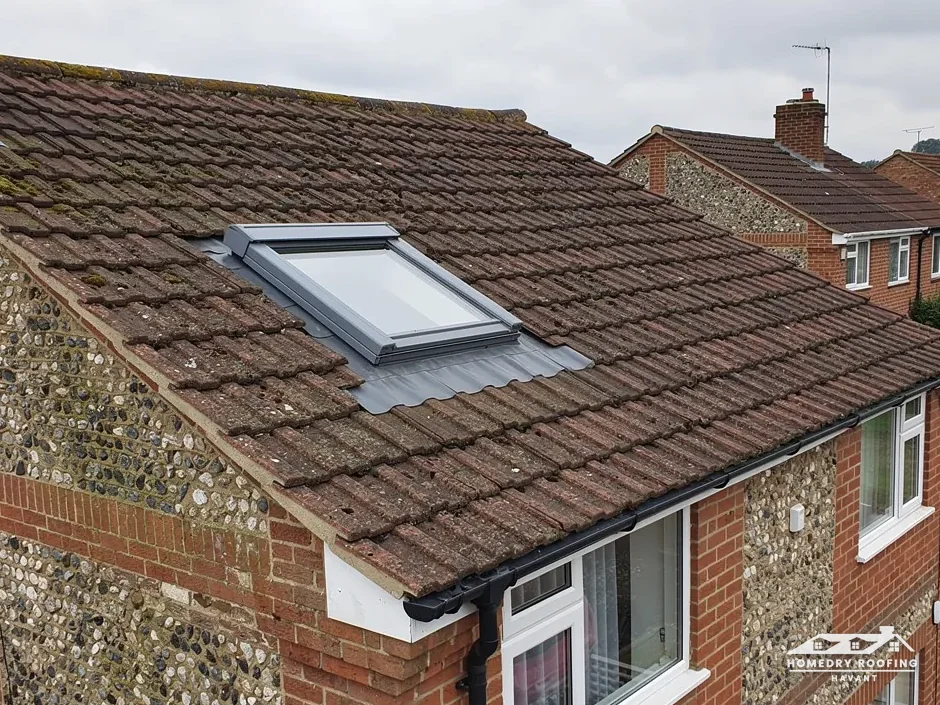
Skylights
Where a roof window is set into an opening cut between two rafters.
When the seal round the frame perishes, a damp mark creeps over the plaster by the glass.

New Alresford is 25.5 road miles north-west of Havant. Its flat roofs, roof windows and the outlets beneath them are each surveyed where the damp begins, and a single written total follows.
10-year workmanship guarantee, in writing
Where a roof window is set into an opening cut between two rafters.
When the seal round the frame perishes, a damp mark creeps over the plaster by the glass.
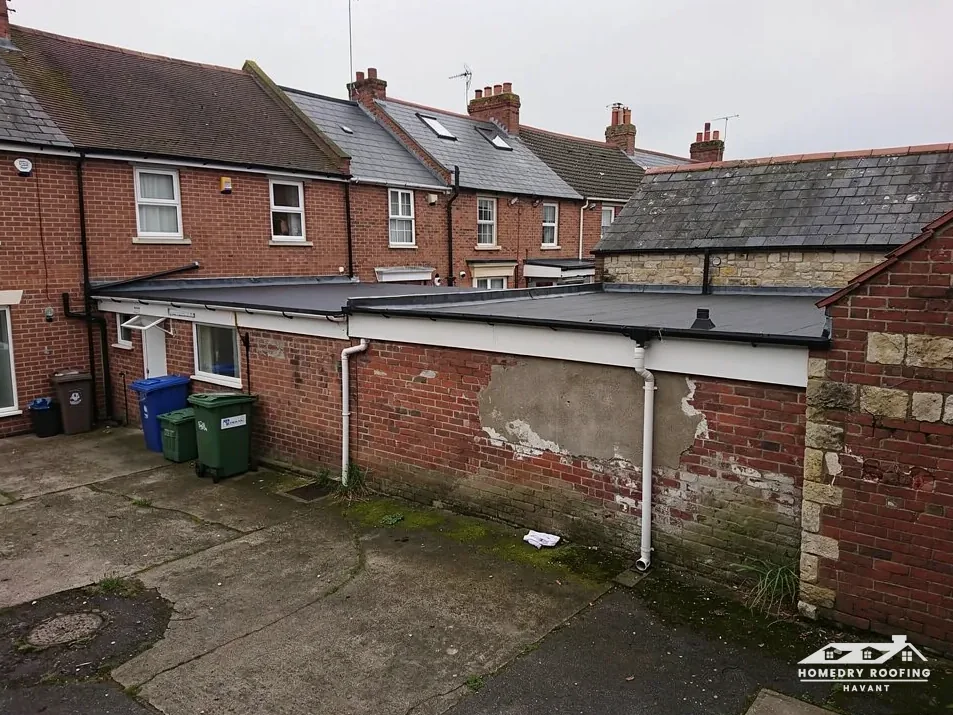
Where a flat roof's covering climbs the side of a wall.
A split along the top edge of that turn-up lets rain slip under the covering.
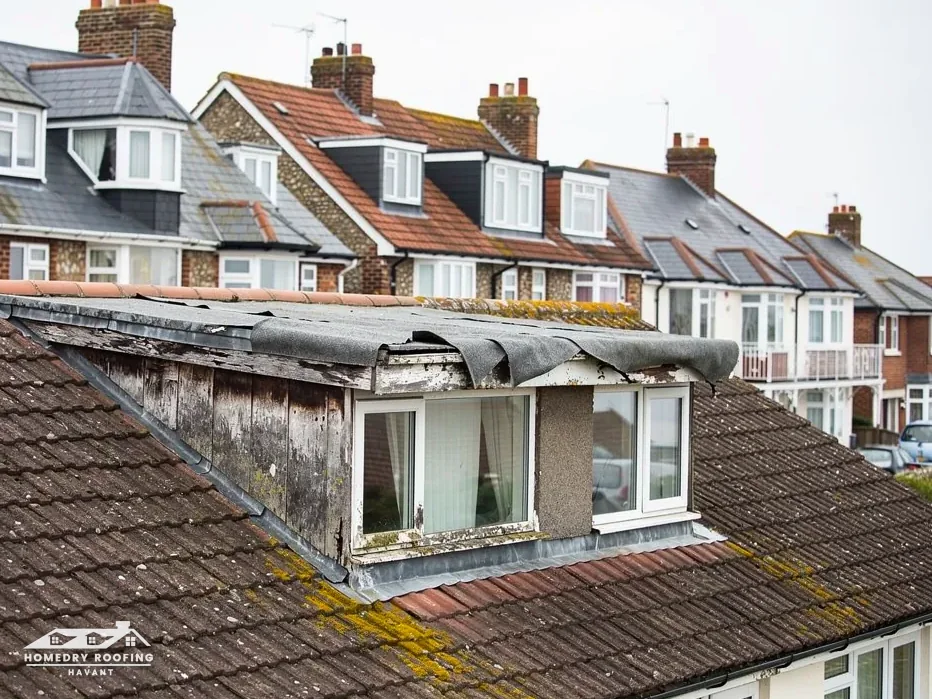
Where rain from a flat deck drains out through a spout or a hopper.
Leaves packed into the outlet leave the roof holding water it ought to have shed.
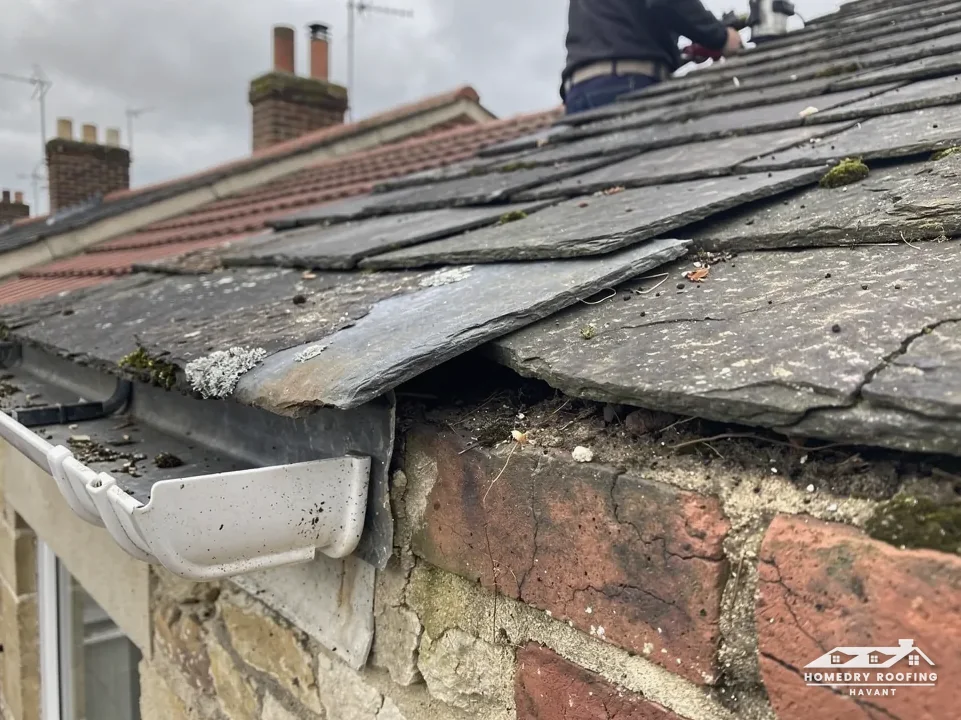
Cut a hole in a roof and the hole must be sealed on all four sides.
Think of a roof window as a frame dropped into a gap in the slope: each of its four edges needs its own route for water. A flashing kit surrounds the frame, rubber seals line the sash, a cill closes the bottom edge, and the glass should stay clear. Mist inside the double glazing means a failed unit, and the cill and glazing bars are pressed and tapped wherever they can be reached. A drip, though, need not begin at the window itself; tiles slipped higher up can push more water onto the frame than it can shed, so the survey walks up the slope before it touches the unit. Our roof windows and skylights page sets out what swapping a unit involves, and roof repairs deals with the roof round it.
The National Heritage List has Grade II* entries in New Alresford for the Church of St John the Baptist, for The Bridge and for Langtons, and Alresford Bridge is a scheduled monument. Church of England worship continues at St John the Baptist, so its roof comes under the faculty system rather than listed building consent. A private house with a listed entry goes the other way, and the entry itself defines what the consent covers. Scheduled monument consent applies to works on the monument itself.
The New Alresford conservation area is designated, and Winchester City Council can say whether an address falls inside it. For a re-roof, Winchester City Council's building control team, on 01962 848 176, is the contact. Ask the same council whether an Article 4 direction reaches your street before booking anything. Keep the reply you receive with the survey papers. Our planning guide for roof work carries the roof rules in full.
When a window drips, the first suspect is the window and the second should be the roof above it. A cluster of slipped tiles throws extra runoff onto the frame, more than its flashing was designed to handle. We work uphill from the frame, so a new unit is not sold for a fault two courses higher, and the findings show both the window frame and the tile courses over it in pictures, taken from the ladder.
A damp ring round the reveal of a roof window, or a drip on the sill after a heavy shower.
A perished seal or flashing beside the frame, or slipped tiles above it throwing more water than the frame can shed.
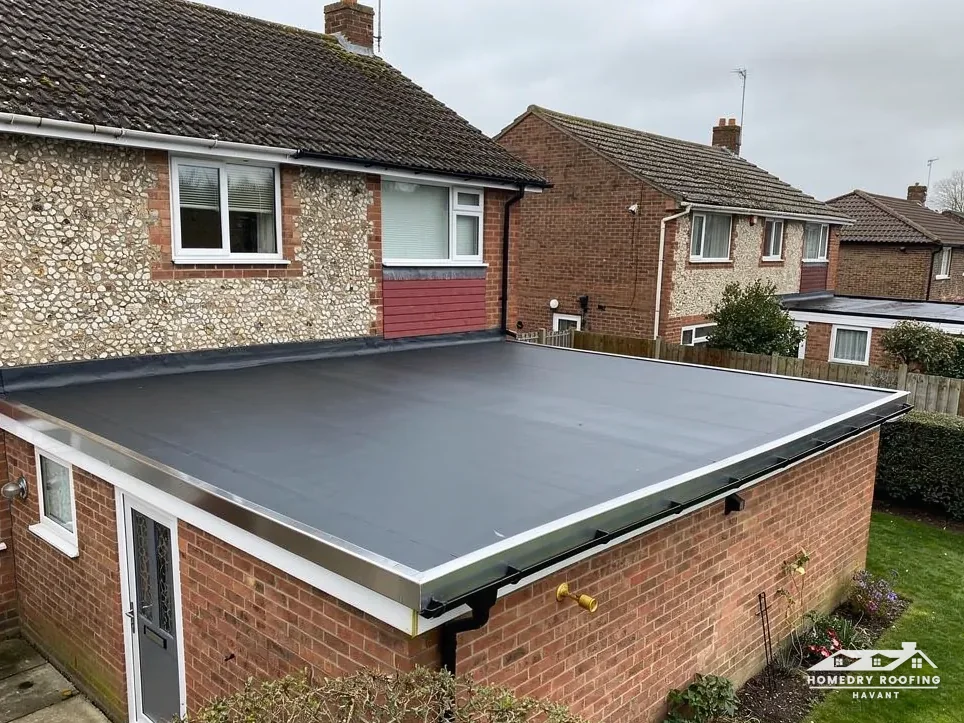
Water that stays reaches every seam. It also signals a blocked outlet or a fall that has gone wrong. The survey tells you which, because the repair differs for each.
A flat roof offers rain three ways in: the upstand, where the roof's surface rises against a wall; the surface, where a poor fall leaves water standing; and the outlet, where the water ought to leave. We walk the surface the day after rain when we can, because a puddle shows where the fall has gone, and we look along the top edge of the upstand for splits and lifting. Two causes can leave water standing, the outlet may be blocked or the fall may be lost, and the repair for each is different. Photographs of any pool go to you with the findings. Our flat roofing page describes recovering and relaying.
Below the outlet the water still has somewhere to go. Land near New Alresford sits in Flood Zone 3 on the flood map of the Environment Agency, which shows the ground and not the roof; a roof carries no extra requirement because of it, yet it is a good reason to follow each pipe down to its gully and record what is there. A gully clogged with silt turns a sound roof into a wet wall, so the survey finishes at the drain, not at the edge of the deck. Pipes that stop short of the gully, or empty on to paving that falls towards the wall, are noted for correction.
When the survey is complete, you hear whether a repair will serve or the whole covering must be replaced, with the reasons set out beside pictures taken on the deck. Mending leads where the deck and the fall are sound. The price is one written total, the findings sit next to it, and the garden is checked over for offcuts and torn felt or membrane before we leave. Anything beyond the roof, such as a blocked drain below ground, is flagged in the findings as a separate matter.
A flat roof that holds a puddle is telling you where its fall has gone.
A puddle still there a day after rain points at a lost fall, or at an outlet that is partly choked. A stain on the ceiling beneath may sit under the puddle or a metre away, since rain can run along the deck before dropping through. We note where the pools lie, sketch them and photograph them, so the repair addresses the cause and not just the nearest wet spot, and the sketch goes into the findings.
Map of New Alresford and the places around it, with the dashed line of our 30-mile service area from Havant. The same places are listed below the map.
Frame first, then the flashing kit round it, the seals, the cill under it and the glass; misting between the panes is read as a failed unit. After that the survey climbs the slope above, because slipped tiles can send more water onto the frame than its flashing was made for. Only when both have been read do we say whether the unit, its seals or the tiles above are at fault. Photographs of every part come with the findings, so the diagnosis can be checked by eye, and a unit that is simply dirty or stiff is cleaned and left in place.
Winchester City Council handles both, through different teams. Its building control team, on 01962 848 176, answers the Building Regulations question for New Alresford, and we take that question to the team ourselves ahead of the job. Planning Portal guidance treats a re-roof as outside building regulations applications when under 25 per cent of the building envelope and under 50 per cent of the roof is involved; a covering 15 per cent or more heavier needs approval. Planning questions go to the council too, and our planning guide covers them, including what to ask for a listed or conservation area address.
The licence is a Highways Act 1980 section 169 matter, and for New Alresford the issuing body is Hampshire County Council. Hampshire County Council's published fee is £211.90 on application for the first 2 weeks and £72 for each additional 2-week period, and the first day of scaffolding cannot fall within ten clear working days of applying. Hampshire County Council's page says: "Scaffolding companies must apply on behalf of their customers." We arrange the licence with our scaffolder, once the dates have been settled between us, so the scaffold is up only while the roof needs it.
The Church of St John the Baptist is a Grade II* entry (National Heritage List entry 1156507), and the Church of England worships there, which makes its roof a matter for the faculty system, not for the council's listed building consent. The Bridge and Langtons are separate Grade II* entries, each covering its own building. A listed house, as distinct from a listed church, takes the council's consent route. Run your address through the National Heritage List search, because each entry names exactly what it protects, and read the wording before any tile or slate is ordered for the job.
Winchester City Council decides that question, because its boundary is the one that counts. The New Alresford conservation area is designated. On a house, putting on a new covering is in the ordinary run still permitted development, conservation area or not, but an Article 4 direction can remove further rights. Ask Winchester City Council before a date is booked, and ask for the reply on paper, so that it can be kept with the house papers and shown to a future buyer if the question ever arises. The roof rules have their own page, our planning guide.
The roof is built and fixed in the usual way. Land near New Alresford is shown in Flood Zone 3 on the Environment Agency's map, a statement about land, not about slopes or flat decks. It affects the survey only below the eaves: the state of the gully, where each downpipe empties, and where the water goes after that. For a particular address, the flood map itself gives the answer, and we record what we find at the foot of each pipe, with a photograph. A blocked ground drain is reported, and clearing it is left to whoever is responsible for it, since that lies outside the roof.
Look at the roof the morning after rain. Water still lying in the middle, or a dark tide-line where a pool has dried, suggests a choked outlet or a fall that has gone. BS 6229:2025 sets a minimum finished fall of 1:80 for membrane flat roofs, which is why the design fall is steeper than that, leaving room for tolerances. A pool that persists is a reason for a survey, and photographs of the pools help us tell a blocked outlet from a deck that has dipped, and the report says which of the two you have.
Look for a plain statement on scaffold and VAT: are they counted in, or not? Get it in writing, since a lower-looking quote can leave one of them out and meet you with it later. Ours is a single written total issued when the survey has been completed, with the findings printed beside it. A sound repair leads the quote, and the aim is a good, fair price, with replacement described only where the roof needs it and the reasons given. The site is left clear of offcuts and debris, and any old covering goes with us when the work is done.
You'll get one written total price.
Fill in what you like. It opens WhatsApp with your message ready to send.