
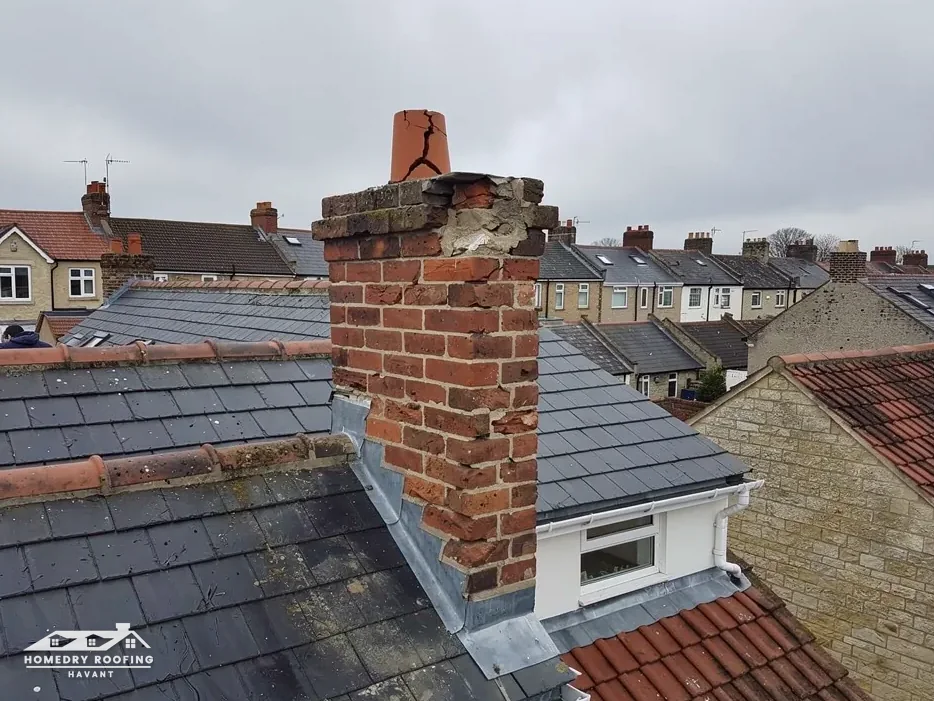
Stacks
Where a column of brickwork rises through the slope with lead dressed round its base.
A lifted edge or a cracked cap there sends rain down the breast inside.

Petworth is 25.7 road miles north-east of Havant; its chimney stacks and roof windows are each traced back to the joint at fault, and the survey ends with a single written total price.
10-year workmanship guarantee, in writing
Where a column of brickwork rises through the slope with lead dressed round its base.
A lifted edge or a cracked cap there sends rain down the breast inside.
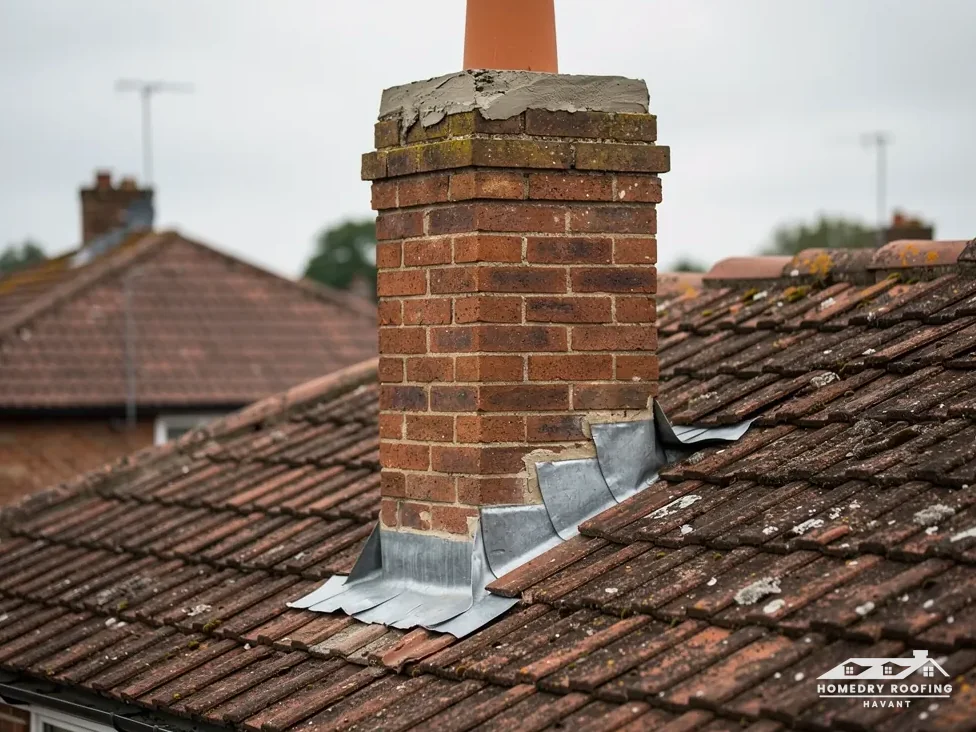
Where a cement cap on top of the stack grips each chimney pot in place.
Once that cap cracks, rain soaks the brickwork below and works down the flue.
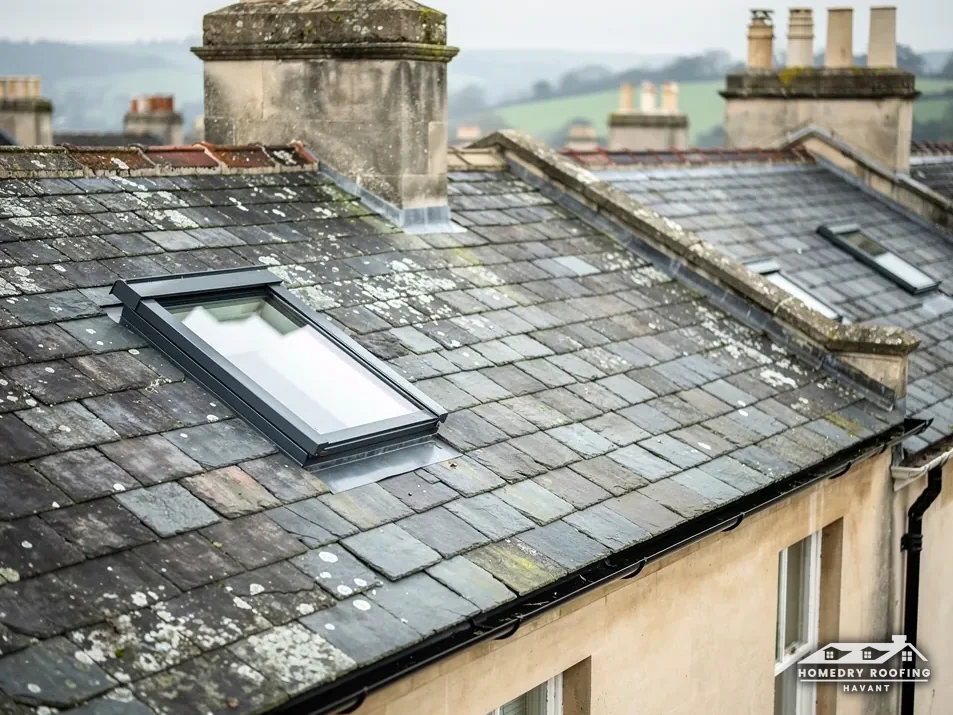
Where a glazed unit is fitted into a hole formed in the roof slope.
A worn seal or a bent flashing lets drips reach the sill and the plaster.
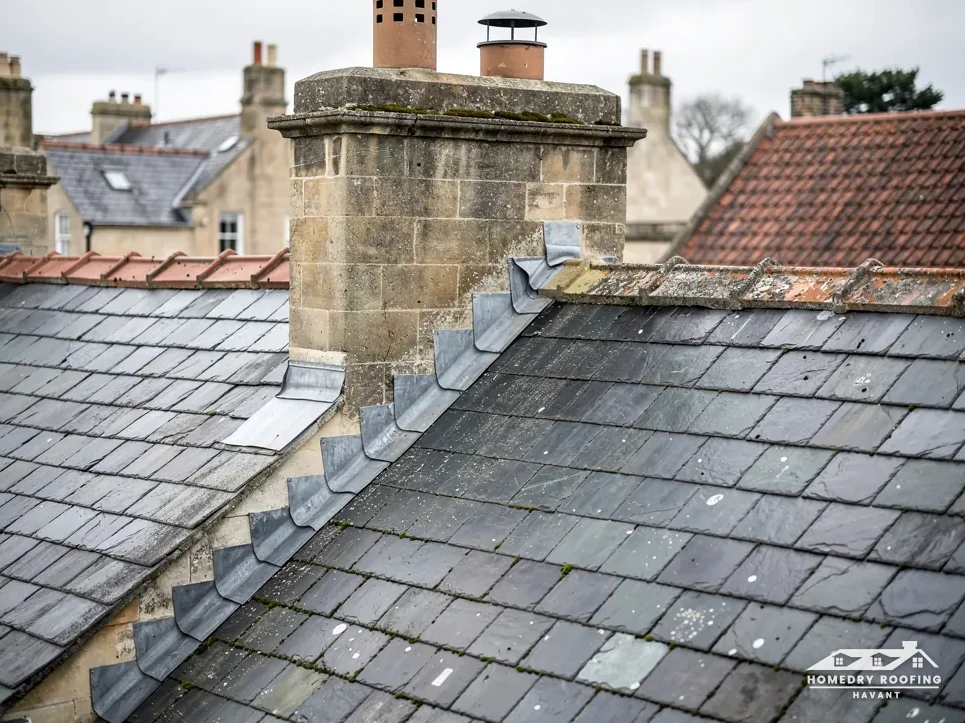
Yes. Rain can enter through cracked pointing higher up the shaft, or through a flaunching that has opened, and then run down inside the brickwork to show at the breast. We read the whole stack from cap to base, not just the lead.
Brick chimneys rise through the covering as stacks, and the ring where one leaves the slope holds three joints worth reading. The back gutter is a small lead channel on the uphill side that carries water round the stack. The flashings run up each flank and over the tiles. The flaunching is the cement cap on top, which holds the pots in place. Lead is inspected for lifted edges, the cap for hairline cracks and each pot for any wobble. Moss in the back gutter is cleared before the lead is judged. Up in the loft, a tide-mark on the wood beside the breast tells us how long the damp has been coming in. Our chimney repairs page sets out what a repair involves.
Grade I is the listing of both The Parish Church of St Mary and Petworth House, with The Town Hall at Grade II*, all three named on the National Heritage List, and Church of England worship carries on at St Mary's, so repairs to it are a matter for the faculty system of that Church, while the council's listed building consent plays no part. Any other building with its own list entry is a council matter: work that could affect its character needs listed building consent granted first, and the entry itself says what is protected.
Petworth has a conservation area, and the town lies inside the South Downs National Park, so planning is a role of the South Downs National Park Authority, while Chichester District Council deals with enquiries for it. An Article 4 question belongs with that council too, along with your postcode. Our planning guide for roof work covers the rules, leaving this page free to describe what the survey looks at on a chimney.
A stack stays dry only while every ring of lead and cement holds.
A stack can look sound from the pavement while the lead at its foot has lifted, or the cap has opened a hairline. We climb to the stack, lay a hand on each joint, and photograph the back gutter and both flanks. Matching those pictures with the stain in the loft shows whether one repair is enough or the flashing needs renewing along all four sides, and you see the evidence.
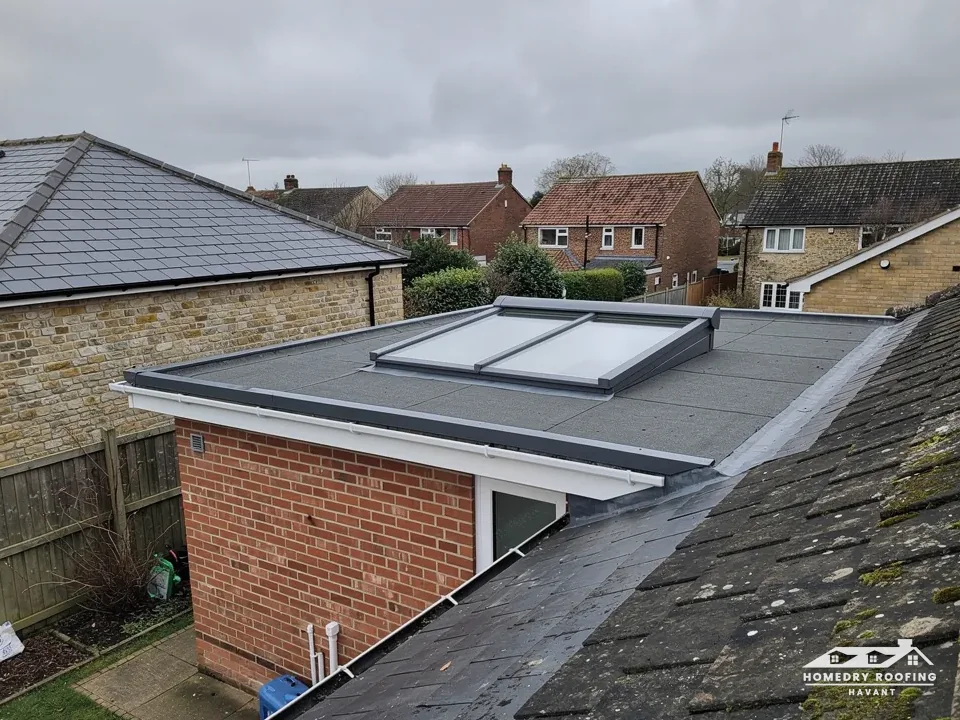
A hole cut in the slope brings a joint of its own to seal.
A roof window is a glazed unit fixed into the slope itself, and it adds three parts that can fail: the glazing seal, the frame, and the flashing kit that ties the frame to the covering. A unit that has misted between its panes has lost its seal and needs replacing. Drips at the sill can come from the frame, or from a tile above that no longer sheds water. We look at each in turn, from outside first and then from the room. Our roof windows and skylights page lays out the options if a unit has to be changed.
A replacement unit is not simply a matter of matching the old one. Until 24 March 2027, Approved Document L (2021) Table 4.2 asks for 1.4 W/m²K or Window Energy Rating Band B for roof windows, and a new opening changes the frame as well as the glass. For Petworth addresses we take the plan to Chichester District Council's building control team before ordering, so the route is known and a unit is not bought that cannot be fitted. While the opening is bare, the rafters either side of it can be examined properly, perhaps for the first time in years, and any soft timber replaced before the new frame goes in.
Petworth has a conservation area and lies within the South Downs National Park, so the size or position of a new opening is a planning question for Chichester District Council, acting for the Authority, not for this page. We photograph the existing opening and the slope around it before and after, so the planning and building control teams each see the same evidence. We arrange the licence with our scaffolder for any frontage that needs scaffold over a pavement, a matter the highway authority controls.
A damp sill gets blamed on the window, but three different faults can cause it: a failed glazing seal, a frame whose flashing has bent, or a tile higher up that sheds water onto the frame instead of past it. Looking at all three before suggesting a new unit means the money is not spent on glass when a slipped tile is the culprit, and the photographs let you judge that for yourself.
Condensation trapped between the panes, or a ring of damp plaster on the reveal beneath the sill.
A failed glazing seal, a flashing bent at one corner, or a slipped tile sending water onto the frame.
Map of Petworth and the places around it, with the dashed line of our 30-mile service area from Havant. The same places are listed below the map.
The back gutter is the lead channel behind the stack, and it takes all the water running down the slope toward the chimney. We look for splits, for lead lifting away from the tiles beside it, and for leaves or moss packed in so that the flow stops. Then we follow the flashings round both flanks and test the flaunching for cracks and the brickwork above it for open joints. Inside, we check the timber around the breast for staining. You are shown photographs of every joint, along with a plain view on whether a single repair will do or the whole run of lead should be renewed, and the reasons for either answer.
It is listed Grade I, and Church of England worship continues there, so the church counts as an exempt building. Any roof work at the church goes through the Church of England's faculty system, and the council's listed building consent is not the route. That arrangement covers the church and nothing else on the street. Petworth House, The Town Hall and any home carrying its own list entry sit under the council's route instead, so find the entry for your address and read it before plans are drawn or materials are ordered, because a listed home needs its consent in place first. Nothing here is a reason to delay a simple repair.
A listing attaches to the one building it names. Petworth House is Grade I and The Town Hall is Grade II*, which says nothing about the house across the road. Should your own home turn out to have an entry, you need listed building consent for work touching its character; tell us at the start so the survey notes can follow that entry. Repairs to an unlisted house are a different matter altogether. To find out which you have, enter your address in the National Heritage List search and read what returns.
Until 24 March 2027, Approved Document L (2021) Table 4.2 asks for 1.4 W/m²K or Window Energy Rating Band B for roof windows. A new opening is also building work, so the plan goes to Chichester District Council's building control team before a unit is ordered. The size and position of a new opening in the Petworth conservation area are planning questions for that council, acting for South Downs National Park Authority. Photographs of the present opening go with those enquiries, and the written price follows once the route is clear. A unit bought before that point can turn out not to fit the opening or the rules.
That depends on the licence. Section 169 of the Highways Act 1980 requires one before scaffolding goes up above the footway or carriageway. West Sussex County Council issues it for Petworth, charging £266 for a month's licence and requiring at least 10 working days' notice. Those days run from the date of application to the date the scaffolding goes up, and we arrange the licence with our scaffolder, so your start date is realistic and not merely hopeful. The written price shows whether scaffold is counted in the sum, a detail worth asking any other firm about as well.
By the Authority. Petworth lies inside the South Downs National Park, and planning powers there rest with South Downs National Park Authority. Chichester District Council is the usual host for processing, with the Authority taking over any application that is called in. Building control does not belong to the Authority; that stays with the district council, so expect two separate enquiries on a re-roof. Anything that goes further than a like-for-like repair should be put to Chichester District Council first. Our planning guide lays out the roof rules themselves, so skim it first if you would rather arrive at the call prepared.
Ask Chichester District Council, which takes planning enquiries here for South Downs National Park Authority, since Petworth lies in the Park. The Petworth conservation area lies close to the town centre, and two houses on one street may sit either side of the boundary line. A direction under Article 4 can take permitted development rights away, and only the council can judge whether your own address is covered, so put that question at the same time and file its reply. A boundary question is cheap to settle at the start and awkward to untangle halfway through a job.
It tells you what was found, because someone climbed up and looked first; nothing is priced from the road. You receive one written total for the job described, with a note saying if VAT and scaffold are counted, and a repair, where sound, is put forward before any replacement. Photographs back each recommendation, so you can see the fault for yourself. Prices are good and fair. Request the same details from any other firm in writing, so the figures can be set side by side, and expect the garden and the path to be swept at the end of the work. A price that arrives without a visit is a guess.
You'll get one written total price.
Fill in what you like. It opens WhatsApp with your message ready to send.