
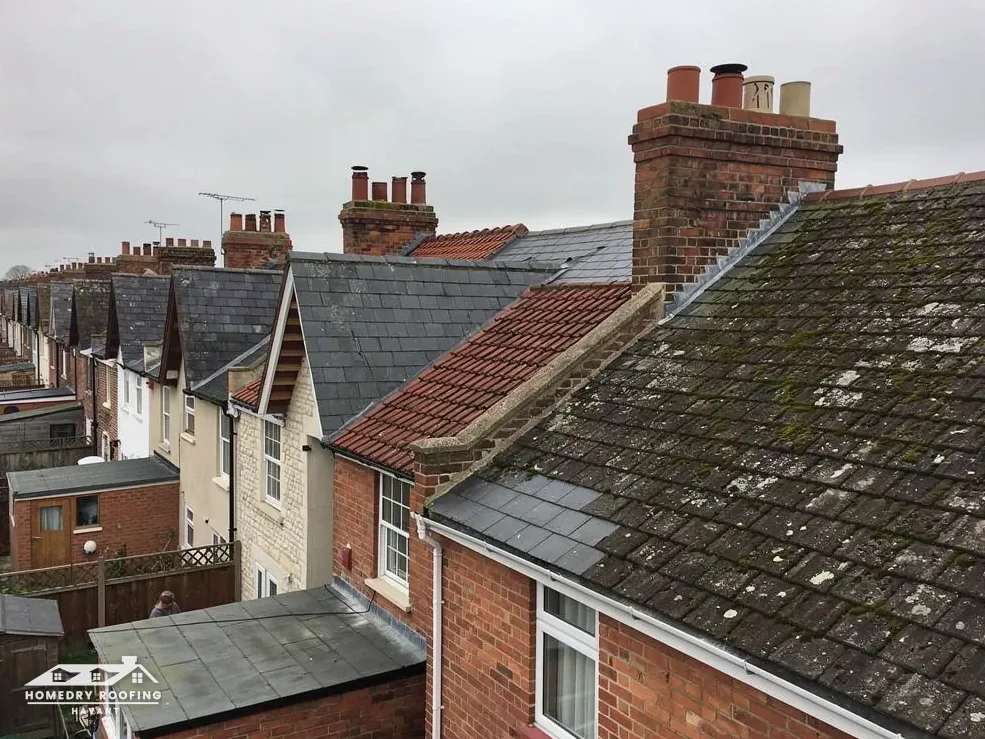
Crowns
Where the top of a Coldwaltham chimney stack is capped and the pots are bedded in mortar.
A cracked crown lets rain slip into the brickwork and down the flue beneath.
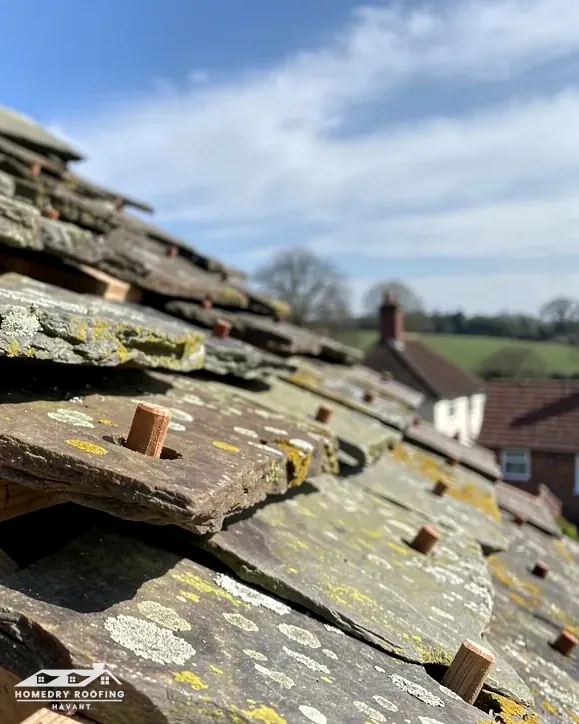
Coldwaltham is a West Sussex village 25.9 road miles east of Havant, inside the South Downs National Park; chimneys, listed houses and conservatory roofs are surveyed first, then priced as one written total.
10-year workmanship guarantee, in writing
Where the top of a Coldwaltham chimney stack is capped and the pots are bedded in mortar.
A cracked crown lets rain slip into the brickwork and down the flue beneath.
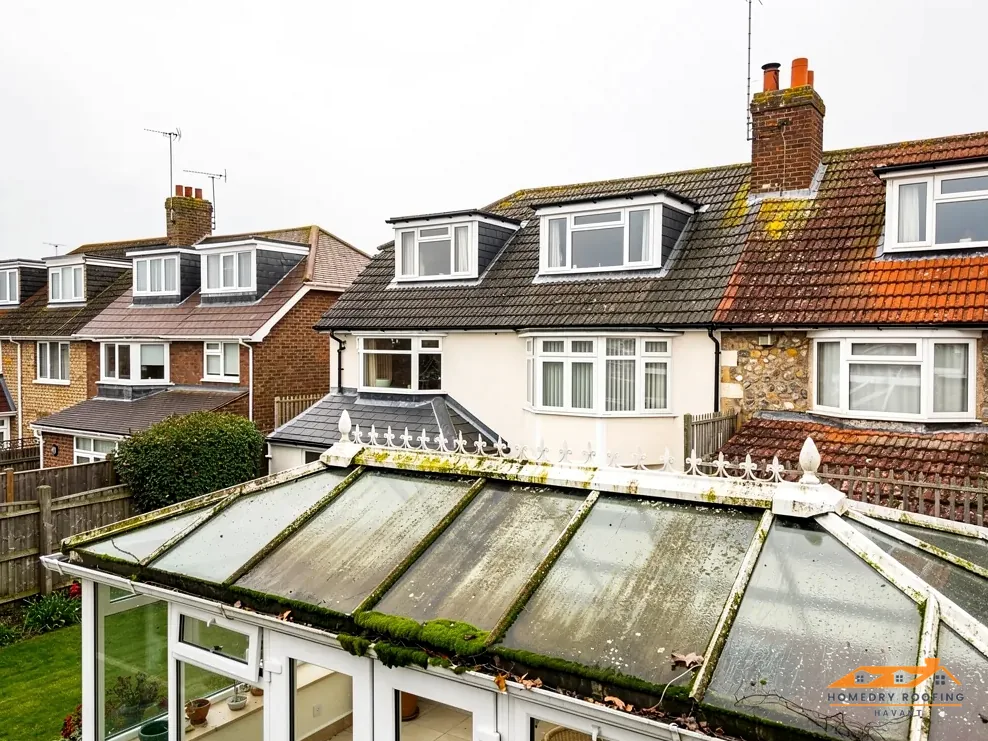
Where a Coldwaltham conservatory frame sits against the house wall on a ledge that sheds water.
A split seal at that ledge lets rain run behind the glazing bars.

Where a gutter feeds a hopper head and a downpipe beside a Coldwaltham wall.
A blocked hopper overflows over the brickwork instead of passing the water down.
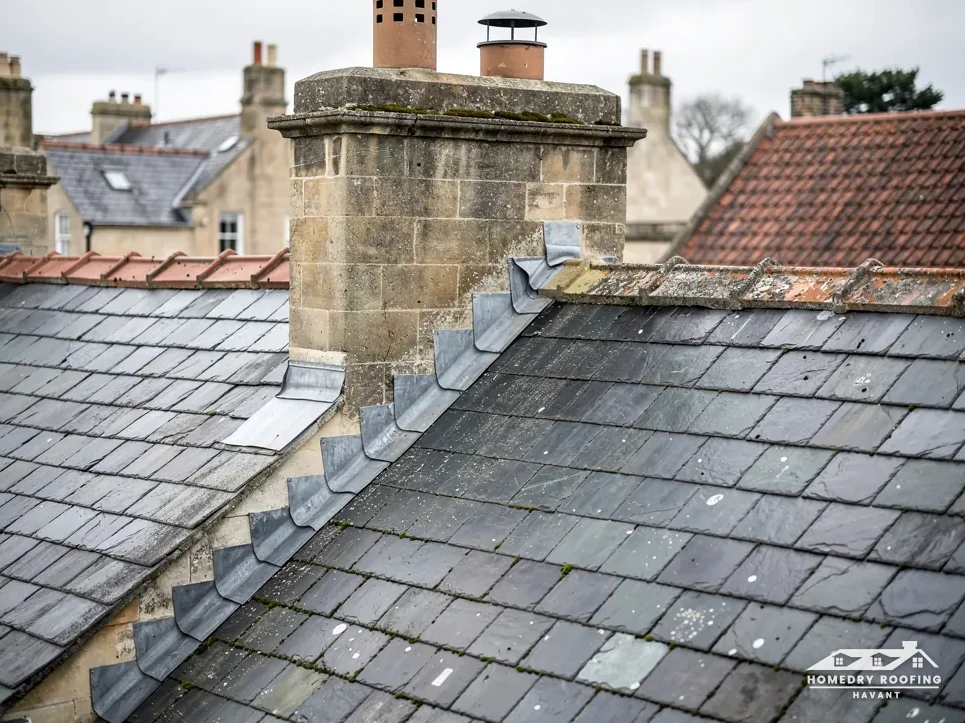
A chimney is a tall wall with a hole through the middle.
A chimney is the tallest thing on a roof and has the most joints in it: the pointing in the stack, the flaunching that holds the pots, the flashing at the foot of the stack where brick meets slope, and the back gutter above. A Coldwaltham survey reads each of them from the roof and from the loft, where a stained chimney breast can show water coming down the stack. If a breast is to be cut away and it stands on a party wall, the building owner serves the party wall notice, at least two months ahead for work to a party wall. Our chimney repairs page covers the stack itself.
Coldwaltham sits within the South Downs National Park, and applications for work there are decided by the South Downs National Park Authority, which deals with them itself rather than through a district council. Building control is another matter: it stays with the district council, as the Authority does not provide it. Three conservation areas lie close to the village: Coldwaltham and Watersfield under Horsham District Council, and Coldwaltham (north) under the Authority. An Article 4 direction is a matter to check with the South Downs National Park Authority. The planning guide for roof work covers what changes inside a National Park.
The Parish Church of St Giles is listed Grade II* (National Heritage List entry 1027424) and holds Church of England services, so roof work there goes through the faculty system rather than listed building consent. Ivy Cottage (entry 1192070) and Widneys (entry 1027420) are listed Grade II. For a house on the list, listed building consent under section 7 of LBCA 1990 is needed for works "in any manner which would affect its character as a building of special architectural or historic interest", which is why an address is checked before a price is written.
A stack carries rain in two directions: down the outside, where pointing and flashing meet it, and down the flue, where an uncapped pot lets it in. We look at the crown, the pots, the flashing and the pointing in that order, take a photograph at each stage, and match any stain on the chimney breast inside to the section of stack above it. Each photograph is labelled with its position on the stack.
A damp ring on the chimney breast inside a bedroom, or flaking paint around the breast after a spell of rain.
A cracked crown, an open joint in the stack, or lifted lead at the foot of the stack.
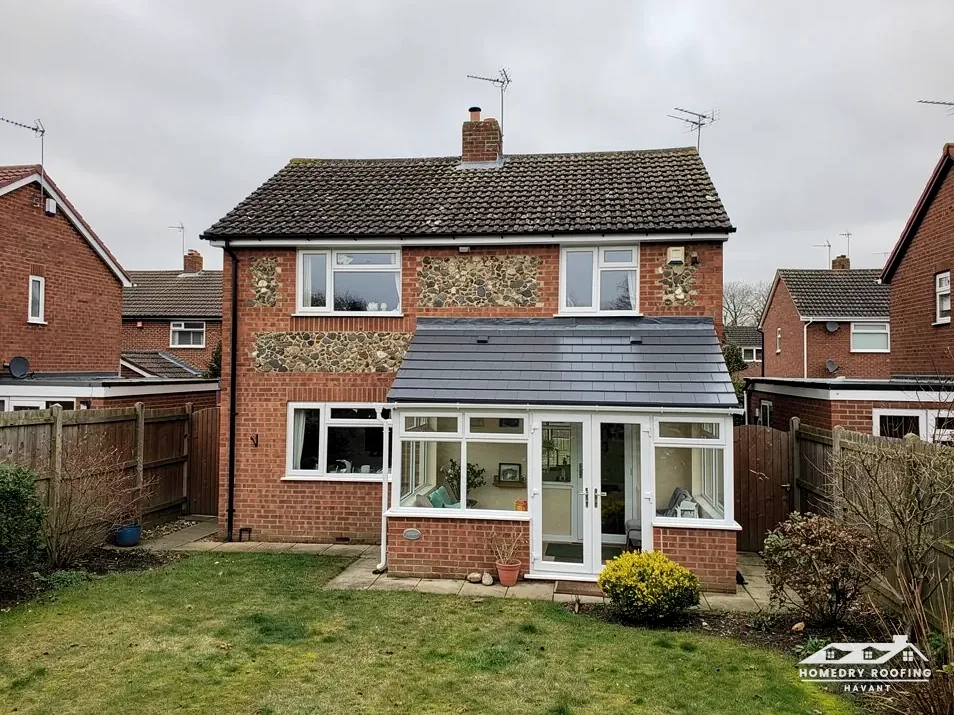
A new solid roof must comply with building regulations, so building control is asked before any price is given. Whether the exemption for small ground-level conservatories still holds depends on the wall, door or window that separates the room from the house.
A conservatory roof is a roof like any other, with a frame, a covering and joints at every edge, and the survey treats it so. For a polycarbonate, glass or solid covering we look at the seals along each glazing bar, the flashing where the conservatory roof butts against the house, the gutters and the eaves beam, and the inside face for condensation or staining. Rainwater from the glazing runs to the gutter along the eaves beam, so that beam is checked for softness too. HomeBuilding gives polycarbonate a typical lifespan of 10 years, and quotes Roofing Megastore's managing director saying a glass conservatory roof "will likely last in excess of 30 years". Our conservatory roofs page describes replacements.
A new solid roof on a conservatory must comply with building regulations. A ground-level conservatory of up to 30 m² with Part K glazing is exempt from the energy rules only while a wall, door or window still separates it from the house and the home's heating is not extended into it, so your building control body is asked before a solid roof is priced, and the reply is passed on in plain words.
Land near Coldwaltham falls in Flood Zone 3, according to the Environment Agency's flood map. That is a statement about the map and sets no rule for roofs. What it does make worth checking is where a conservatory gutter and its downpipe discharge, since a downpipe discharging at the brickwork can leave the base of the wall damp. Nothing here asks you to act on the map; the point is only that the water has a clear route away. We follow each pipe to its end and report where the water lands, and on any house the same visit notes any listed or conservation-area details that need their own consent steps.
A conservatory is a roof on a wall of glass.
Where a conservatory meets the house, the junction is the first place to read: the flashing on the wall above, the seal under it and the gutter below. We photograph the junction from the ladder and from inside the room, and the findings pair the two pictures, so you can follow the line water would take from the outside crack to the mark indoors. The pair makes the cause easy to explain to a neighbour or a buyer later.
Map of Coldwaltham and the places around it, with the dashed line of our 30-mile service area from Havant. The same places are listed below the map.
The survey starts at the top with the crown and the pots, then works down through the flashing at the foot of the stack and the pointing in the brickwork. From the loft, a stained chimney breast is matched to the section of stack above it, so the repair goes after the source and not the stain. Each stage is photographed, and the findings state whether the stack needs repointing, a new flashing or only a cleared back gutter, with a plain reason given for each choice. Pictures of the crown and the flashing sit beside the notes.
Coldwaltham sits within the South Downs National Park, and the South Downs National Park Authority decides applications for work there, dealing with them itself and not through a district council. Building control is different: it stays with the district council, since the Authority does not provide it. For a re-roof we ask your building control body which route applies and pass the reply on in plain words. Questions about dormers or other planning matters go to the Authority, while the national rules are in our planning guide. Nothing is assumed about your address until the answer is in, so that it is on record before work starts.
Three lie close to the village: Coldwaltham and Watersfield, which Horsham District Council lists, and Coldwaltham (north), which the South Downs National Park Authority lists. Whether a particular address falls inside one, or under an Article 4 direction, is a question for the Authority, and it should be put before any job is booked. Permitted development normally covers a straightforward re-roof even inside a conservation area, whereas dormers lose that cover, and an Article 4 direction can remove more. The Authority's reply goes into the survey notes, so the answer travels with your papers, and its own answer is the only one that counts. Asking early avoids a job being stopped halfway.
The Parish Church of St Giles is listed Grade II* (list entry 1027424) and holds Church of England services, so its roof work goes through the faculty system and not listed building consent. Ivy Cottage (list entry 1192070) and Widneys (list entry 1027420) are listed Grade II, and a house on the list needs listed building consent under section 7 of LBCA 1990 for anything affecting its character. Check your own entry first; we read it at the survey and describe the work so consent can be sought before a price is fixed.
The Planning Portal gives two limits: under 25 per cent of the building envelope and under 50 per cent of the roof. Inside both, re-roofing does not normally need a building regulations application. A covering heavier by 15 per cent or more needs approval, whatever the area. For a Coldwaltham house we ask your building control body which route fits before the job is priced, then give you the answer in everyday words. A written copy can be requested for your own file, and nothing proceeds until that reply is in.
Scaffold on a Coldwaltham pavement or road is licensed under section 169 of the Highways Act 1980, and West Sussex County Council is the licensing body. West Sussex County Council's fee is £266 for one month, with notice of at least 10 working days asked for ahead of the scaffolding going up. We arrange the licence with our scaffolder, and the dates are put to you for approval beforehand, so the start is one you have agreed. A longer stay than the licence covers needs a separate request, which we raise early, and no scaffolding goes up before the licence is in place.
A new solid roof must comply with building regulations, so building control is asked first. A ground-level conservatory of up to 30 m² with Part K glazing is exempt from the energy rules only while a wall, door or window still separates it from the house and the home's heating is not extended into it, and that decides whether the exemption holds. We look at the junction with the house wall and the gutter before suggesting any change, and the findings record what building control says, with photographs, filed so the reply can be found again.
One total, written once the roof has been surveyed and the notes are attached. It should state whether VAT and scaffold are counted, and what happens if hidden damage appears when the covering comes off. When another quote is silent on those points, ask for them in writing before the figures are weighed. Ours is a single written total after the survey, with a plain statement on repair or replacement and the reasons, and a repair preferred where one will last. The figure arrives once the survey is finished, never before, and prices are good and fair.
You'll get one written total price.
Fill in what you like. It opens WhatsApp with your message ready to send.