
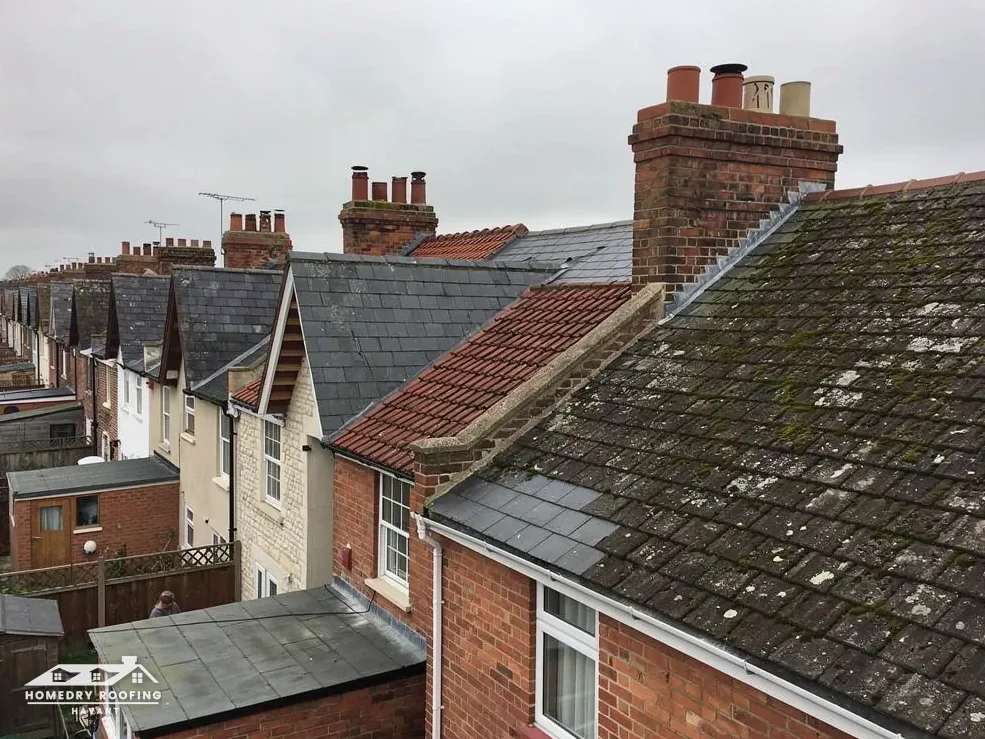
Chimneys
Where a stack climbs through a Pulborough roof and flashing must join brick to slope.
If that strip lifts or cracks, rain tracks down the breast and marks the room below.

Pulborough is 27.9 road miles east of Havant. A roofer climbs up, reads every join and gutter, and only then does a single price get put on paper for you.
10-year workmanship guarantee, in writing
Where a stack climbs through a Pulborough roof and flashing must join brick to slope.
If that strip lifts or cracks, rain tracks down the breast and marks the room below.
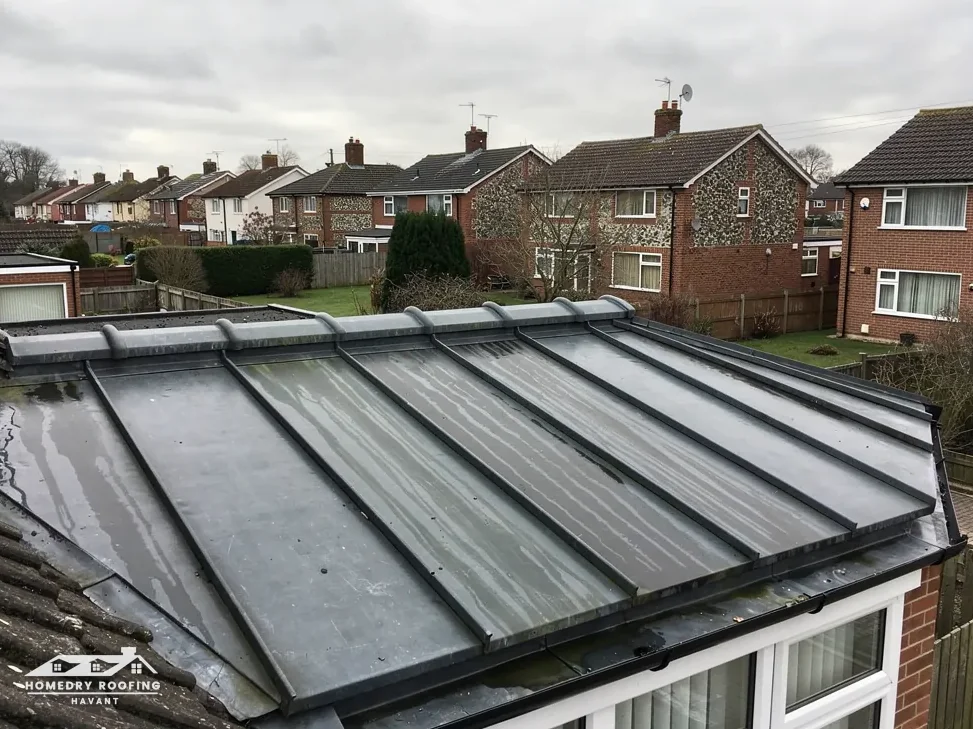
The V where two slopes meet and one channel carries the rain of both down to the gutter.
Leaves in that channel hold the water back until it works under the tiles at either side.
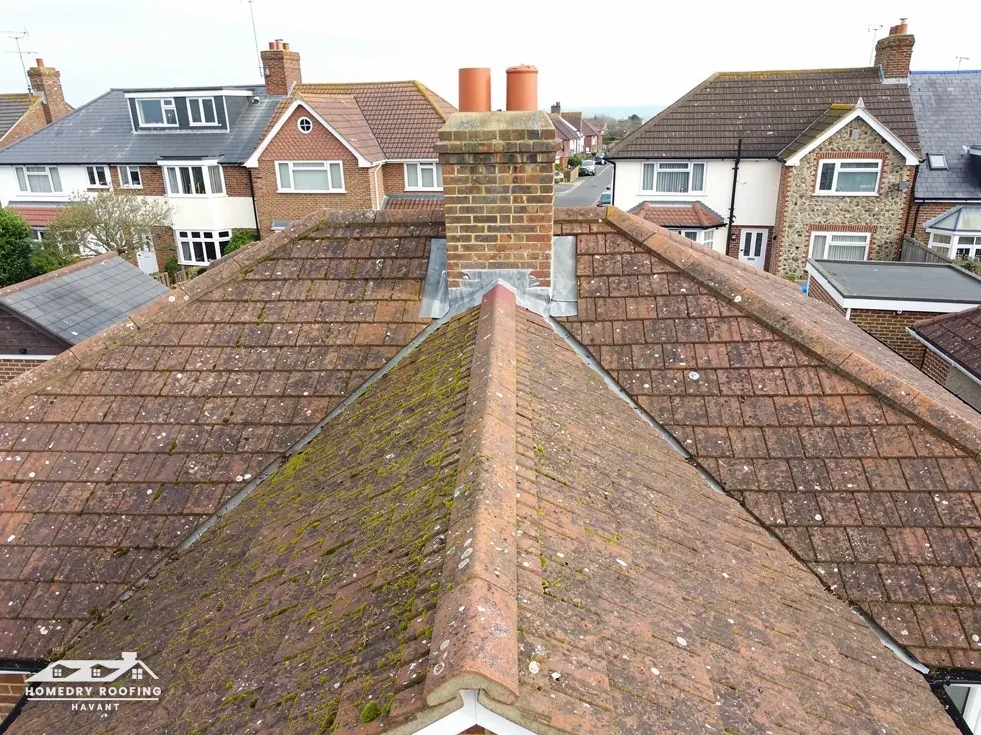
The lowest course of tiles, where the roof overhangs the wall and the gutter hangs beneath.
A board gone soft at that edge lets the gutter sag, and then spill down the brickwork.
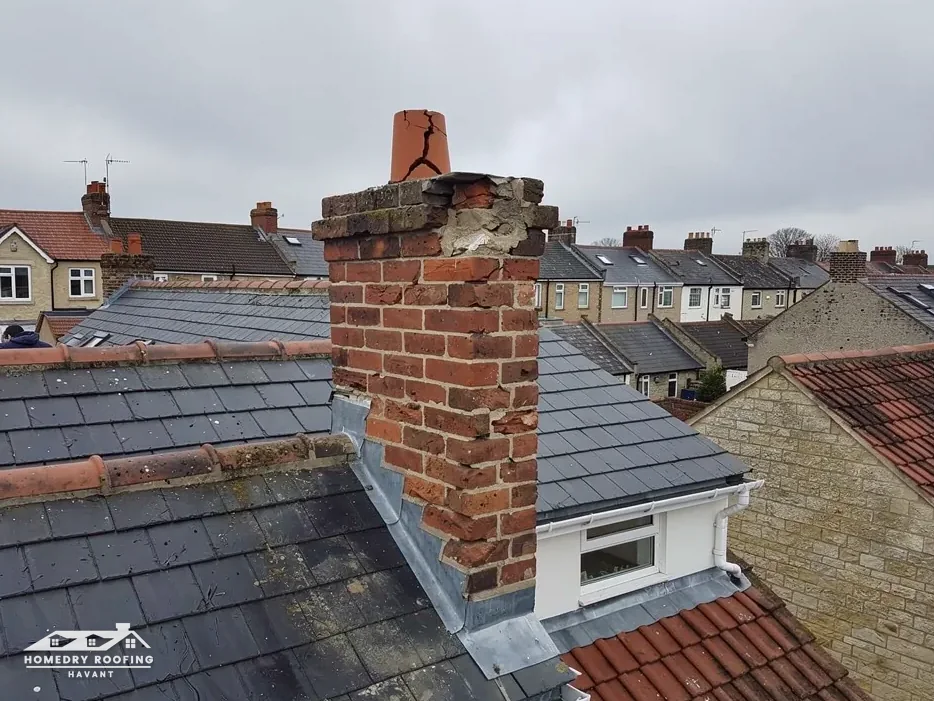
Rain can enter at the flashing, the mortar joints or the top of the stack, then run down inside the breast. The survey looks at all three before suggesting a repair, because mending the wrong one leaves the stain exactly where it was.
On a Pulborough roof we begin where the slope runs into something solid, because rain gathers at those joins. A chimney stack gets the closest look: the flashing, which is the strip of metal that bridges the tiles and the brick, the mortar that holds it in, the joints higher up and the pots on top. The valley, the inner crease where two slopes meet, carries the water of both, so its lining is followed along the whole run for splits and thin patches while the leaves are pulled out. Where a roof stops against a wall, the stepped lead along it must sit tight to the brick, and a lifted edge is photographed. See chimney repairs for the stack itself and lead roofing for the strips and linings.
Several Pulborough buildings carry National Heritage List entries. The Parish Church of St Mary holds the Grade I listing, while The Old House and The Rectory are both Grade II*. Historic England publishes each one in full. Church of England services are held at St Mary's, which puts its roof under the faculty system and not under the council's listed building consent, whereas a private house on the list needs listed building consent before any work that alters what makes it special. Old Swan Bridge is a scheduled monument, a separate protection with consent rules of its own.
Pulborough has two conservation areas, Pulborough (Church Place) and Pulborough (Lower Street), and Horsham District Council holds their maps. Horsham District Council's Article 4 list also includes a direction, reference ART4043, for land south west of Swan Bridge on London Road; such a direction can strip away further permitted development rights, so check with the council before you plan anything at all. Our planning guide for roof work covers the national rules.
Every join between two parts of a roof is a place to look.
A chimney is a tall, cold column standing in the middle of a warm roof, and every joint around its base is a place for water to turn into the house. We photograph the flashing, the mortar and the top of the stack, and inside the loft we check the breast for damp. Pointing and flashing are put right before anyone talks about capping or rebuilding anything, and each step is photographed so the order of work is clear.

Water that cannot leave the roof stays in the house.
Eaves come last on the route of the rain, which is why a Pulborough survey spends time there. We run a hand along each gutter for sag and loose brackets, watch the joints for drips, and look for green or dark streaks on the brickwork, which say the gutter has been spilling for a while. Behind the gutter sit two boards: the fascia, which it hangs from, and the soffit, the lining beneath the eaves overhang. We press both for softness, because a rotten board cannot hold a gutter however many new brackets are screwed to it. See guttering, soffits and fascias for what replacement involves, and for how each part is fitted to the next.
Downpipes get the same look from top to bottom. A pipe discharging against a wall, a joint that has come apart, or a gully choked with silt will each put water where it should not be. At the point where the pipe meets the drain we make sure the water can actually get away, and where it cannot, the findings record it with a photograph. Water that cannot leave a roof is how a dry wall becomes a damp one, and the stain inside may sit well away from the fault outside. That is why the survey follows the whole route and not just the spot you pointed to, and why a ladder goes up at the back of the house as well as the front.
Any scaffold that has to stand on the pavement or the road in Pulborough needs a highway licence from West Sussex County Council. We arrange the licence with our scaffolder, so no application lands on you. Afterwards you are sent one written total price, with the survey notes enclosed. Once the job is done the site is left swept clean.
A gutter that spills does not announce itself on a dry day. Its evidence is a stain on the wall below and a green streak running down from a joint. We look for both before we go up, because they reveal the route the water has been taking, and the spacing of the brackets can explain why. The findings say whether a mend will do or whether a longer run needs replacing.
Green streaking on the brickwork below a joint, or a patch of damp on a ceiling beside an outside wall.
A gutter joint that has come apart, or a dropped bracket, so the water spills over the lip instead of reaching the pipe.
Map of Pulborough and the places around it, with the dashed line of our 30-mile service area from Havant. The same places are listed below the map.
The stack is read from a ladder and from inside. Outside, we study the flashing where metal meets brick, the mortar joints, the crown (a cap of mortar across the top of the stack) and the pots. Inside, a torch on the chimney breast in the loft shows damp or a dark tide line. Rain can come in at any of those places, so a repair that treats only one is a guess. The findings name the point of entry, show it in photographs, and say whether re-pointing, a new flashing or something larger is needed, before any figure is written.
Two limits come from the Planning Portal: less than 25 per cent of the building envelope, meaning the whole shell of the house: walls, floor, roof, windows and doors, and less than 50 per cent of the roof. Re-roofing that stays below both can go ahead without a building regulations application in the normal run, but a covering 15 per cent or more heavier brings approval into play. On a Pulborough address the first step is to raise the matter with your building control body. We then pass on the reply in ordinary words, with a copy if you want one, and the choice of next step stays yours.
A licence is required under section 169 of the Highways Act 1980 for any scaffold erected over the road or the pavement, and in Pulborough that falls to West Sussex County Council. West Sussex County Council lists £266 for one month of scaffolding and requires at least 10 working days of notice. Start dates are therefore planned around that wait. We arrange the licence with our scaffolder, so the paperwork is not left for you to chase. Where the scaffold would stand is noted at the survey, since only what goes up on or over the highway comes under a licence, and you see that picture before anything is booked.
St Mary's is Grade I listed and still holds services. A Church of England church in use goes through the faculty system rather than listed building consent, so its roof is dealt with that way. The route differs for a private house on the National Heritage List, which needs listed building consent before anything affecting its special character is changed. The Old House and The Rectory, both Grade II*, are entries of that sort. Each entry is published by Historic England, so you can read your own and see exactly what is protected at your address.
Pulborough has the Pulborough (Church Place) and Pulborough (Lower Street) conservation areas, and Horsham District Council is the body to confirm whether an address sits inside either one. The council's data also lists Article 4 direction ART4043, for land south west of Swan Bridge on London Road, and a direction of that kind can withdraw permitted development rights, so check with Horsham District Council about your road and its reply can be copied into the survey notes. Parts of the land around Pulborough may also lie within the South Downs National Park, which is one more reason to check the address before work is planned.
Some land near Pulborough shows as Flood Zone 3 on the flood map the Environment Agency publishes, though that says nothing about Pulborough as a whole, and since the map covers ground and rivers, it sets no rule for roof work. You can look up your own address on it in a couple of minutes, and a cautious owner will want to. Where a roof does connect to the ground is the rainwater, so we trace every downpipe to its drain and note any that spill against a wall, which is a check worth making wherever the house stands, with the result noted in the findings.
Leaves in the outlet, a joint that has come apart, a bracket that has dropped or a length whose fall has gone can each cause it. Brett Martin advises a fall of 1 mm for every 600 mm towards the outlet, and a sagging gutter can lose that. From the ladder we see which of the four you have, then check the fascia behind it, because a bracket will not stay in rotten timber. The findings say whether clearing, re-fixing or replacing is the sensible step, and a photograph of every fault, so what is described can also be seen.
A repair suits a covering that is still sound where the fault is local: a slipped tile, a lifted flashing, a cracked cap. Re-covering suits a slope where the covering has worn through, where battens have rotted, or where a repair would be one of many patches on the same stretch. Which of the two applies to your roof is set out in the findings, with photographs and a reason, and where either would work, the repair is offered first. The written total price arrives as a single figure, so there is nothing to add up, and the survey notes sit behind it as the explanation.
You'll get one written total price.
Fill in what you like. It opens WhatsApp with your message ready to send.