
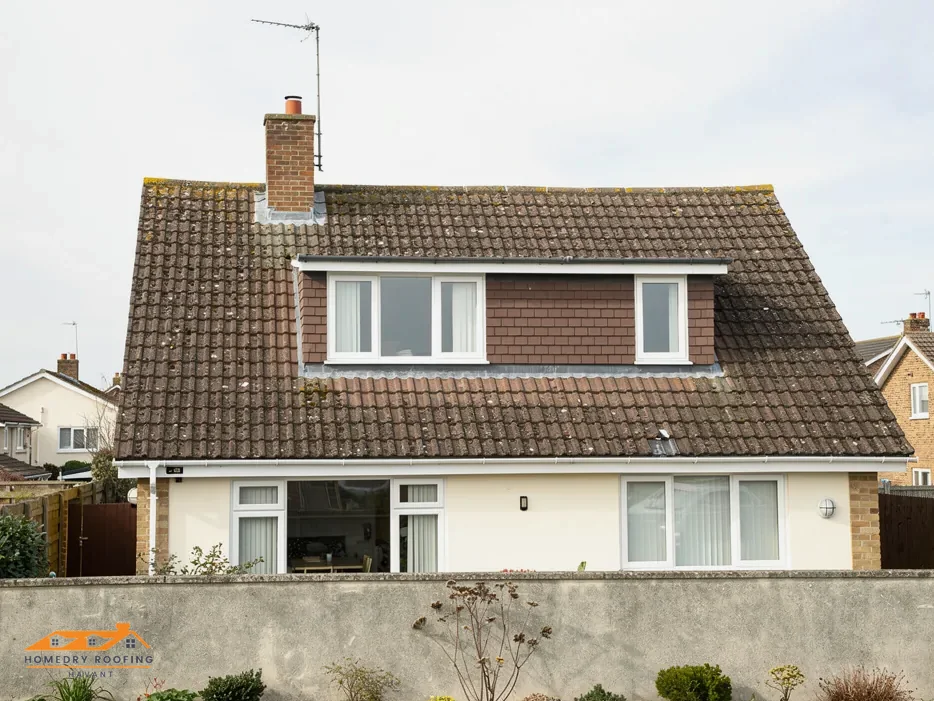
Underlay
Where the membrane beneath the covering catches whatever gets past the top layer.
A torn or sagging sheet lets water reach the battens and the rafters.

Loft-led surveys, roof repairs, porch roofs and re-roofs in Buriton, 12.8 road miles north of Havant, inside the South Downs National Park and followed through to a written price.
10-year workmanship guarantee, in writing
Where the membrane beneath the covering catches whatever gets past the top layer.
A torn or sagging sheet lets water reach the battens and the rafters.
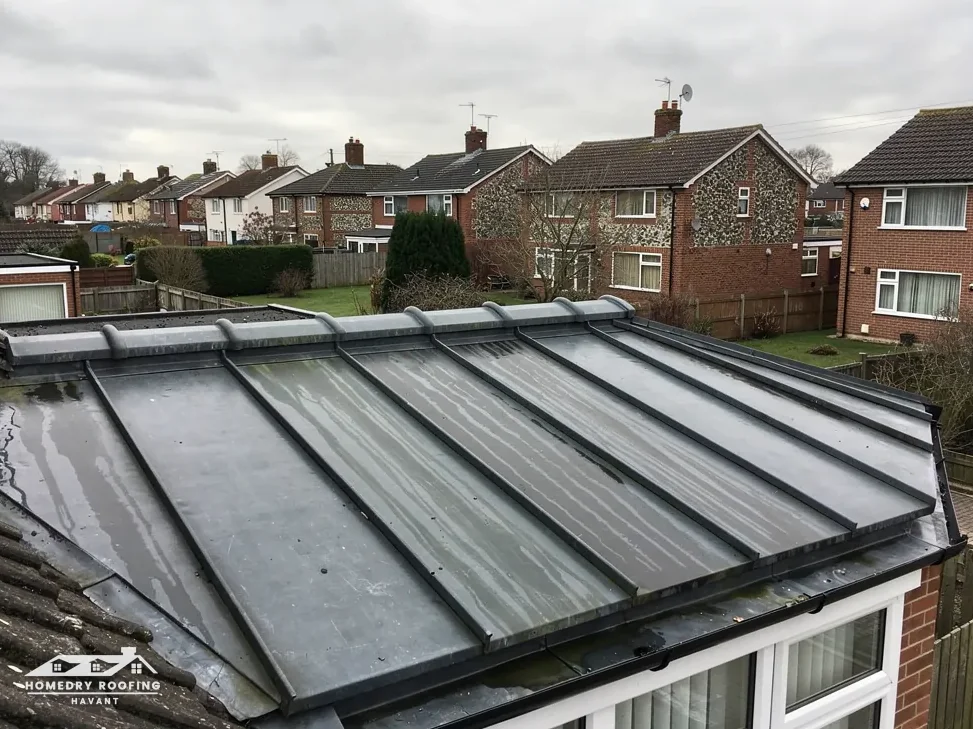
Where a small roof over a door or bay butts against the main house wall.
A lifted flashing at that line lets the wall shed water behind the cover.
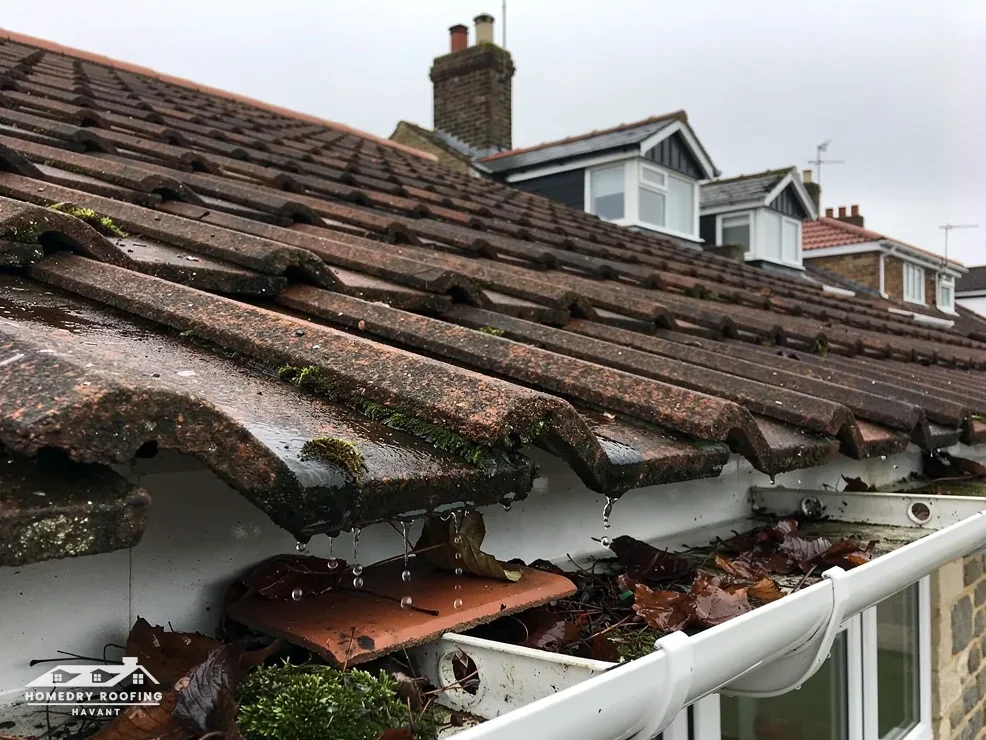
Where a run of channel on the fascia carries roof water to a downpipe.
A dropped section holds a pool and spills it over the back of the board.
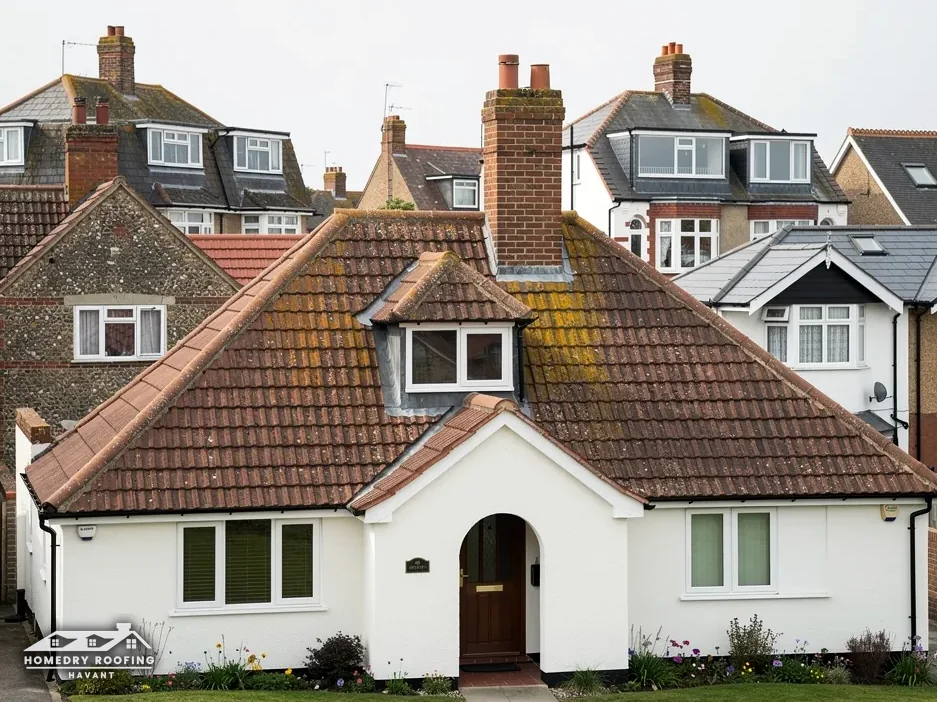
It is a membrane laid over the rafters and under the battens. Wind-driven rain and meltwater can pass the covering, and the underlay catches that and sends it down to the gutter, so a torn or sagging sheet matters even when the covering looks tidy.
The evidence for a roof fault sits on the underside of the covering, so a Buriton survey spends as long in the loft as it does on the slope. Beneath the tiles or slates lies an underlay, the membrane that catches what the covering lets through, and under that the battens that carry the covering and the rafters that carry everything. We look for daylight through the covering, for an underlay that has torn or sagged between rafters, for battens that have gone dark or soft, and for rafter feet stained at the wall plate. A roof can look sound from the garden and still be passing water onto the timbers, which is why the written findings describe the loft before the slope, and why a dry loft counts as good news for the covering above it. Our roof inspections page explains how a visit runs when the aim is a condition report and not a repair.
Buriton lies inside the South Downs National Park, which makes the South Downs National Park Authority the local planning authority here. East Hampshire District Council processes applications here for the Authority unless a case is called in, and building control remains a district council service, which the Authority does not offer. East Hampshire District Council also keeps the record of the Buriton conservation area. Our planning guide for roof work sets out the rules, and the council can confirm what applies at your address.
The National Heritage List holds Grade II* entries for the Church of St Mary, The Old Rectory and The Manor House. For a listed house, listed building consent is needed for anything that affects its character, and a Church of England church in use takes a different route through the faculty system. The same survey method applies to all of them, and the findings are written for whoever needs to read them next.
Looking from beneath shows what the slope has already let through.
Cracked tiles or a streaked ridge catch the eye from the garden, but they only describe the surface. The underlay and the timbers describe what has actually happened to the roof over the years, and they are where a stain is explained. That is why the visit starts inside, with a torch, and why the findings put what we saw in the loft ahead of what we saw from the ladder.
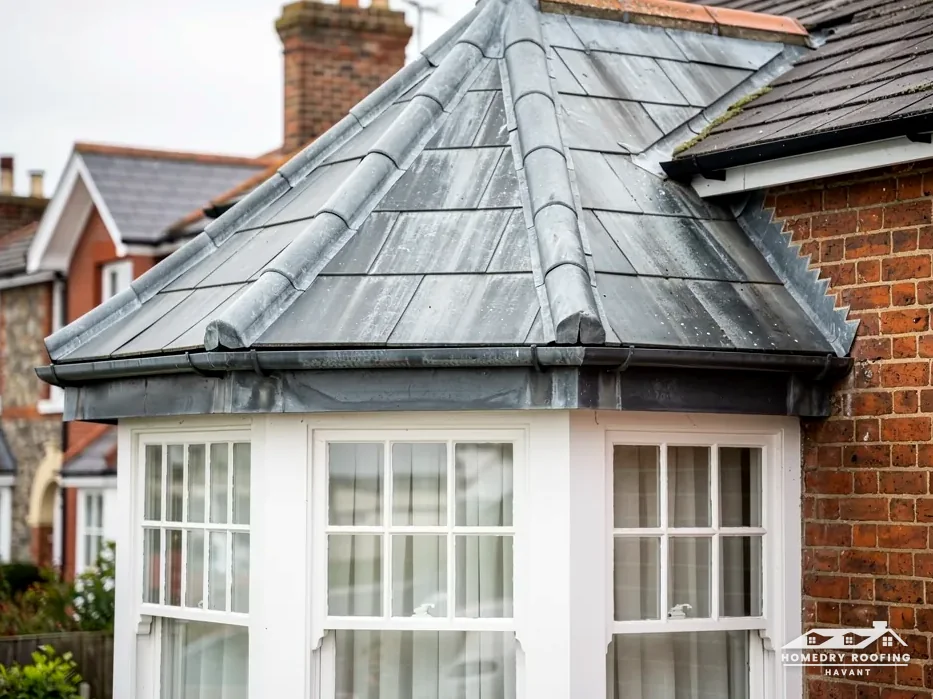
A stain over the front door can come from the porch roof or from the roof above it.
Small roofs meet the house along big joints. A porch roof, a bay window canopy or a lean-to against a side wall each finishes where its covering meets a vertical wall, and that line of contact lets the wall shed water down behind the covering if anything has lifted. We look at the flashing where the small roof butts the house, at the cover along its sides, at the sill or threshold above, and at the gutter that serves the slope. Where lead dresses the junction, we check its length, its laps and its fixings. Where a flat roof covers the porch, we look at the surface, the edge trim and the outlet, which is the opening where the water leaves.
Our leadwork page describes how flashings are dressed and fixed, and our flat roofing page covers the membranes laid on flat porch roofs. If the house is listed, the choice of material is a matter for the consent route, so we write the survey to show what is there and what it needs, and the choice follows from that. Grade II* entries for two houses and a church stand on the Heritage List here, and each has its own route.
A stain on a porch ceiling, a damp patch on the wall above the door or a lining that is darkening at the top are the signs to look for inside. We work out whether the water came from the small roof, from the gutter above it or from the wall itself, because the three need different repairs, and the findings state which one the evidence supports. A repair at the wrong place only moves the damp somewhere else, and the owner pays twice. Photographs of the junction, taken close up, go with the findings so the evidence is in your hands.
A porch sits under the main roof, so a stain over the front door can belong to either one. Water from the main slope can run behind the small roof's flashing and drip onto the porch ceiling, and the porch roof is then blamed for a fault it does not have. Tracing the line from the stain up to the junction answers the question before anybody is asked to pay for the wrong repair.
A brown mark on the porch ceiling, damp on the wall above the door frame, or a lining darkening at its top edge.
A flashing that has lifted at the wall line, a covering cut short at the side, or a gutter that spills behind its board.
Map of Buriton and the places around it, with the dashed line of our 30-mile service area from Havant. The same places are listed below the map.
The loft shows what has already gone through the roof. Daylight where it should not be, an underlay that has torn, battens that have darkened and rafter feet that are stained all describe the history of a fault, while the slope shows only its present state. We take photographs from the hatch and set them beside the outside findings, so a stain on a ceiling is explained by evidence on both faces of the roof. If the timbers are dry and the marks are old, we tell you that too, and no work is proposed for a fault that has stopped. A dry loft under a tired-looking slope is a perfectly good result.
The village sits within the South Downs National Park, and the Park's own Authority holds the planning role. East Hampshire District Council handles applications for the Authority unless a case is called in, and building control stays with the district council. The Authority's own enquiries page tells people in this delegated area to contact their local authority, so for a Buriton address put a planning question to East Hampshire District Council, using your full address. Our planning guide sets out what the rules say about roof work, and nothing on this page replaces the council's answer for your house, so keep its reply with the other papers for the job.
Yes. Building control is the district council's job here, and the National Park Authority does not provide it, so the Park makes no difference to that part of the process. Under the Planning Portal's guide, re-roofing does not normally need a building regulations application if it affects less than 25 per cent of the building envelope and less than 50 per cent of the roof; a new covering 15 per cent or more heavier does need approval. East Hampshire District Council's building control service takes application queries and inspections on 01730 234207, and we check the route with it before work begins, then tell you what it says in plain words.
Where the scaffold stands on the highway, the licence comes from Hampshire County Council, which licenses scaffolding on the highway at £211.90 on application for the first 2 weeks and £72 for each additional 2-week period, needs ten clear working days' notice, and says scaffolding companies must apply on behalf of their customers; we arrange it with our scaffolder. Nothing is erected until the licence is in place. The programme you receive allows for the notice, and the width of the road is considered when the position of the poles is planned, so passers-by and traffic can still get through.
It means those two buildings have list entries, and nothing automatic follows for any other house in the village. The Old Rectory and The Manor House are both Grade II*, and so is the Church of St Mary. If your own house is listed, listed building consent is needed for anything that affects its character, even though listed homes keep their permitted development rights for roof work. The Authority is the planning authority here and East Hampshire District Council handles applications for it, so check with the council before you plan work to a listed house.
The Church of St Mary carries a Grade II* listing and is a working Church of England church, which sets it apart from a private house. Any works to it pass through the faculty system of the Church of England, in place of listed building consent. A listed house follows the other route, and a private owner has no faculty to seek. We record what we find on any roof in the same way, from ridge to drain, and hand the findings to whoever is responsible for a building that follows either path.
Ordinary re-roofing is normally permitted development even in a conservation area, and an Article 4 direction can remove further rights. Buriton has a conservation area in East Hampshire District Council's area, and the council's Article 4 list names no direction for the village, which is not an answer for your own street, so check with East Hampshire District Council. The boundary decides whether your house is inside, and the council can confirm it for your address. Our planning guide gives the wider picture, including where each rule comes from.
One written total for the whole job, with the work, the covering and the finish described, and a plain statement of whether VAT and the scaffold are part of the figure. The survey findings arrive with it, so you can see which fault each part of the job answers, and a quote that lacks them is harder to weigh against ours. Pricing is kept good and fair, and the site is left clean at the end. If any part of the description is unclear, we will go through it with you before you decide anything.
You'll get one written total price.
Fill in what you like. It opens WhatsApp with your message ready to send.