
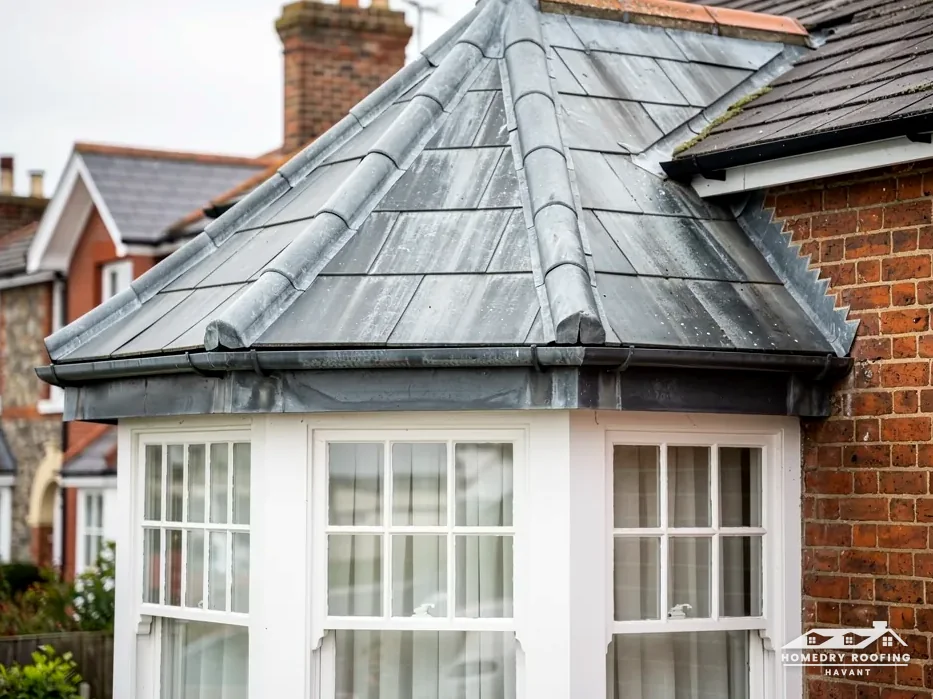
Abutments
A slope running into a masonry wall, closed by a single strip of lead.
Once an edge of that strip lifts, rain runs behind it and down the wall.

Wall joins, lead flashings and gutters in East Meon, 14 road miles north of Havant, each one traced to the spot the rain enters, with one written total price after that.
10-year workmanship guarantee, in writing
A slope running into a masonry wall, closed by a single strip of lead.
Once an edge of that strip lifts, rain runs behind it and down the wall.
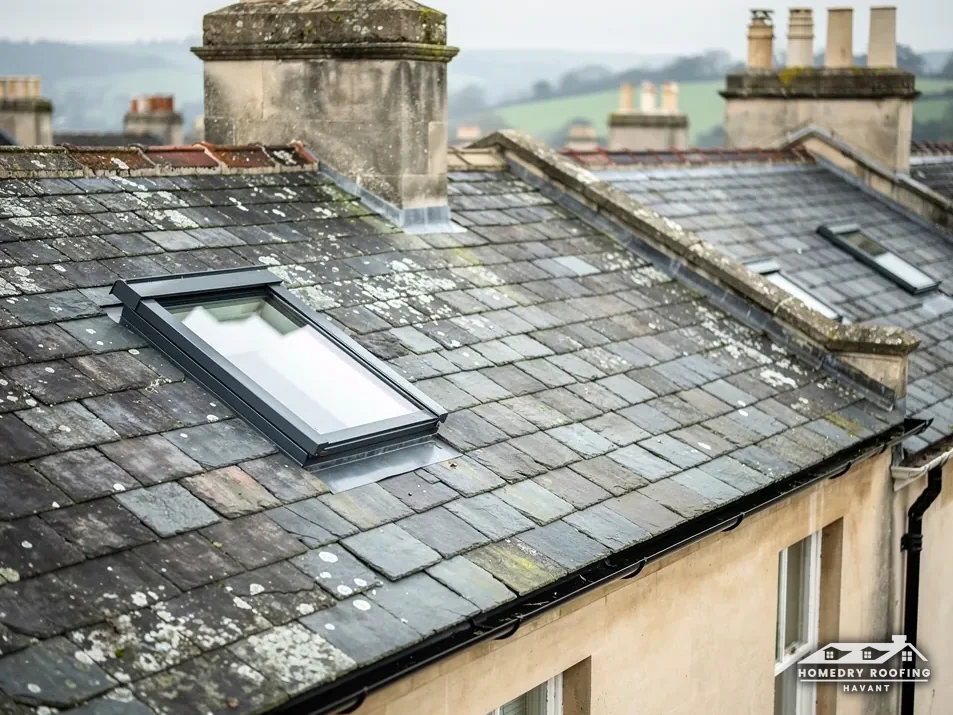
Where a dormer side meets the slope and the flashing must hug the frame.
A stain beneath a window can start in the roof above it, not in the glazing.
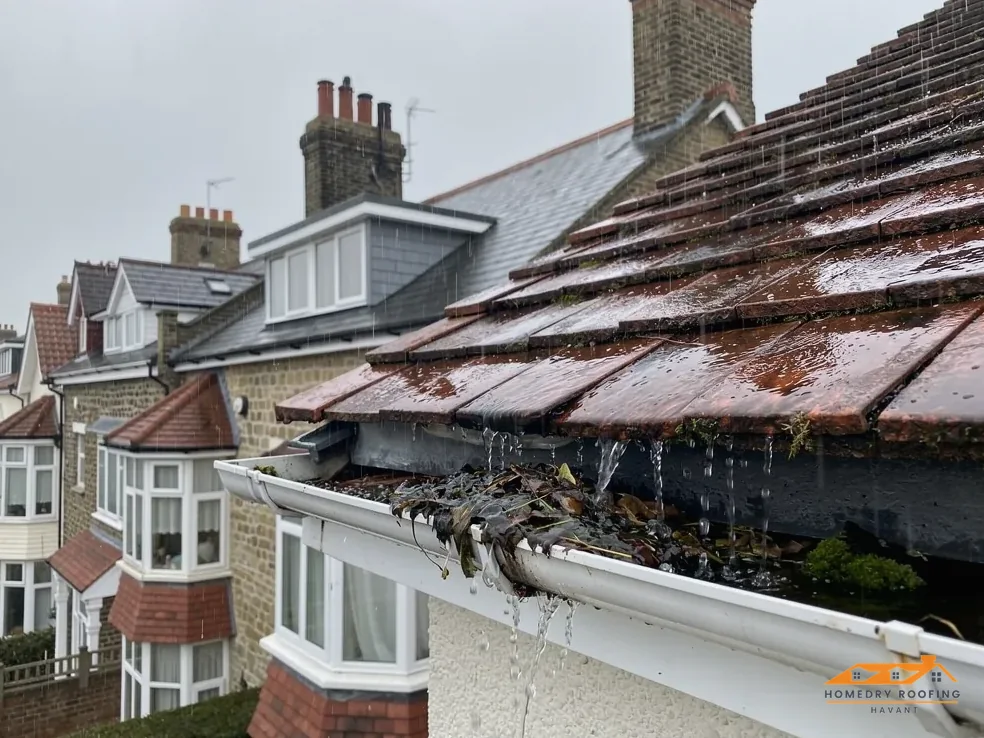
Where a gutter hands on its load and a pipe carries it down to the ground.
A pipe that ends against a wall sends the roof's rain straight back at the house.
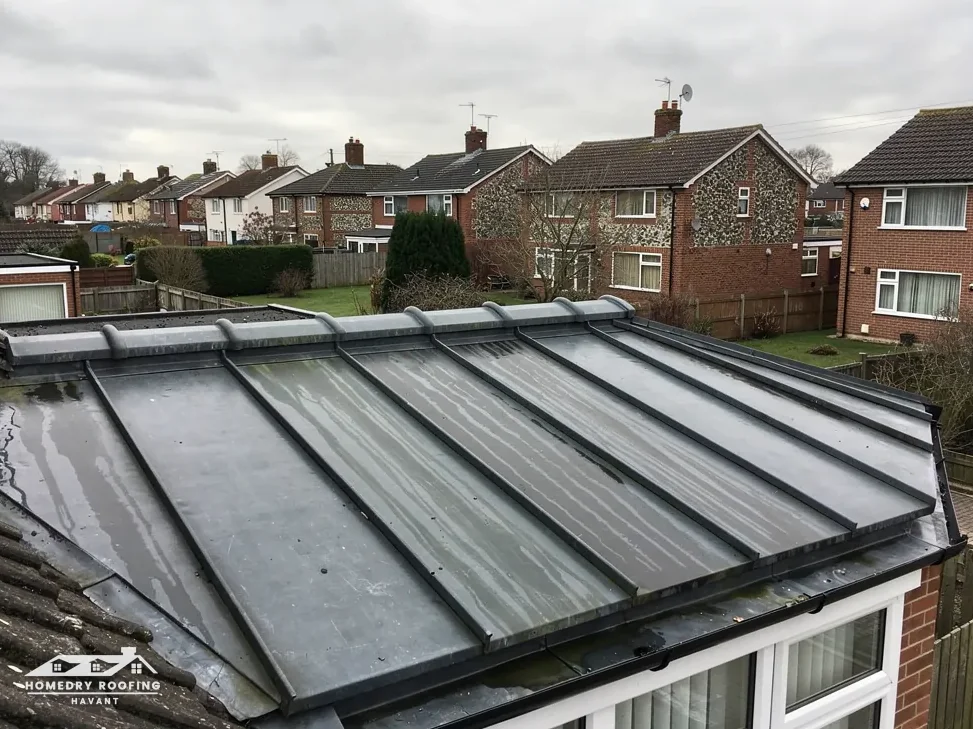
Lead, fixings and pointing fail separately, so a wall join is read in three parts.
East Meon work starts at the joins. Where a slope ends against a wall, the weather seal is a strip of lead stepped up the masonry, tucked into a cut and closed with mortar, so the survey reads three things: the metal for splits and lifted edges, the fixings holding it down, and the pointing above for gaps. A mark indoors may lie a long way from the faulty join, so the loft timbers get traced as well, back towards that join. Our lead roofing and leadwork page explains the metal, and roof repairs covers what a mend involves.
The National Heritage List holds Grade I entries in East Meon for the Church of All Saints and for The Court House, and a Grade II* entry for Glenthorne and Forecourt Rail. Because the Church of England still uses All Saints for worship, roof work there is a faculty matter rather than a listed building consent one. A private house is a different case: if the list names it, works touching its character need listed building consent, and the entry under your address tells you where you stand, so look it up before booking a date.
East Meon sits within the South Downs National Park and has a designated conservation area. A planning application here is processed by East Hampshire District Council on behalf of South Downs National Park Authority, the planning authority, unless the case is called in. Building control stays with the district, through East Hampshire District Council's building control service on 01730 234207. Ask East Hampshire District Council, before booking, whether an Article 4 direction touches your road. Our planning guide for roof work holds the roof rules, which this page does not repeat.
Damp on an East Meon bedroom wall may start several rafters away from where it shows, since rain can travel along metal and timber before it drips. Working back from the mark through the loft gives us the route, each stage is photographed, and the mend goes to the entry point, never just to the damp patch you can see indoors.
A tide-mark across the ceiling beside an outside wall, returning after each wet spell and fading in between.
One step of lead that has lifted, or open pointing over it, letting rain slip behind and reach the masonry.

A roof's rain is dealt with only once a drain has taken it. A pipe that stops short, a gully clogged with leaves or a path that slopes towards the wall can undo a good roof, so those points are checked and written into the findings.
Below the slope the rain becomes the gutter's load, so an East Meon survey walks each run along its whole length. Falls, joints and brackets are tested, and so is any section sagging far enough to keep water standing in it. A gutter that overflows at a corner is blamed on heavy rain when a hopper clogged with leaves, or a joint that has opened, is the cause. Fascia and soffit boards sit behind the run, and a screwdriver tip pressed against them shows soft timber. Our gutters, soffits and fascias page explains what can be done, whether one bracket or a whole new run.
Attention stays on the pipe right down to the ground. A pipe that stops against a wall, or empties onto a path falling towards the house, sends the roof's rain back to where it started. Flood Zone 3 appears on the Environment Agency's flood map for land near East Meon. That concerns ground and not roofs, and no roofing requirement comes from it, but it is a fair prompt to follow every pipe to its end and record what we find. An East Meon survey therefore finishes at the drain.
By the end of the visit you know if the roof can be mended or needs a new covering, and you know why. A mend is the first choice if battens and tiles are in good order; covering again is described by what is wrong with them and with the details around them. Ladder and loft photographs sit with the report, so you can look at every named fault before any decision. One written total price follows, and we sweep the garden and drive when the work ends. Where a gutter run is the whole fault, the job stays a gutter job.
The survey ends where the downpipe does, at the drain and not the gutter.
Fascia timber that dents under a fingertip, or brown staining along a soffit edge, means the run above has been wetting those boards for some time. The cause may be a joint that drips, a bracket that has let the gutter tilt, or tiles that overshoot the wrong way. The report names the cause, so new boards never go up under an old drip.
It checks three things in turn: the stepped lead along the join, the fixings that hold the lead down, and the pointing above it that keeps rain from running behind. We look from the roof and then from the loft, because a stain inside can show up far from the entry point. An edge that has risen needs only a modest repair to lead and mortar, whereas a lengthwise split means new lead on that section. You receive the findings in writing with photographs of the join, and mending is offered before replacing wherever the lead and the timber under it are sound.
Both can come up, and each has its own answer. Two figures come from the Planning Portal: an East Meon job under them, at less than 25 per cent of the building envelope and less than 50 per cent of the roof, can as a rule proceed without a building regulations application. Separately, a covering 15 per cent or more heavier needs approval. In East Meon the building control side is East Hampshire District Council's building control service, on 01730 234207. Planning is a separate question, because South Downs National Park Authority decides it here, so start with our planning guide for roof work.
Where scaffolding overhangs the pavement or road, a licence is needed under section 169 of the Highways Act 1980, and in East Meon the licensing body is Hampshire County Council. Hampshire County Council charges £211.90 on application for the first 2 weeks and £72 for each additional 2-week period, and the council wants ten clear working days' notice ahead of the licence start. Hampshire County Council's page says: "Scaffolding companies must apply on behalf of their customers." We arrange the licence with our scaffolder, and you see the likely dates before an application goes in, so poles stay up only while the work needs them.
An entry on the list protects the one building it names. As a Grade I building in Church of England use, the Church of All Saints has its work decided under the faculty system, and the council's listed building consent plays no part. Whether a house nearby is listed in its own right shows on the National Heritage List, where each entry names what it covers. If your house has an entry, listed building consent applies to works that affect its character, and re-roofing can be one of them, so read the entry, and ask the council first, before materials are bought.
East Meon lies within the South Downs National Park, which makes South Downs National Park Authority the body that decides planning. East Hampshire District Council handles the applications for it, except called-in cases, and building control stays with the district council. The East Meon conservation area is designated, and East Hampshire District Council is the one to tell you if your address lies inside it. The same council is also the one to ask whether an Article 4 direction touches any one road, before work starts. The roof rules get fuller treatment in our planning guide, so start there.
The zone changes nothing about the roof itself. Land near East Meon sits in Flood Zone 3 according to the Environment Agency, and the zone concerns the ground, not the way the slope is laid and fixed. It does point us at what happens under the eaves: the place every pipe discharges, whether a gully is blocked, and whether the roof's rain has anywhere to go. Those observations join the roof findings in the report, each with a photograph, so you can see the ground as well as the slope. Anyone who wants the flood map for a particular address can look it up with the Environment Agency.
Yes, if the only trouble is an edge that has risen or some slack fixings. MyJobQuote says lead flashing that is correctly installed can last for over 80 years, which makes good lead worth saving. A split, or metal worn thin, is different, as the photograph will show. In that case we renew the affected section of the join and repoint above it, and we do not hide the fault under sealant, because sealant leaves the split in place. You see the photographs before deciding, and the sound lengths either side stay where they are.
You get the findings in plain English, plus roof and loft photographs of each fault. The figure, one written total price, arrives once surveying has finished, and it spells out whether VAT and scaffold are included, which makes it easy to hold against any other quote. A sound repair comes first in the quote; a new roof appears only where the survey calls for one. Prices are kept good and fair, and when work finishes the site is swept clean. Nothing is priced from the ground. A second fault gets its own paragraph in the findings.
You'll get one written total price.
Fill in what you like. It opens WhatsApp with your message ready to send.