
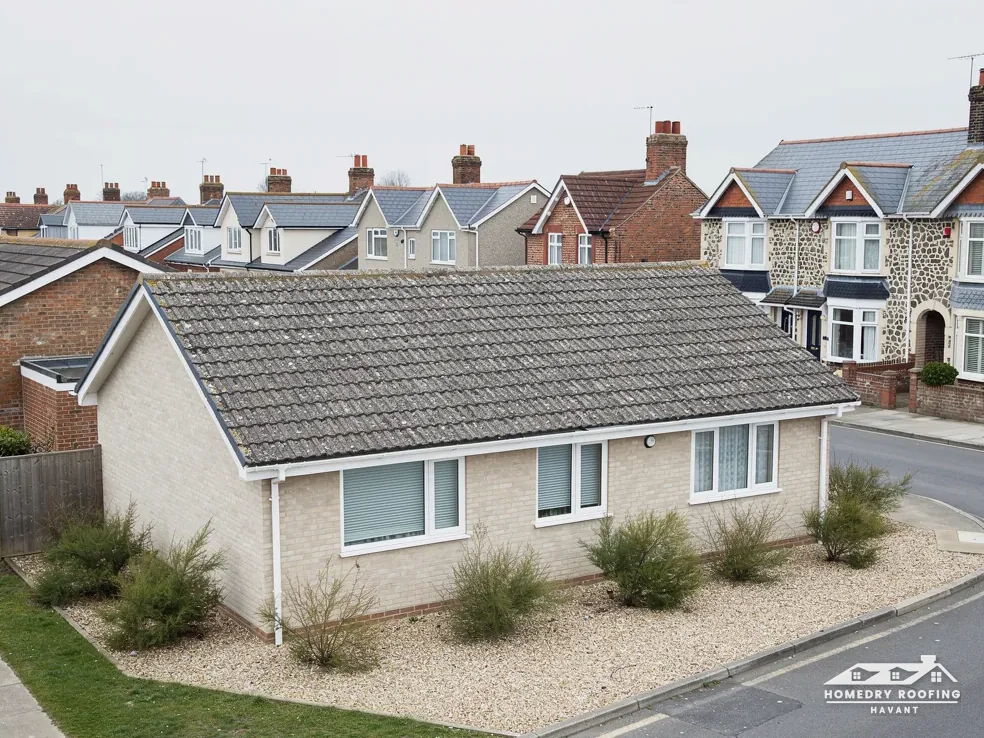
Ridges
Where the highest line of a roof joins its two slopes and capping tiles cover the join.
A cracked bed or a slipped cap lets rain into the roof space below the line.

Ridges, hips and flat extension roofs in Petersfield, 14 road miles north of Havant, surveyed from the crest down to the outlet, with a single written total to follow.
10-year workmanship guarantee, in writing
Where the highest line of a roof joins its two slopes and capping tiles cover the join.
A cracked bed or a slipped cap lets rain into the roof space below the line.
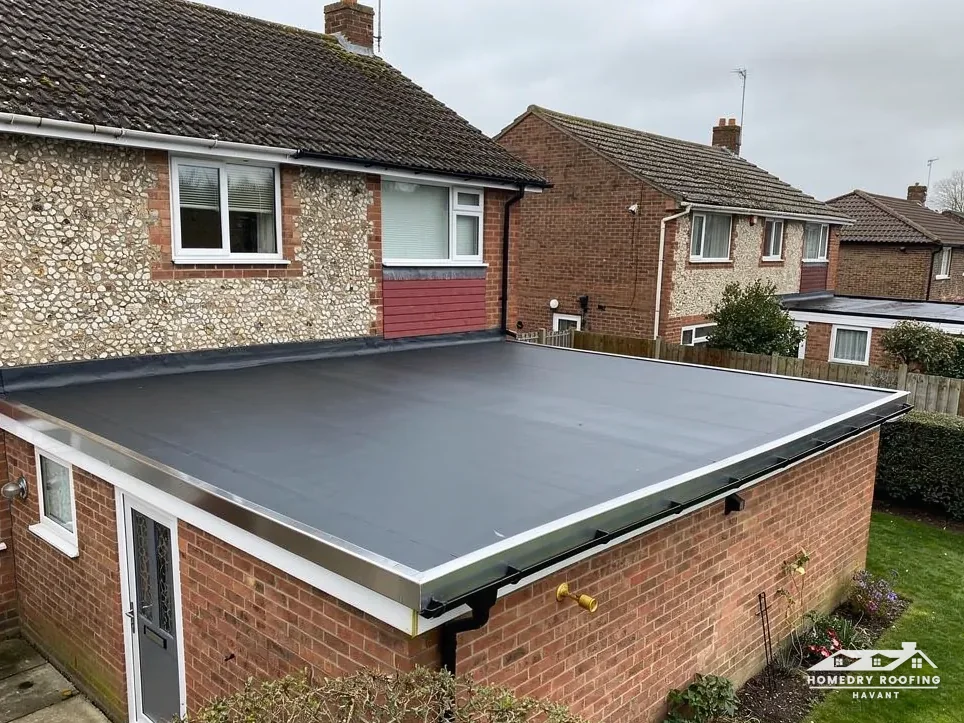
Where a flat extension roof is turned up a house wall to stop rain running behind.
A split at the turn-up shows on the ceiling inside, well away from the wall.
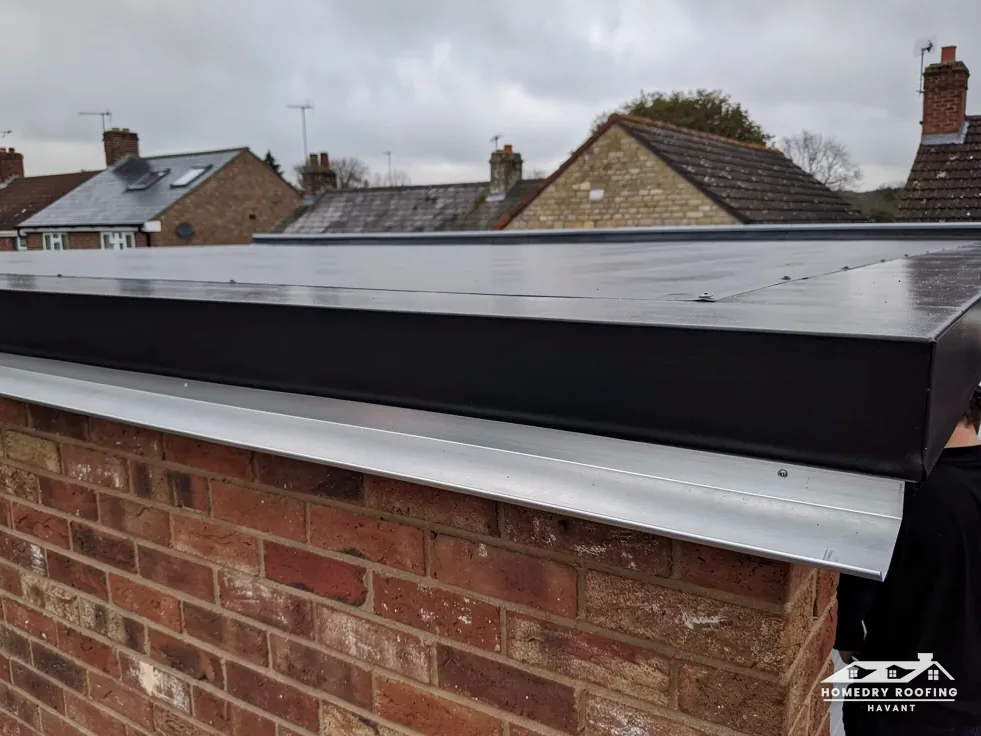
The spot at which a flat roof empties: a gutter, a hopper or a pipe through the edge.
Leaves and grit in the throat leave a pool on the surface after every shower.
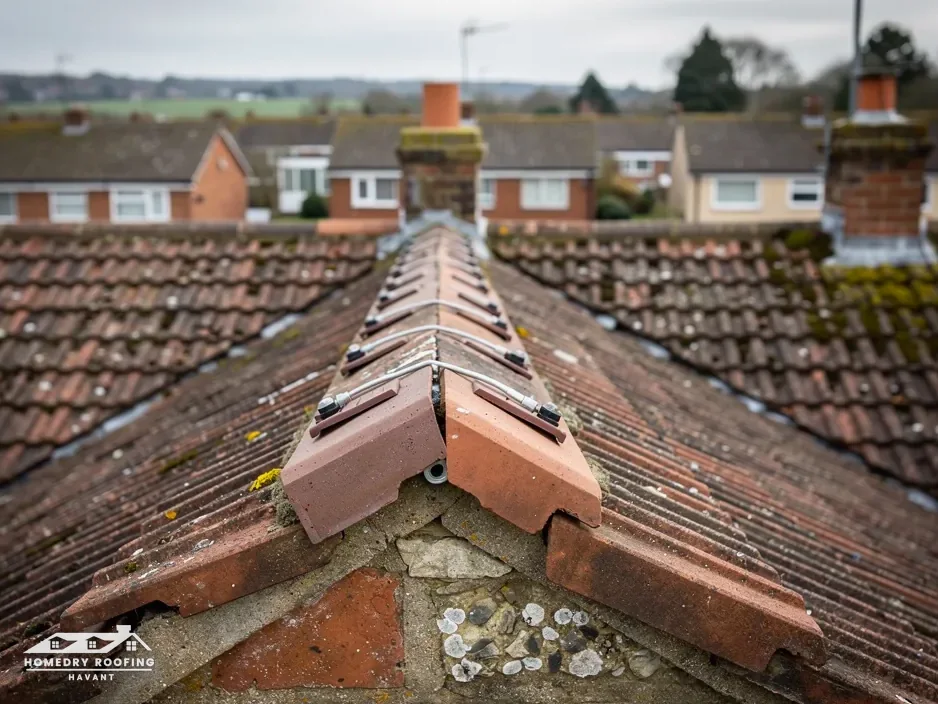
Yes, where the tiles either side and the fixings beneath are sound. We check the neighbours before agreeing to it, because one cracked cap can mean a bed that has loosened along a longer stretch, and the report says which case yours is.
Two slopes join at the high line of a pitched roof, and ridge or hip tiles close that meeting along its length. In Petersfield the walk along that line looks for cracked or slipped capping tiles, for gaps in the bedding beneath them, and for the clips or screws that hold each tile in place. Hips get the same reading from the crest to the eaves, including the end where a hip meets the gutter. Our pitched roofing page describes the coverings and the details around them, and roof inspections explains what a survey covers.
The National Heritage List entries in Petersfield include the Church of St Peter and the Statue of William III, both Grade I, and Goodyers at Grade II*. The Church of England still worships at St Peter's, so roof work there belongs to the faculty system and not to the council's listed building consent. For a house the test is different: an entry of its own brings listed building consent for work that touches the building's character, and the list entry for your address settles which case applies.
Petersfield lies within the South Downs National Park, and its conservation area is designated. Planning applications go through East Hampshire District Council acting on behalf of South Downs National Park Authority, and called-in cases pass to the Authority itself. East Hampshire District Council's building control service, on 01730 234207, covers the building regulations side. An Article 4 direction withdraws chosen permitted development rights across a set area, and one is recorded for a named site at Bedford Road, which says nothing about other roads, so check any address with East Hampshire District Council. The roof rules themselves live in the planning guide for roof work.
A ridge relies on the bed and fixings under its tiles.
A capping tile can look sound from the ground while the bedding beneath it has crumbled. We lift a tile only where the survey needs it, look at what holds it, and photograph the result, so the report shows whether the fault is the tile, the mortar or the fixing. A fault in one tile means one tile is replaced, and the neighbours are refixed where they have worked loose.
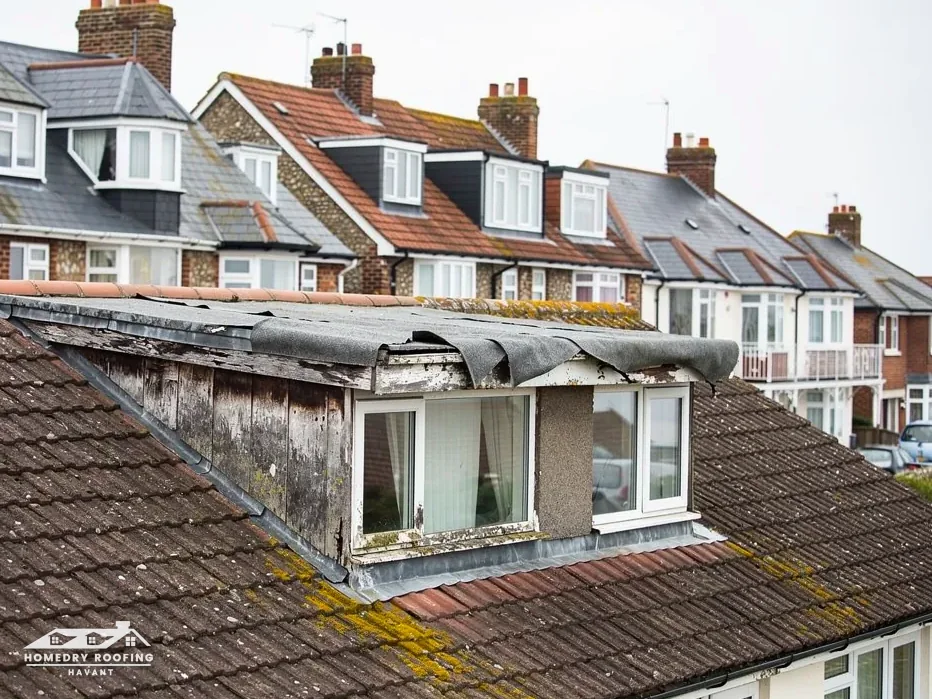
Where a flat roof holds a pool, the cause is one of three.
A flat roof is built to a gentle fall, and the survey reads the fall first. Where the surface holds a pool after rain, the fall to the outlet may be too shallow, the outlet may not be clearing, or the covering may have sunk. Next comes the upstand, the edge of the covering turned up the house wall to stop rain running behind it, and we look for splits, lifting and a lost seal along its length. Last are the joints in the covering, the edge trim and any penetrations, such as a pipe or a roof light, that have their own seals. Our flat roofing page describes the coverings in use, and the survey names the fault in yours before a new surface is suggested.
Flood Zone 2 is where the Environment Agency's map puts the mapped centre of Petersfield. That describes the ground, and no rule for covering a roof comes from it, yet a flat roof that drains to a gully makes the question of where the water goes a practical one. Each outlet is traced to its pipe, and the pipe to wherever it finally empties, with notes on what is there, including a gully clogged with leaf litter or a path that falls towards the wall.
Whether renewing a flat roof in full needs a building regulations application turns on the share of roof that is renewed. The answer for your address comes from East Hampshire District Council's building control service before work starts, and it goes in writing beside the price. The survey settles whether this covering has a mend left in it or must be laid afresh, with photographs of the pooling, the upstand and the outlet next to the reasons, and one written total price for whichever job is right. Nothing larger than the fault needs is suggested.
Standing water the morning after rain is a symptom, not a verdict. It can come from a blocked outlet, from a fall that was shallow to begin with, or from a covering that has sunk between its supports. We tell these apart on site, because each one is a different job, and the last of them can mean a new covering from edge to edge.
A soft, discoloured patch on the ceiling under an extension, spreading slowly after each long wet spell.
A split along the upstand, or a pool standing over a joint, where rain is pushed behind the covering.
A cracked tile is cracked on its own, while a failing bed loosens a whole stretch. We tap and press along the line from the ladder, lift a tile only where one is already loose, and look at the mortar or dry fixings beneath it. Where the neighbours sit firm, one tile is swapped. Where the bed has worked loose along a length, that length is rebedded or refixed, because replacing a single tile in a loose run only moves the fault to the next. The report says which case you have, with the photograph of what lay under the tile.
It depends on how much is renewed. The Planning Portal sets two measures: no application is normally called for when less than 25 per cent of the building envelope and less than 50 per cent of the roof comes into it; approval is still needed for any new covering that is 15 per cent or more heavier. The answer for your address comes from East Hampshire District Council's building control service, and we settle that route with them ahead of the first tile, so a renewal never begins on an assumption, and the reply is kept with the survey notes. The written price states what the work includes, and if VAT and scaffold are counted.
Scaffolding that stands on a Petersfield road or pavement comes under section 169 of the Highways Act 1980, and Hampshire County Council is the licensing body. Hampshire County Council's fee is £211.90 on application for the first 2 weeks and £72 for each additional 2-week period, and the application goes in early, since the council's minimum is ten clear working days from form to licence. Hampshire County Council's page reads: "Scaffolding companies must apply on behalf of their customers." We arrange the licence with our scaffolder, and you see the dates before anything is submitted.
The listing covers what its entry names, which here is the church. St Peter's is used by the Church of England for worship, so roof work to the church follows the faculty system and not the council's listed building consent. A house elsewhere in Petersfield is listed only if the National Heritage List carries an entry for it, and then listed building consent applies to work that touches its character. Search the list for your address and read the entry in full. If there is no entry, the listing of the church places no consent step on your roof by itself, though a conservation area may still apply.
Petersfield has a designated conservation area, and an Article 4 direction is recorded for a named site at Bedford Road. A direction withdraws permitted development rights it chooses, but a named site is not a whole street, and it does not mean the houses in the town are covered. South Downs National Park Authority has the planning role for Petersfield, with East Hampshire District Council processing the applications for it, so put your own road to that council. Our planning guide lists the roof rules, and a short call to the council settles any doubt before a date is fixed.
Nothing in the way the roof is built. Flood Zone 2 is where the Environment Agency's map puts the mapped centre of Petersfield, which describes land, and no rule for flat roof coverings or their fixings hangs on it, however wet the ground nearby may be. What follows is practical: we check that outlets, pipes and gullies carry the roof's water away from the building and not towards it, and the written findings record what each discharge point looks like, with a photograph. The Environment Agency can show you the map for your own address.
Mending suits a covering that is sound apart from one local fault: a split upstand, a lifted edge, an outlet that needs clearing. Laying afresh suits a covering that has sunk, split across its width or lost its seal in several places, because a patch on top of a failing surface can let go beside itself, so you could end up paying for the same roof twice. We show you the photographs that decide it. A mend is offered first wherever it will do the job, and a new covering is justified by the faults in the old one.
You will hold a written total price for the work, the findings in plain words, and photographs from the slope and the loft. On VAT and scaffold the price is explicit, so another quote can be laid beside it on equal terms. Where a repair is enough, a repair is what you are quoted for, and a replacement is quoted only if the roof needs one. Prices stay good and fair. When work finishes, the garden and path are swept clean, and any question about the findings gets a plain reply, whether it concerns the roof, the loft or the gutters below.
You'll get one written total price.
Fill in what you like. It opens WhatsApp with your message ready to send.