
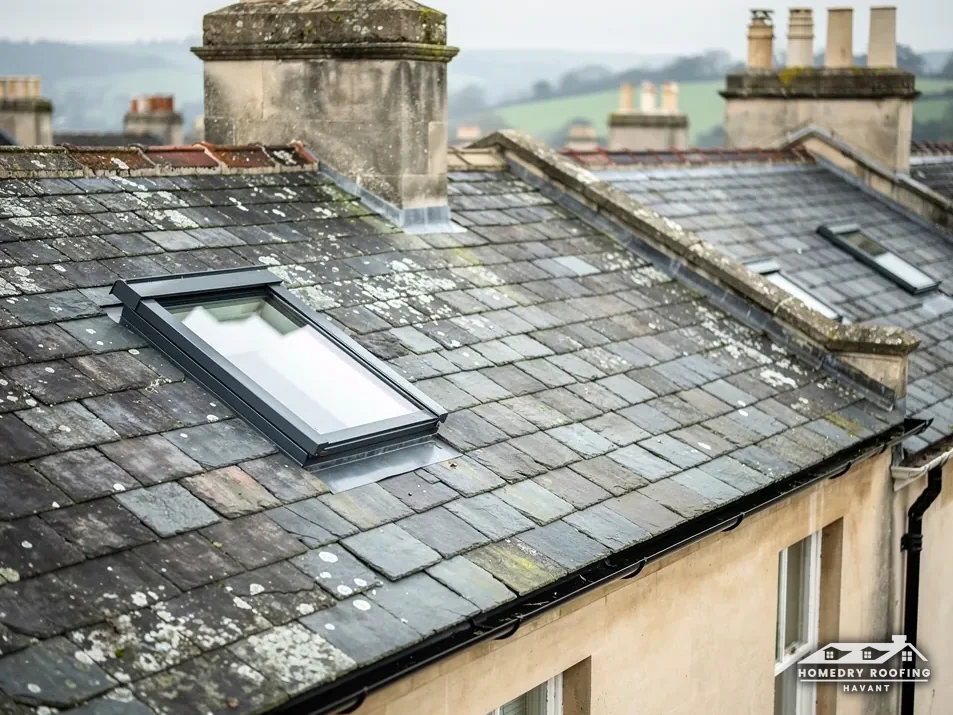
Cracked, chipped and delaminated are different faults
The words describe different damage, and each points somewhere different.
- cracked: a line runs across the face of the slate, sometimes through a nail hole
- chipped: a corner or the tail has broken off, leaving a shorter slate
- delaminated: the layers that make up the slate have begun to separate, so the face flakes or lifts
All three reduce the cover a slate gives. A crack lets water cross the slate, a chip shortens it, and a flaking face thins it until it can no longer do its job. Headlap, the overlap that lets each slate shelter the joint two courses down, then has less to work with.
None of the three is a leak by itself, and a cracked slate can sit on a roof for a while with the course beneath still carrying the water. The risk is that cover has been lost without anything showing indoors, so the first leak is the first warning.
That is why the first step is to look at where the damage is and what pattern it makes, before settling on a cause.
Weight, impact and rough cleaning
A slate is a thin piece of stone hung from fixings, and weight at the wrong point breaks it. A footstep is the obvious source, which is one reason HSE says "all roofs should be treated as fragile until a competent person has confirmed they are not."
Other loads do the same job. A ladder laid against a slope, a branch that drops onto the roof, or a heavy object set down on it can crack slates that look fine from the ground.
Cleaning is another source. Marley says "The use of high powered jet washes is not recommended as it can damage the surface of the slate or tile, thus reducing its expected life considerably". A cleaning method, in other words, can shorten the life of a slate that would otherwise have carried on, which is why moss is cleared by hand where it has to go.
Where cracks sit in a cluster in one place, such as along the line of a ladder or where someone has walked, a source like these is the first suspect. Our answer on walking on a slate roof explains how to look without climbing.
Fixings, battens and the slate's own condition
Some cracks start from the way a slate is held. A crack that runs from a nail hole puts the fixing first on the list of suspects, and a slate carried on a batten that has moved or rotted can be loaded in a way it was not made for.
The slate itself can be the cause. Slate is a layered stone, and it can split along those layers with age. HomeBuilding's approximate lifespans differ by type, at 100+ years for Welsh slate and 75 to 100 years for Spanish natural slate, which shows the published figures treat slate as varying with its source. They are typical ranges, not a promise.
When flaking or cracking spreads across a slope, and not only a few slates, the reading is that the covering is wearing out, not that it has been damaged.
Slipped slates are a separate matter, covered in our post on nail sickness. A slate that slips has not necessarily cracked, though it may be loaded awkwardly as it moves, and the two faults can turn up together on the same slope.
Replace one slate, or re-slate the slope
What to do depends on how much of the slope is affected, and the survey records that before anything is priced.
A few damaged slates with sound fixings are replaced one by one. A cracked slate is not patched, because a repair on its face will not restore its overlap. It comes out, and its replacement is chosen to be the same size and thickness, so the course keeps its lap.
Damage spread across a slope is a different decision. Where cracks and flaking run through many slates, replacing them singly can be a poor use of the work, and the question moves to whether the slope is close to the end of its useful life. Our guide to re-slating or repairing a slate roof sets out how that choice is made.
Where a repair would hold, a repair is what you are offered, and where it would not, the findings are put in front of you so that you can see why. One total price in writing follows the survey, and the work is not started on a figure given by phone. Our slate roofing page covers the wider service.