
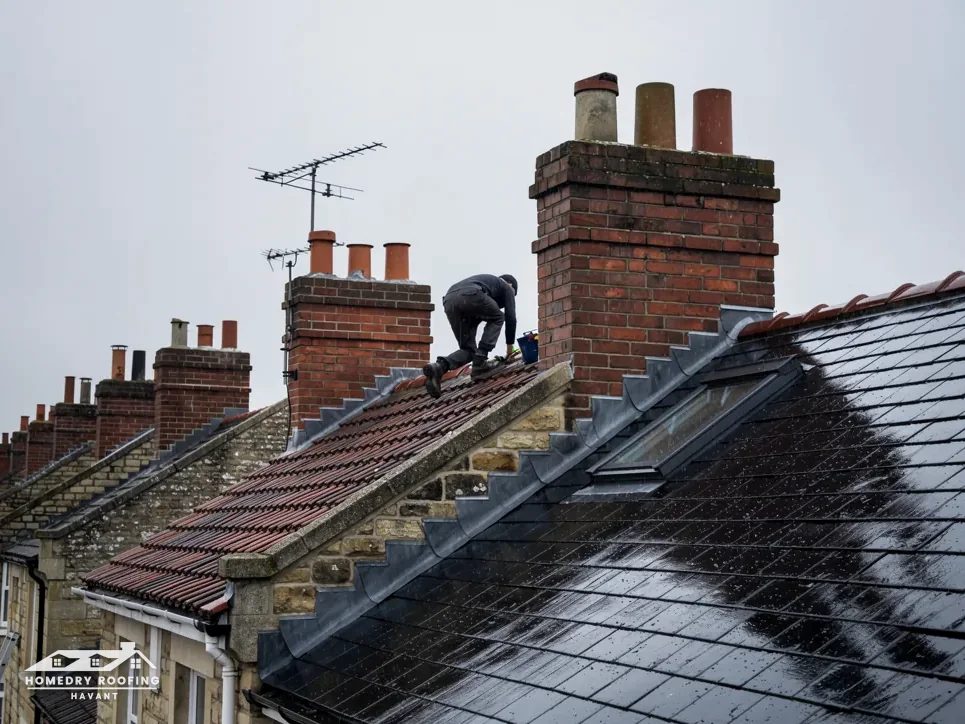
A slate that drops into the gutter looks like a slate problem. The slate may still be whole, still the right size and still a good piece of stone. What has changed is whatever held it to the roof. Trades people call this nail sickness, and it is the reason a roof can lose slates one at a time for years before anyone thinks of the roof as failing.
The distinction matters because it changes the repair. Replacing a cracked slate is a small job with a clear answer. Pushing a slipped slate back up is not, because if the fixing behind it is weak, the same slate comes down again, and so may the ones beside it. The question for a survey is how far the weakness runs: a few slates, one slope or the whole roof.
This post explains what holds a slate in place, how to spot slipping slates from the ground, how a roofer decides between refixing, stripping a slope and re-slating, and what the fixing specification depends on. It also covers published age and cost figures for slate and the permission questions that come before re-roofing in England. It cannot say what has made the fixings give up on your roof, because that has to be looked at on the roof itself.
What nail sickness means on a slate roof
Slate roofers use the term nail sickness for a roof whose slates are sound but are no longer held firmly. The slate has not cracked or worn through. It slides down its course, hangs loose or lands in the gutter, because the fixing that was meant to hold it has stopped doing the job. The stone is fine, and the fault sits in the small metal and timber parts behind it.
That is why the name matters when a roof is priced. A cracked slate is swapped for one that matches. A slipped slate that is only pushed back up will slip again if what held it is still weak, so the repair has to deal with the fixing rather than the symptom. Old iron or thinly galvanised nails can corrode and snap, and a nail hole can widen as it decays, though a post cannot say which of these has happened on your roof. Finding out is part of the survey: someone has to look at how each slate is held, from underneath where the loft allows it, and judge whether the trouble is local or general.
Three separate questions are worth keeping apart, as every answer leads to a different repair.
- Is the slate itself sound? A sound slate can be refixed or reused.
- Is the fixing sound? If it is not, the slate needs a new one, and neighbouring slates held the same way may need one too.
- Is the batten sound? The timber that the fixing goes into belongs to the system, and BS 5534 covers batten selection as well as methods of fixing.
A roofer who can answer all three has the evidence to say whether a repair will hold. One who can answer only the first is guessing at the rest.
How a slate is held on the roof
A slate roof is built in overlapping courses. Each slate is fixed through or over its upper part, to a timber batten, and covered by the slates above it. Nothing is glued, so the whole covering depends on the fixings and on the overlap between courses.
According to Cupa, a slate maker, three things set the head lap: the pitch of the roof, wind uplift, and how exposed the site is to driving rain. The head lap is the amount of overlap between courses, and it is what keeps driven rain from being pushed up and under the slates. Cupa also says that small slates suit steep roofs, while on a more exposed site or a lower pitch wider slates should be used and the lap increased.
The number of choices that go into one roof is larger than it looks from the street.
- The size of slate, which sets how much of each one is exposed.
- The head lap, which depends on pitch and exposure.
- The fixing type: nails, or hooks on pitches where they are suitable.
- The batten that takes the fixing.
Cupa gives one worked example. BS 5534 indicates a minimum pitch of 20 degrees for natural slate on a site with moderate exposure, with a slate 500mm long and a 115mm overlap. It adds that hook fixings should not be used on any pitch below 25 degrees. Those figures belong to that slate and that exposure, and the product data sheet is the place to check any other combination.
If you want the full comparison of the two fixing types, the answer on slate hooks or nails sets it out.
Spotting slipped slates from the ground
You do not need to go near the roof to see the early signs. Step back to the pavement opposite or the far end of the garden, in good light, and look along each slope. A phone with a zoom lens or a pair of binoculars shows more than the eye does.
- Slates lying on a porch roof, in a flower bed, on the path or inside the gutter.
- A line of slates with a wavy edge, where one sits lower than its neighbours.
- A slate hanging out at an angle, or a dark gap where one has gone.
- Several marks like this on the same slope rather than one on its own.
- A ceiling stain, or a damp patch on the loft side of a slope that lines up with a gap outside.
Several slipped slates on one slope is worth more attention than one on its own, because it hints that the same fixing is behind all of them. That is a hint, not a diagnosis. A single slate can also be knocked loose by a falling branch or a previous visitor on the roof, and a survey tells the difference.
Do not climb up to push slates back. HSE guidance is to presume this roof fragile, pending a look by a competent person, and a slipped slate means one part of the covering is already unsupported. Walking across it puts weight on the very fixings that are in doubt, and slate breaks easily underfoot.
When you ring for a survey, say what you saw and where. Note which elevation faces the road, how many slates you counted and whether any have landed on glazing or a path. A clear picture of the problem lets the visit start at the right slope.
Repair, strip a slope or re-slate the roof
Once the survey has looked at the slates, fixings and battens, the findings point to one of a few jobs. Where a sound repair will do, it is chosen over a bigger job, and the quote explains why the roof needs the work it names.
| What the survey finds | What it points to |
|---|---|
| A few slipped slates, fixings sound elsewhere | Refix or replace those slates and leave the rest alone |
| Slipping spread along one slope | Strip that slope and refix it, reusing slates that are sound |
| Slipping on several slopes | Re-slating becomes the question, set against repeated repairs |
| Battens weak where fixings hold | New battens are part of the refix, not an extra |
The middle two rows are where the money is decided. Stripping a slope costs more than patching, but it deals with the cause across the whole area, while a patch leaves the neighbouring slates held as before. Re-slating costs more again, and it is the right answer only when the evidence says the problem is general. If you are weighing the two, the guide to re-slating or repairing a slate roof goes through the trade-off.
Reusing slates is a decision made slate by slate, not for the whole roof at once. Sound slates can go back on new fixings and battens, and a survey separates them from slates that have cracked or worn. What you receive is a single total in writing, fixed after the visit, in place of a menu of options to add up yourself.
Exposure, pitch and the fixing specification
Fixings are not chosen from a single list. Cupa says the most significant thing for a slate roof is the environment, through its exposure to wind and rain, and that a building on a slope, on a hill, in a coastal area or simply a tall one is graded with higher exposure. That grading feeds into the fixing specification, which is calculated for the site under BS 5534.
According to Marley, BS 5534 deals with how battens are chosen, how slates are fixed, the formulas for wind uplift and the calculation of a fixing specification. Marley also says that installing to BS 5534 is not required by law. So the standard does not compel a roofer to follow it. What it offers is a method for working out how the slates on a particular roof should be fixed.
For a house on the Solent coast, near Langstone Harbour or on Hayling Island, the sensible step is to ask how the exposure of that site was assessed. We have no local wind figure to give, so a quote should not assume one without showing how it was reached.
Questions that bring out whether a quote has done this thinking:
- Does it say which pitch and slate size the fixing is based on?
- Does it say whether nails or hooks are proposed, and why?
- Does it name the head lap, and does that match the slate and the pitch?
- Does it describe the battens being replaced or kept?
A quote that answers these on paper is easier to compare with another one than a quote that says only that the roof will be re-slated.
Age, cost and permission before re-slating
Published lifespans give a sense of scale, though they describe the covering and promise nothing about a particular roof. HomeBuilding's table lists approximate lifespans of 100 or more years for Welsh slate, 75 to 100 years for Spanish natural slate and 50 to 80 years for reclaimed Welsh slate. The same site shows that a slate roof can last a long time, which is why a slipping slate is worth repairing properly rather than writing off the roof.
On cost, third-party figures disagree and are best quoted by name. MyJobQuote (October 2026) puts the average slate roof installation at around £7,800. For a semi of three bedrooms with a 65m2 roof, HomeBuilding (September 2025) says the Welsh slate version might reach £18,000. Neither figure describes your house, and our written price follows a survey.
Permission comes next. In England, the Planning Portal sets a two-part test. Building regulations approval is not normally needed if work touches under 25 per cent of the building envelope and under 50 per cent of the roof. Where the new covering adds 15 per cent or more to the weight, approval is needed. Permitted development Class C covers re-roofing a house.
Listed and conservation area homes need an extra check. Havant Borough Council states that works to a listed building without first getting the council's permission are a criminal offence. In Langstone, an Article 4 direction removes some permitted development rights on elevations that front a public area, so check with Havant Borough Council before work. The guide to slate on listed and conservation homes covers the rest, and our slate roofing service shows what a slate job includes.
Filed under Slate roofing