
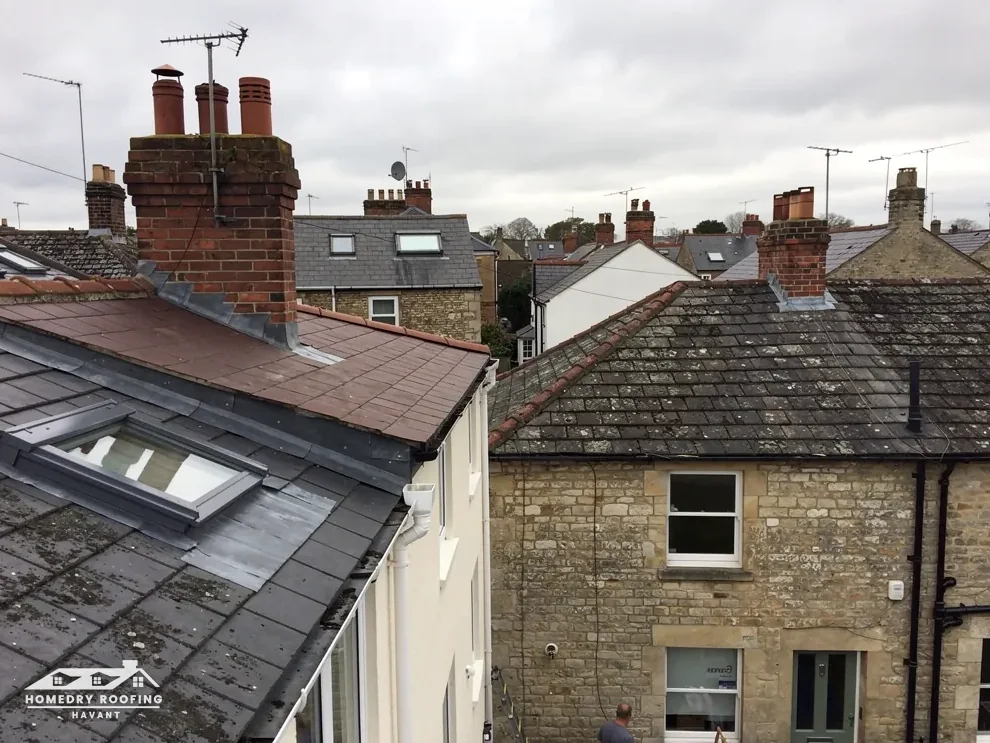
What a re-slate may use, and whether it needs consent before work starts, depends on which protection applies to the house and which council holds it. A roofer can survey the slates, the battens and the lead, but only the council can say what it will allow.
This guide is for houses in England. It sets out the four questions that matter, what listed building consent adds, what a conservation area changes, the Article 4 directions that name roofs in Havant and Portsmouth, and the order to ask in. Where this guide has no roof wording for a council's direction, it says so and leaves the answer with the council. Listed buildings, conservation areas and landscape designations each work differently, and the sections below keep them apart.
For the work on the slate itself, see our slate roofing page, and to decide between mending and re-covering, our guide to re-slating or repairing a slate roof.
Four questions that decide who answers first
A protected home can meet several protections at once, and each has its own decision-maker. Sorting them first stops a re-slate being planned around the wrong one.
| Question | Who answers | What it changes |
|---|---|---|
| Is the home listed? | The council, through listed building consent | Work that affects the building's character needs consent |
| Is it in a conservation area? | The council | Dormers lose their permitted development rights |
| Does an Article 4 direction cover the street? | The council that made it | The rights it names are withdrawn |
| Is it a church, chapel or minister's house? | The denomination's own system, or the council | The consent route differs by denomination |
The council for the address is the first call in each of the first three rows, because outside the South Downs National Park it decides listed building consent and planning applications, and the Park is covered below. Its answer is the one that counts.
Gather three things before you call: the address with its postcode, a photograph of each slope from the street, and a note of what you want done, whether a repair, a full re-slate or a new roof window. The council can answer more precisely when it can see what is proposed.
None of this alters how slate is fixed. Marley says installing to BS 5534 "isn't required by law", and the fixing for the site is still worked out under that standard. What the protections change is who has to agree the slate, its size and the details before the scaffold goes up.
Listed homes: rights stay, consent is added
A listed home keeps Classes B and C of the permitted development rights, because neither class excludes listed buildings. Listed building consent applies on top, for works "in any manner which would affect its character as a building of special architectural or historic interest", in the words of section 7 of the Planning (Listed Buildings and Conservation Areas) Act 1990.
Havant Borough Council states the risk plainly: "It is a criminal offence to carry out works to a listed building or protected trees without first getting permission from the council, even if you did not know the building was listed or the trees were protected."
A dormer is a bigger step than a re-slate. A listed home keeps Class B, but listed building consent is needed as well, so a dormer meets that consent route as well as the permitted development tests.
Whether a given change affects character is the council's judgement, and no list of safe changes exists to copy. For a slate roof, these are the points worth raising before anything is ordered:
- the slate itself, and whether it is the same stone, size and colour as the roof now has;
- the headlap and fixing the new covering will use;
- the ridge and hip detail, and the lead around chimneys and valleys;
- whether the existing slates are to be reused, which our answer on reusing old slates explains.
Even a like-for-like re-slate deserves a conversation with the council before work begins, since only the council can say it is like for like.
Conservation areas and what an Article 4 direction removes
Ordinary re-roofing stays permitted development in a conservation area, but a dormer does not, and an Article 4 direction can take further rights away. A conservation area is one of the kinds of land the order calls article 2(3) land, alongside an area of outstanding natural beauty, a National Park and a World Heritage Site. On that land the dormer class, Class B, does not apply, while Class C, the class that covers re-roofing, has no article 2(3) exclusion.
- GOV.UK explains the tool: "An article 4 direction is a direction under article 4 of the General Permitted Development Order which enables the Secretary of State or the local planning authority to withdraw specified permitted development rights across a defined area."
- Portsmouth City Council says "Many changes to doors, windows, roofs, chimneys and boundary walls remain permitted development" in conservation areas, and that "In some cases special controls called Article 4 Directions have been introduced."
A roof window is a roof alteration in its own right, and our planning guide covers the side-slope glazing condition that governs it.
Whether a particular street sits inside a conservation area, and whether a direction applies to it, are questions for the council. A direction takes away only the rights it names, and the council that made it holds that wording, so the safe step for a slate roof is to ask it first and ask in writing.
A direction removes only the rights it names, so the wording decides.
Directions that name roofs in Havant and Portsmouth
Some directions are written down in enough detail to name roof work. These are the ones whose roof wording is published for the two councils closest to us.
| Area | What the direction covers | Roof wording |
|---|---|---|
| Langstone, Havant | All properties in the conservation area, on elevations that front a public area | The council's leaflet lists eight alterations, one of them an alteration to the roof of the house |
| Homewell, Havant | A direction in the council's list that removes permitted development rights | Check with Havant Borough Council |
| Portsmouth, Old Portsmouth | Two directions for the Old Portsmouth addresses they name, made under article 4(2) | Chimney stack removal or alteration, and replacing the roof cladding on the main elevation that fronts a highway |
| Portsmouth, Castle Road | Castle Road area directions, for the addresses they name | The same two roof items as the Old Portsmouth directions |
| Portsmouth, Campbell Road | Campbell Road directions, for the addresses they name | Chimney stack removal or alteration; the council's notice for each direction has the rest |
Read the table by area: each row is a different direction made by a different council, so one row says nothing about another.
The Langstone direction does not reach rear and side elevations that do not face a highway, footpath or public space. The Portsmouth wording belongs to the addresses named, and it is never a city-wide rule or a rule for Havant. For Campbell Road, read the council's notice for the street for the rest of its list.
For Rowlands Castle, check with East Hampshire District Council, which says it is "currently revising and updating its guidance regarding the Rowlands Castle conservation area". For Fareham, Gosport, Chichester, Winchester, Southampton, Eastleigh and Arun, ask the council whether a direction names roofs.
Protected landscapes, churches and ministers' houses
Other protections sit outside the listing and the conservation area, and they come into play when a dormer or a new window is in view. A listed home, a conservation area and a protected landscape can overlap, so more than one line below can apply to the same roof, and each is answered by its own body.
- Chichester Harbour National Landscape, which the planning rules still call an area of outstanding natural beauty: dormers need planning permission, while ordinary re-roofing stays under the normal rules. The council decides, and the National Landscape team advises.
- The South Downs National Park: planning applications in the East Hampshire, Winchester and Chichester areas are usually processed by those district councils for the Authority, while the Authority itself handles Arun's part. Building control stays with the district council.
- A Church of England church in use goes through the faculty system rather than listed building consent, and a Church of England cathedral comes under the Care of Cathedrals Measure instead.
- Listed Unitarian, Quaker and redundant churches need listed building consent, and so does a minister's house: a building used or available for use by a minister wholly or mainly as a residence from which to perform the duties of the office is not an ecclesiastical building.
- A scheduled monument needs scheduled monument consent for works, under AMAA 1979, section 2.
A loft conversion brings Building Regulations questions of its own, so mention any such plan when you ask. Whichever of these applies, the order of calls stays the same: the council first, the roofer's survey second, and a written price only when both are in hand.
The order to ask in, and what we bring
A short sequence keeps the questions in the right order and puts the answers in writing.
- Ask the council for your address whether the home is listed and whether the street lies in a conservation area.
- Ask whether an Article 4 direction covers the street, and which rights it names.
- Describe the slate, its size, the fixing and any new dormer or roof window, and ask whether listed building consent or planning permission is needed.
- Hold off on any order until the council's answer is in your hands, in writing.
Allow time for the council's reply before a scaffold is booked. For planning queries in Havant, the council asks you to call its Customer Services on 023 9244 6019. Other councils publish their own contact routes.
Our part comes before and after that. The survey records the slates, battens, underlay, flashings and lead, with photographs, so the council has something concrete to read. We say whether the roof wants a patch or a new covering, and why; a repair that is sound comes first. Choosing between Welsh, Spanish and man-made slate is worth doing alongside the council, and our guide to Welsh, Spanish or man-made slate compares them.
The decision on consent is the council's, not ours. You receive one written total, priced after the survey, and our planning guide, at planning permission for roof work, sets out the permitted development tests in full.