
Slate is a long-lived covering: HomeBuilding gives approximate lifespans of 100+ years for Welsh slate. A slipped slate on a roof like that does not settle whether the roof is finished, and that is the question this guide helps with.
The slate and whatever holds it up are two different things. The slates can outlast the nails or hooks that fix them, the battens they hang on and the underlay beneath. The choice between mending and re-slating turns on those parts and on the cause of the fault, not on the stone.
Our survey names which it is, with its reasons, and a repair that is sound gets recommended ahead of any new covering. The chapters below follow a survey: the signs, the questions that decide it, fixing and exposure for a new covering, what can be kept, published figures and the rules for protected homes. For the wider service, see our slate roofing page.
Signs a survey reads, from the gutter to the loft
The slope shows where the covering has let go, and the loft shows where rain has been. Between them they tell one story, though the two places can be some way apart. These are the signs a survey looks for.
- Slates lying in the gutter, on a porch roof or on the ground after wind.
- A slate that has dropped below its neighbours and left a gap above it.
- Slates cracked across or split along their length.
- A row that sits lower than the rest, as if the course has slid.
- Daylight through the covering, seen from the loft on a bright day.
- Stained underlay or damp battens beneath an area that looks sound from outside.
Photographs help. Look from the ground after a storm, with binoculars if you have a pair, and take a loft photograph beside any stain. Please stay off the roof: HSE advises treating a roof as fragile unless someone competent has checked it.
A stain on a ceiling is where the rain ended up. It may be metres from the slate that let it in, and the slates themselves may be sound while a flashing or a valley lining is the real fault. For that reason the survey follows the whole route of the rain from ridge to gutter before it names a repair, and it notes what the battens and nail heads look like wherever a slate has been lifted.
The questions that decide repair or re-slate
Replacing slates one at a time is the right answer when the fault is local. It is the wrong answer when the cause lies in the fixings or the timber, because each repair then leaves its neighbours on the same failing nails. The survey sorts the findings like this.
| Finding | Points towards |
|---|---|
| A few slates cracked or slipped, with sound fixings and battens beside them | Repair: replace and refix the slates |
| Slates dropping across a slope, with nails or hooks giving way | Re-slating that slope, since repairs would leave the rest on the same fixings |
| Battens soft or split where slates are lifted | Re-slating, with new battens fixed first |
| Underlay torn or perished under lifted slates | Re-slating the area, or lifting it, for new underlay |
| Flashing or valley lining failing under sound slates | Repair the metalwork and keep the slates |
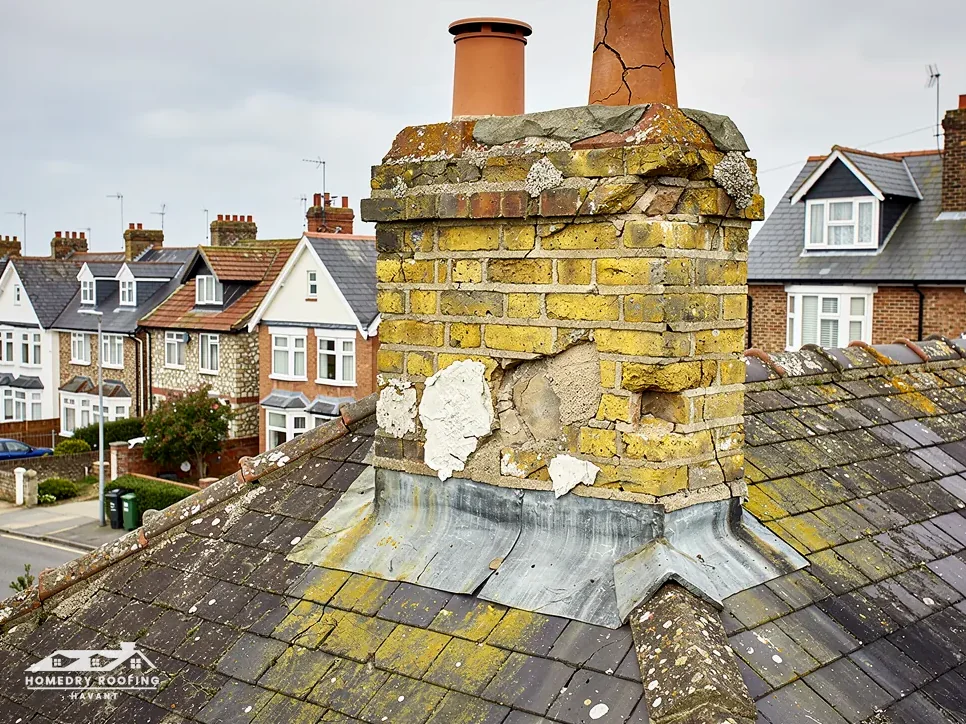
| Slipped slates found beside a chimney or in a valley | Check the flashing or lining first, then the slates beside it |
How many slates are involved matters less than why they moved. A handful broken by one impact, such as a fallen branch, is a repair. A handful that slipped without any impact, with more following along the same course, is a pattern, and a pattern points at the fixings.
Age is a prompt and never a verdict. A roof well inside its approximate lifespan can still have failing fixings, and one near the end of it can still be sound on the slope in front of you, which is why the survey looks at the roof and not at the date.
Each slope is read on its own. A roof that needs re-slating on one side may need only repairs on the other, and the written quote can say so. Ask for the photographs behind each row that applies to your roof.
A repair is judged by what it leaves behind, as well as by what it mends.
Fixing, headlap and exposure on a new covering
A re-slate starts from the specification, not from the slate. BSI lists BS 5534:2014+A2:2018, its slating and tiling standard, as current. Marley says "Installing to BS 5534 isn't required by law", and also that mortar alone "could no longer be relied upon as the only means of securing the roof covering". The specification is still how the fixings and the overlap get worked out.
Cupa, a slate maker, says "Most significant is the environment, with the two main factors being exposure to wind and rain." It adds: "Buildings positioned on slopes, hills or coastal areas as well as tall buildings will be graded with higher exposure." So a coastal house is graded for higher exposure, and its fixing specification is calculated for the site under BS 5534.
The survey also notes whether the roof has nails or hooks now, since the answer on hooks depends on pitch. Two further limits from Cupa matter there.
- The minimum roof pitch for natural slate is 20 degrees where exposure is moderate and the slate is 500mm long with a 115mm overlap.
- Hook fixings should not be used on any pitch below 25º.
Pitch limits shift with the slate chosen, so the product data sheet is the document to check. The headlap, the overlap of one course over the next, follows from the exposure grading. A quote that names the grading, the headlap and the fixing shows the numbers were worked out and not assumed.
What a re-slate keeps, and what it changes
Re-slating takes the covering off a slope and builds it up again. Some of what comes off can go back, and some cannot.
- Slates that are sound can sometimes be reused, as our answer on whether old slates can be reused explains.
- Battens and underlay that have failed are replaced, since a new covering relies on what carries it.
- Flashings and valley linings are renewed where the survey finds them tired, so that they do not wear out soon after the slates are laid.
The rules are a second set of questions. Under the Planning Portal's test, a re-roof needs no building regulations application as a rule if it touches less than 25 per cent of the building envelope and less than 50 per cent of the roof. Weight is a separate trigger: a covering 15 per cent or more heavier needs approval too, and the Portal says you are advised to "check with a structural engineer or surveyor before commencing with works". Approved Document A puts it this way: "A significant change in roof loading is when the loading upon the roof is increased by more than 15%."
Class C of the permitted development rights covers re-roofing a house, and our planning guide sets out when that stops being true. In Havant, we confirm the building regulations route with your building control body before work starts. On Arun addresses, Arun District Council's building control page lists replacing roof coverings on pitched and flat roofs among alteration projects that need approval, so we confirm the route with the council before a re-roof.
Lifespans and published figures
Third-party figures give a sense of scale. None is a price from us, and none is a promise. HomeBuilding's lifespan column is headed approximate, and the rows are shown as published.
| Covering | Approximate lifespan |
|---|---|
| Welsh slate | 100+ years |
| Spanish natural slate | 75-100 years |
| Reclaimed Welsh slate | 50-80 years |
| Clay tiles | 60-80 years |
| Plain concrete tiles | 40-50 years |
The word approximate is part of the figure. It says the column describes a typical range for each material and does not describe any one roof.
A lifespan belongs to the covering, and a roof is more than its covering. That is why a long-lived slate can still need work on what sits under it, and why the survey records the underlay and battens as carefully as the slates.
For repairs, Checkatrade's table, dated June 2026, gives natural slate at £150 to £220 per m². It says its rates are based on a m² rate up to a maximum of 3m², exclude VAT and leave out access equipment, so it is a rate for a small repair and it is never multiplied up across a slope.
MyJobQuote's roof maintenance page, last updated in October 2026, says "The average roof repair cost is around £650 in 2026", for roofs in general and with no VAT basis given. Our guide to what a slate roof costs sets out the re-slating figures, each with its source and its basis.
Protected homes, permissions and the written price
Slate can cover a listed home or one inside a conservation area, and a change of slate, size or fixing there may be a question for the council before it is a question for the roofer. Listed status does not take away permitted development for roof work, but it adds listed building consent for work touching the building's special character. Ordinary re-roofing stays permitted development in a conservation area, but an Article 4 direction can take further rights away, which is why the council is asked first. Our guide to slate on listed and conservation homes sets out who to ask.
The written quote that follows the survey carries one total for the lot. It should say:
- which slopes are repaired and which are re-slated, if the answer differs;
- the slate, its size, and the headlap and fixing it was calculated to;
- whether battens, underlay, flashings and valley linings are renewed;
- scaffold and VAT, in or out of the total.
Planning has a protected-land side too. In the South Downs National Park and in Chichester Harbour National Landscape, dormers need planning permission, while ordinary re-roofing is dealt with under the usual rules. A slate roof there is checked against the same questions as any other.
Scaffold stands inside that one price, and the highway licence is handled the way we always handle it: we arrange the licence with our scaffolder. The site is left clean.