
What HSE says about every roof, slate included
HSE's roof-work guidance starts from a presumption, and it applies to the covering whatever it is made of. It names no material that is safe to assume, so a roof of natural stone earns no exemption.
The same guidance sets out the scale of the problem. HSE says "almost one in five deaths in construction work involve roof work." It adds that some of those who die are specialist roofers, but many are just repairing and cleaning roofs. The people hurt are not only those who do it for a living.
Competence here means training and the right equipment for the slope, such as edge protection and a way of spreading weight. A good head for heights and a borrowed ladder do not amount to it. If you cannot say how the roof will be reached safely, then nobody goes up.
That is also why access is planned at the survey, and never improvised on the day. A roof that looks solid from the pavement has not been confirmed as anything, and a slate slope has to be earned before anyone steps onto it.
What a footstep does to slates
Slates are laid in overlapping courses, each held by fixings that are hidden beneath the course above. Nothing about that arrangement is designed to carry a person, and a slope that looks gentle from below is steeper and more slippery up close.
Standing on a slate puts a point load on a thin piece of stone. The slate can crack across its face, or the fixing holding it can be worked loose so that it slides down later. Either fault can be invisible from the ground, because the course above covers the damage, and either one leaves the lap beneath it thinner than it was laid.
A short visit to look at a roof can therefore turn into a new leak. The stain on the ceiling appears days afterwards, a long way from the footprint that caused it, and nobody connects the two.
Wet slate is worse, and a leak never justifies climbing a roof in the rain. If water is coming in now, catch it with a bowl and move belongings out of its path. Rooflights call for extra distance too, because HSE describes fragile rooflights as a particular hazard.
Checking a slate roof from safer ground
A survey needs to know a lot that can be seen without climbing. Choose a dry day, go round the house and study each slope in turn, noting what you see.
- slates sitting lower than their neighbours, or a gap where one has slipped
- fragments of slate that have landed below the eaves, on the path or in the gutter
- a line of small metal strips across a slope, which are tingles holding slipped slates
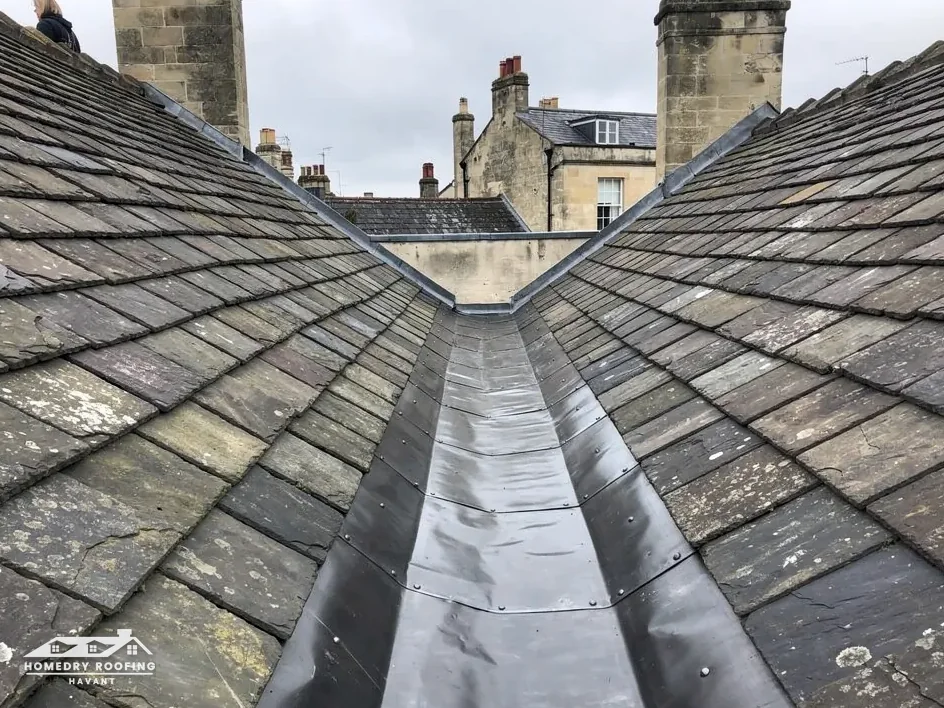
- moss or leaves collecting where two slopes meet
- stains on bedroom ceilings, or damp on the wall under the eaves
Binoculars, or a phone zoomed in, do the job of a ladder. From the loft hatch, use a torch to look for daylight showing between slates, timbers that are dark or wet, and underlay that has sagged or torn. Stay on the hatch ladder or a boarded walkway, never on the bare ceiling between the joists.
Dated photographs let us read the roof before we arrive. Our answer on why roof slates crack explains what some of the marks you find may mean. Photographs taken now also make a useful record, so that next year's look at the same slope has something to be compared against.
What the survey does on the slope
Where the ground check turns something up, we arrange safe access for the survey and decide on the day how far onto the slope it needs to go. The aim is a written account of what is wrong and why, so that the work deals with the cause and not only the slate you happened to notice.
The route the rain takes is the guide. We begin at the stain or the slipped slate, trace upslope to where water could have entered, and then examine the battens, underlay and fixings in that area. A single slipped slate may only need a slate tingle, and where a repair is enough it stays a repair. Where the covering has reached the end, you are told that, with the reasons given.
The price arrives afterwards as one figure in writing, never as a number offered over the phone, and when we leave, the garden and path are clear of slate and debris. If a repair is needed, you decide whether to go ahead once you have seen what the survey found. For the full range of work on slate roofs, see slate roofing.