
Why one figure for the whole ridge does not exist
A dry ridge is not a single object. Marley describes dry-fix systems as using "mechanical fasteners such as nails, screws or clips to secure roof tiles without a mortar bedding". In practice that means a run of ridge tiles or units, a set of fasteners, and the timber that the fasteners grip.
Each part is made of a different material and sits in a different position on the roof, so each wears in its own way and at its own rate. A ridge tile can outlast the fastener that holds it, and a sound fastener can sit in timber that has not stayed dry. The weakest part decides when the ridge needs attention, and a published figure for one part says nothing about the others.
BSI lists BS 8612:2018 as current, and it is the specification for dry-fixed ridge, hip and verge work. That tells you the standard stands. It does not give a number of years, and it should not be read as one, because a specification sets out how a system is made and fitted.
What the published figures describe
The figures that exist are for roof tiles, and the sources differ, so each is named. They describe the covering across the slopes, and a ridge tile in the same material has no figure of its own. Read the table with that limit in mind, because a tile figure says what the material can do and says nothing about how it was fixed.
| Tile | Figure | Source |
|---|---|---|
| Clay | Minimum life expectancy of 60 years, determined by the BRE | Marley |
| Clay | 60 to 80 years, approximate | HomeBuilding |
| Roof tiles generally | Typically expected to last for around 60 years | Marley |
| Plain concrete | 40 to 50 years, approximate | HomeBuilding |
The 60-year minimum belongs to clay tiles alone, and it is a floor for the material, not a forecast for any one roof. Marley states that its general expectation is not a promise of longevity, and HomeBuilding labels its own as approximate. No row above is a lifespan for a ridge fixing, a fastener or the timber beneath, and no row should be carried across to them.
What wears on a dry ridge
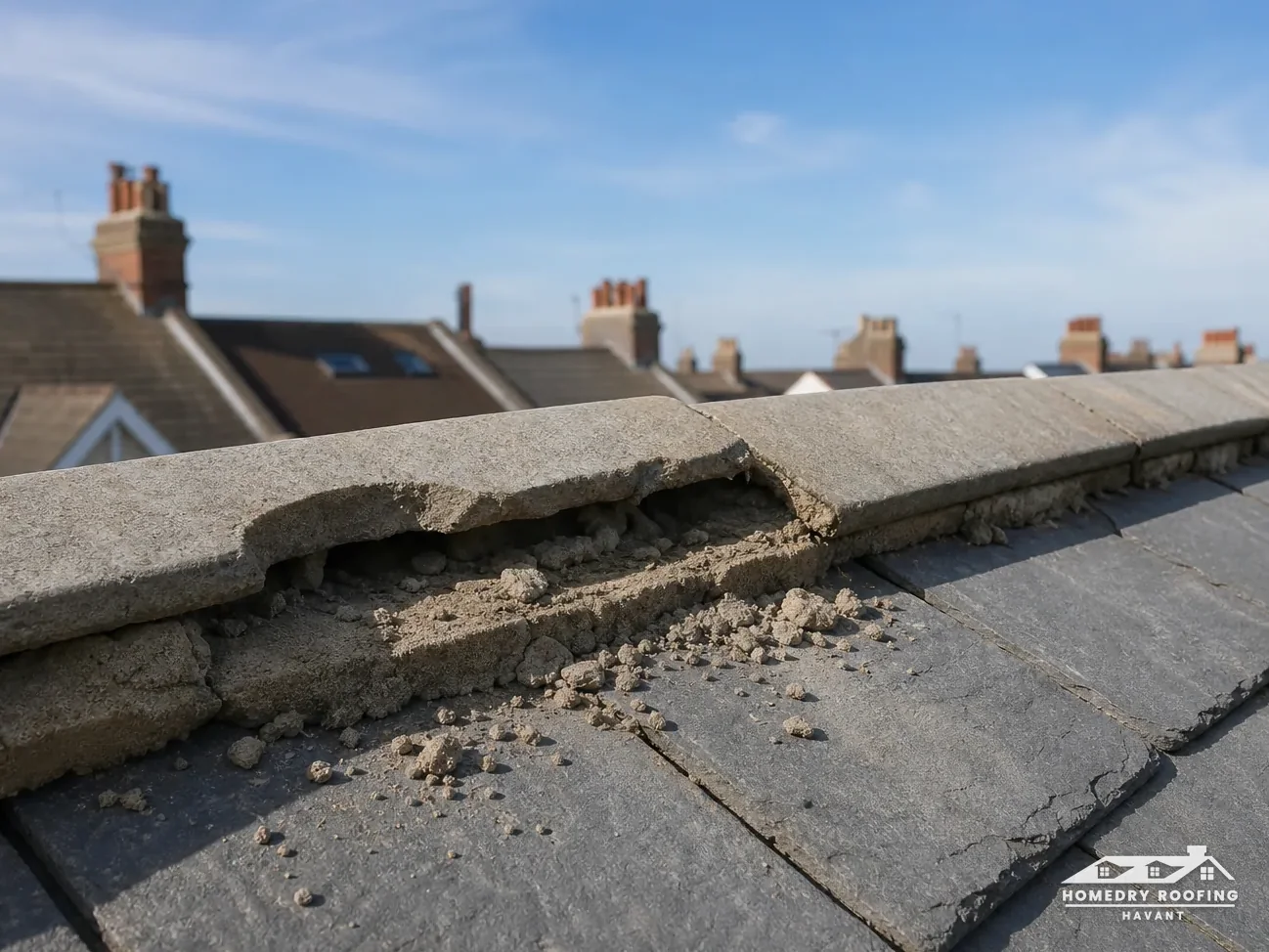
With no mortar bed, a dry ridge removes the part that cracks and crumbles on a mortar ridge. Four other things remain, and a survey looks at each of them when it judges how much life a ridge has left in it.
- The ridge tiles or units: chips, cracks and a surface that is breaking down.
- The fixings: fasteners that have worked loose, or clips that have let go.
- The timber beneath: whether it is dry and firm enough to keep gripping a fastener.
- The details at each end: the points where the line ends against a wall, a hip or a stack, which are the most awkward spots along it.
A fault in one part does not mean the whole ridge is finished, and a survey separates a single tired fixing from a line that is worn along its length. Where the rest of the line is in good order, a repair is what we propose, and a full renewal only where the survey shows the ridge cannot be saved. Our answer on whether a dry ridge needs maintenance explains how a check is carried out.
What to ask before a dry ridge goes on
Since no figure for the whole ridge exists, the useful questions are about what is being fitted and how it is fitted.
- Which system is it, and does its maker publish fixing instructions?
- Which standard was it fitted to, and has the fixing specification been worked out for the exposure of the site, not copied from another roof?
- What was found in the timber beneath, and what was done about it before the new fixings went in?
- Is the ridge being fitted along its whole length, or only where the old one has failed?
Cupa's slate guidance says exposed positions "will be graded with higher exposure", and coastal homes fall into that group. Exposure bears on how a ridge is fixed, and a survey records the position of the house along with the state of the ridge.
After the survey, our quote carries one figure in writing, along with a note of what the ridge showed from end to end. The guide to BS 8612 and dry-fix explains the standard, and the full service is set out on the dry ridge and verge page.