
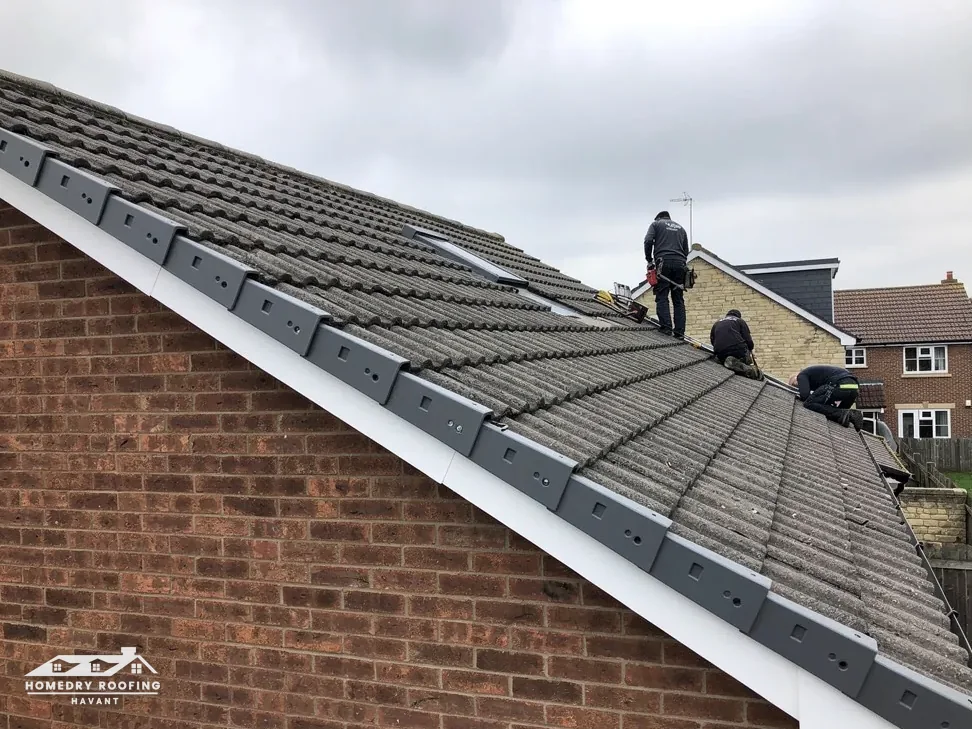
What a dry ridge takes away and what stays
A mortar ridge fails where its mortar does: the bed cracks, crumbles or lets go of a tile. A dry ridge is secured in another way, with no wet trade involved at all. Marley describes dry-fix systems as using "mechanical fasteners such as nails, screws or clips to secure roof tiles without a mortar bedding". With no bedding, there is nothing to rake out and repoint, and that is the maintenance job a mortar ridge brings with it.
Several things remain on any roof, whatever the ridge is made of:
- the ridge tiles or ridge units themselves, which can crack or chip;
- the fasteners, and the timber they are fixed into;
- the line of the ridge, which should still run straight from end to end;
- the junctions where the ridge meets hips, a gable or a chimney stack.
BSI lists BS 8612:2018, the specification for dry-fixed ridge, hip and verge systems, as current. A specification describes how a system should be made and fitted, and it says nothing to suggest that the roof beneath needs no further attention. A mortar ridge is looked at for the same reason.
What a check of the ridge covers
A check does not mean a day on the roof. It is a close look at the ridge, together with the rest of the roof, and it takes in:
- whether every ridge tile or unit is in place and sitting level with its neighbours;
- whether any tile is cracked, chipped or showing a gap at the join;
- whether the fixings are all there and tight, as far as can be seen;
- whether the batten and ridge timber beneath look dry and firm;
- how the ridge ends at the gable, hip or stack.
Where one fastener or one tile has gone, the survey says whether a single refix is enough. If the fault runs along the ridge, it says that instead, and the written price follows what was found, not a fixed list of tasks.
You can see more than you might expect from the ground. Standing back across the road, a straight ridge reads as one clean line, and a tile out of line stands out against the sky, so a look once or twice a year costs nothing and takes a minute.
Looking from the ground and when to book a visit
Stay off the roof for this. The ridge is the highest and steepest part, and HSE puts it plainly: "all roofs should be treated as fragile until a competent person has confirmed they are not."
Look for a ridge tile that sits out of line, a missing piece, or a tile on the ground below. A zoomed photograph from the pavement is worth taking, and you can send it by WhatsApp or the quote form to help us plan the survey.
Book a visit if you see any of those signs, if the ridge has been disturbed by a storm, or if you are buying or selling a house and want the roof looked at first. Our answer on loose or fallen ridge tiles sets out what to do when something has already moved.
If a storm is involved and you plan to claim, the Financial Ombudsman Service says it will usually look at expert reports and photos, which is a good reason to take pictures of any damage before a tile is touched.
What to ask a roofer, and published costs
When you are quoted for a dry ridge, ask what the survey of the old ridge covered, which standard the system was fitted to, and whether the fixings were chosen for the exposure of the site. Cupa's slate guidance says of buildings on slopes, on hills or in coastal areas, and of tall buildings, that they "will be graded with higher exposure". For that reason each roof gets its own fixing design under BS 5534, rather than a part chosen off a shelf.
For repairs to an existing ridge, Checkatrade's June 2026 table lists ridge tile repairs at £50 to £70 per metre, where VAT is added on top and access equipment is not counted. It is a rate for a repair, and nobody should build a total from it. MyJobQuote's 2026 page puts the average ridge tile replacement between £225 and £550.
None of this is our pricing. What we send is one total, in writing, after the survey. For the wider choice between mortar and dry fix, start with our dry ridge and verge page.