
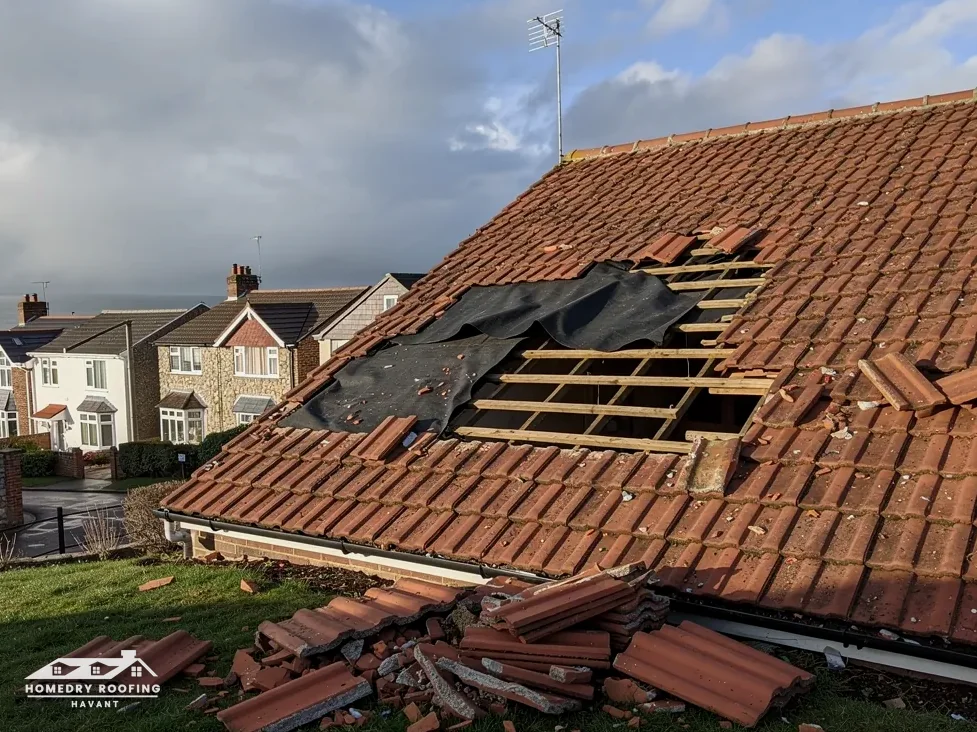
Slate and tile coverings
Slate is a natural stone split into thin sheets, while concrete tiles are moulded from cement and sand. HomeBuilding's cost guide (last updated 30 September 2025) gives approximate lifespans for pitched coverings. Marley, a tile maker, gives a figure of its own for concrete tiles, and the two do not match, so both are named rather than blended into one.
| Material | Published figure | Where it comes from |
|---|---|---|
| Welsh slate | 100+ years (approx) | HomeBuilding |
| Spanish natural slate | 75 to 100 years | HomeBuilding |
| Reclaimed Welsh slate | 50 to 80 years | HomeBuilding |
| Plain concrete tile | 40 to 50 years | HomeBuilding |
| Concrete tile | around 60 years expected | Marley |
| Fibre cement tile | 30 to 40 years | HomeBuilding |
Marley adds that its figure for roof tiles is not a promise of longevity. It is an expectation set by the maker, to be read as one view among several. A slate roof and a concrete tile roof that went on in the same year can be in quite different states, so the figure is where a conversation starts, not a verdict on the roof.
Clay tiles and the minimum life expectancy
Clay tiles have a published figure from two directions. HomeBuilding gives 60 to 80 years, approximate. Marley says that for clay roof tiles the BRE determined a minimum life expectancy of 60 years, and that figure applies to clay alone: no other tile is covered by it.
The two sit comfortably together, because one is a range and the other a floor set for the material, but both describe the tile and not the roof it covers. A clay tile roof also has battens, nails, underlay and flashings, and each of those has its own life that may differ from the tile's.
The fixings and the timber beneath can need attention while the tiles themselves are sound. Ask your roofer which of these parts the survey looked at on your roof. A survey looks at those parts as well as the covering, so that a repair can be chosen wherever the covering itself can be kept.
That is the reason a published lifespan is a starting point for a question, never the end of the answer.
Flat roof coverings
Flat roof figures differ more than pitched ones, so each pair below names both. HomeBuilding's guide is dated 30 September 2025, and Less's flat roof cost page was last updated on 27 October 2026.
| Covering | HomeBuilding | Less |
|---|---|---|
| EPDM (rubber sheet) | 25 to 30 years | 30 to 50 years |
| GRP (fibreglass) | 25 to 30 years | 25 to 40 years, with minimal maintenance |
| Felt (torch-on) | 10 to 15 years | 10 to 20 years, depending on quality and installation |
Less says EPDM rubber membrane typically lasts its range, which is a hedge worth keeping, and its felt range depends on quality and installation. A flat roof with a poor fall, where water stands, raises a separate question from the covering itself, and a survey checks both.
The fall matters because BS 6229:2025 sets a minimum finished fall of 1:80 on a membrane flat roof, so the design calls for a steeper fall to leave room for tolerances. A roof built flatter than that can hold water, and standing water is a question for the survey whatever the covering is.
Lead, zinc and roofline materials
Metals and plastics carry their own published figures, each with its own hedge:
- Lead flashing that is correctly installed can last for over 80 years, according to MyJobQuote. HomeBuilding's lead flat roof range is 60 to 100 years, and Less puts lead at 50 to 100 years, the longest-lasting option it lists.
- VMZinc, the maker, says a zinc roof, when correctly designed and installed, can last in excess of 100 years.
- A roofline retailer says uPVC boards, when installed correctly, can typically maintain reliable performance for between 20 and 40 years.
- For conservatory roofs, HomeBuilding gives polycarbonate a typical lifespan of 10 years; the managing director of Roofing Megastore, quoted by HomeBuilding, says a glass roof will likely last in excess of 30 years and a tiled roof in excess of 50.
"Can last" and "correctly installed" are part of each claim, not decoration. A figure from a maker describes the maker's product under the maker's conditions.
For what moves a price once you know the job, see how roofers price a job and the roofing costs page. Coastal homes are graded for higher exposure, so the fixing specification is calculated for the site under BS 5534, and that is separate from the covering's own figure. More roofing answers are on the homepage.