
Capping is the name for new plastic fitted over existing fascia and soffit boards, in place of taking the old boards down. The finish is clean, the old paint disappears and the work can look like a full replacement from the drive.
The catch is in the word over. Whatever is under the new face stays where it is, out of sight, and the roofline is the part of the house that carries the gutters and meets the edge of the roof. If those boards are sound, capping is a reasonable choice. If they are not, the cover simply hides the problem.
This post looks at what capping does and does not touch, when it makes sense, what to check on an older house before anyone fixes anything to the soffit, and how the gutters, the birds and the price fit in. It uses published cost figures with their sources, and it says plainly where a figure is only a guide.
What capping actually covers
A fascia is the board along the bottom edge of the roof that the gutter is fixed to. A soffit is the underside panel at the eaves, that spans from the house wall to the fascia and closes off the overhang. Capping wraps new plastic round the front of one and the underside of the other, usually leaving the original timber in place behind it.
That is the whole idea, and it is why it appeals. There is less to take down, the look is renewed and the visible surfaces no longer need painting. MyJobQuote (September 2026) gives the average cost of capping fascias and soffits as around £800. That is an average from one cost guide, it states no VAT basis, and it says nothing about the length of your roofline or the access to it.
Capping is not the same as replacing, and the two get confused in quotes. The difference sits in a few simple questions:
- Are the old boards coming off, or staying behind the new face?
- Is anyone checking the timber before the cover goes on?
- Are the gutters coming down and going back, or being worked around?
- Is the old soffit being left in place, and do you know what it is made of?
A quote that says capping and nothing else has answered none of these, however tidy the sample looks. Ask for each answer in writing, because the price only makes sense once you know which job it describes, and keep the written version with your other house papers.
Our guide on replacing fascias and soffits sets out the other route, where the old boards come off.
What stays hidden underneath
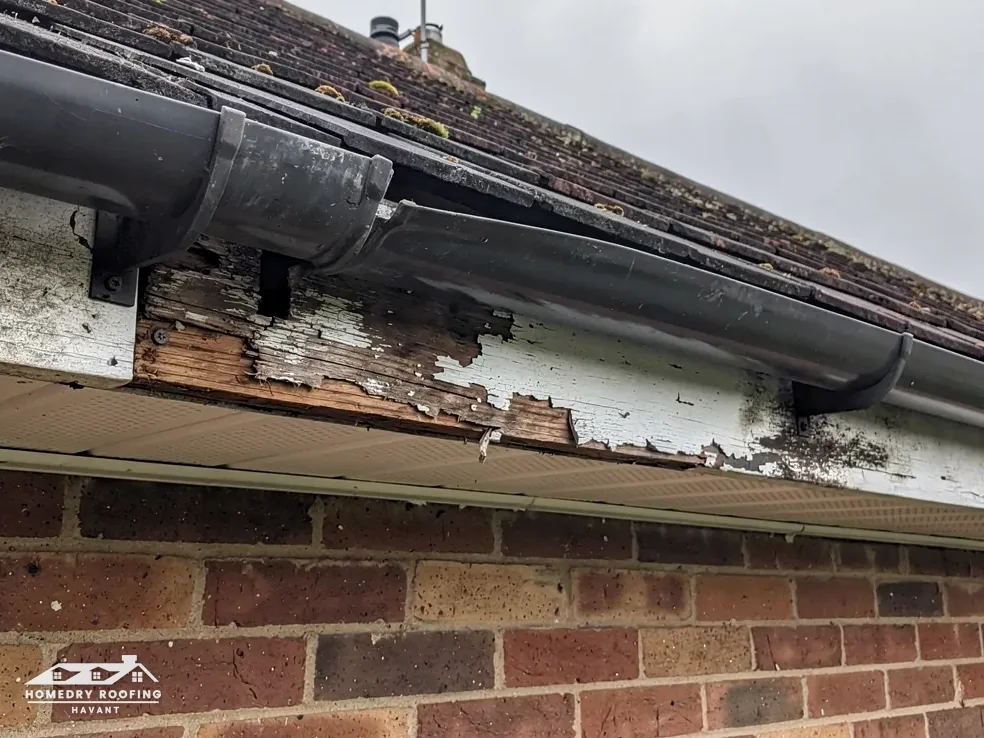
The roofline is exposed to weather all year. Rainwater runs down it from the roof edge, and when a gutter overflows or a joint leaks, the board behind is the first thing to get wet. Timber that has been wet for long enough softens. That is the risk with capping: once the new face is on, the board behind it can no longer be seen or pressed, so a problem there has nowhere to show itself.
The point is not that capping hides rot every time. It is that nobody can say from the outside, once it is fitted, that the timber is sound. The time to find out is before the cover goes on, when the boards are still visible and can be tested.
A fair check before capping covers several things:
- Whether the boards are firm along their full length, particularly at joints, corners and where the gutter fixes.
- Whether the rafter ends behind the fascia are sound, since the fascia often rests against them.
- Whether the old fixings will still hold a gutter once the cover is added.
- Whether anything in the soffit needs to stay ventilated, and whether the new face allows for it.
A board that is already soft is not made sound by covering it. If any of it fails the check, the board comes off and is replaced, and capping goes over the new timber instead of the old.
That is also the answer to whether capping is a false economy. It is false when it is chosen to avoid finding out what is behind it, because the saving is only on the day. It is a fair choice when the finding-out has been done first and the result is written down.
When capping is a sound choice
Capping suits a roofline that is structurally fine and visually tired. The boards are straight, firm and dry, the gutters are fixed well and nothing behind the face is in doubt. In that case the cover renews the look and saves taking boards down, and nobody is hiding anything.
The table sets the two routes side by side for a few common situations. It is a guide to the thinking, not a rule, and your own survey decides.
| Situation | Capping | Replacing |
|---|---|---|
| Boards firm, finish tired | Reasonable | Not needed |
| Soft or split boards | Covers the fault | Fixes the fault |
| Old gutter brackets loose | Needs the boards checked | Boards and brackets done together |
| Soffit material unknown | Hold until identified | Hold until identified |
The last row is worth reading twice, because it is the row that is easy to miss. On an older house the soffit might not be timber at all, and the next section explains why that changes the order of work.
Capping also leaves the gutter question open. If the gutters are due for replacement, taking them off to fit the cover and then replacing them later means doing the roofline twice. Where both need doing, one visit and one written price is simpler than two.
If the survey says capping is right, we will say so, and the written total will cover the capping, the fixings and the clearing away. If it says the boards need to go, we will say that instead, and why.
Older soffits and the asbestos question
HSE advises assuming that a building built or refurbished before 2000 may contain asbestos. For a roofline, that matters because HSE's list of where asbestos turns up includes asbestos insulating board, written AIB, in white soffit panels under the roof eaves, and damaged AIB soffit is listed as well.
AIB is a different material from the cement sheets used on garage roofs, and it has different rules. HSE says AIB work counts as licensed work when the assessment of risk finds the job is not of short duration. Short-duration removal of AIB in a refurbishment is notifiable non-licensed work, which is a separate category with its own steps.
For a homeowner, the practical consequence is simple:
- Do not drill, cut, scrub or pressure wash a soffit on an older house until you know what it is.
- Ask for the material to be identified before capping or replacement is priced.
- If it is AIB, expect the route to change, and expect the price to follow once the route is set.
The point of identifying the board is so that the right route can be chosen before anyone puts a fixing through it. Capping over an unidentified soffit is the version of the job to avoid, because it buries the question instead of answering it.
Our guide on asbestos in soffits goes through what HSE lists and how a roofer approaches an older roofline. Read it before you agree to any work on a house of that age.
Gutters, birds and the order of work
A roofline job touches the gutters, whether or not they are being replaced. The gutter hangs from the fascia, so the board has to be sound enough to hold the brackets, and the gutter has to go back with its fall intact. Brett Martin, which makes gutters, advises a fall towards the outlet of 1 mm for every 600 mm. A board that has moved or a bracket that no longer bites will change that.
If the gutters are old as well, MyJobQuote's average gutter replacement cost in the UK is around £1,000 to £1,600. That is a separate job with a separate figure, and the comparison you want is between doing the roofline once or twice, not between those two numbers.
Nests in the eaves
Eaves are where some birds nest. Under section 1 of the Wildlife and Countryside Act 1981, it is an offence for anyone to damage or destroy, intentionally, a wild bird's nest that is in use or being built. Work on the boards should therefore start with a look along the eaves for nests, and any nest in use is left alone until the birds have finished with it.
No nesting dates are given here, so look at what is actually there on the day. Our answer on birds nesting in the eaves goes through it.
Planning the order sensibly saves a second visit. The eaves are checked, the gutters come down, the boards are tested, the old ones that fail are replaced, the new face goes on and the gutters go back. That order also gives you a point where the work can stop if something unexpected turns up.
Cost, lifespan and what to ask in the quote
Published figures give a sense of the range. Which? Trusted Traders put the clearing of gutters along both the front and the rear of a property at £75 to £350 in November 2025, excluding VAT, and said prices are likely to be at the upper end in the South East. MyJobQuote's average for capping fascias and soffits is around £800. These are outside figures with their own bases, not a price for your roofline.
On lifespan, a uPVC retailer says correctly fitted uPVC fascia boards can typically keep performing reliably for between 20 and 40 years. That is a seller's own claim and not a promise, and it describes boards that are installed correctly over sound timber.
When you compare quotes, ask each roofer the same questions:
- Are the old boards staying or going, and who checks them before anything goes on?
- Has the soffit material been identified, and if not, when will it be?
- Are the gutters coming down, and does the price include putting them back?
- Is the scaffold or access included in the written total, and is VAT?
- What happens if a board turns out to be unsound once it is exposed?
The last question is the telling one. A fair answer sets out what will be replaced and how the written total changes, before work begins, and it is put in writing so that nothing is decided on the scaffold. Our price for gutters, soffits and fascias is a single written figure given after the survey, and it names the route chosen.
Filed under Gutters, soffits & fascias