
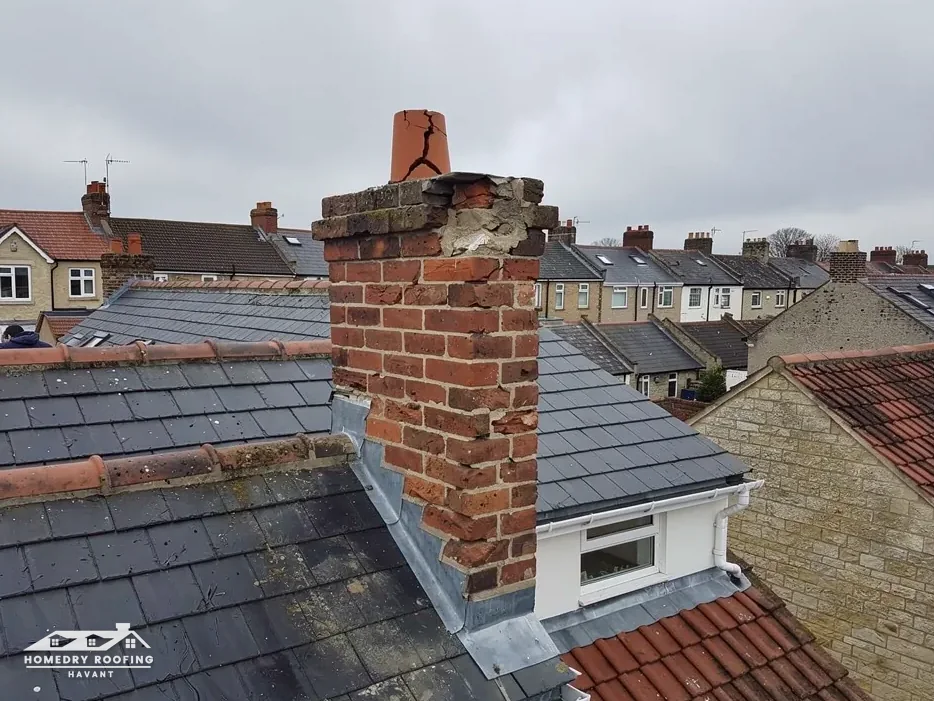
Stacks
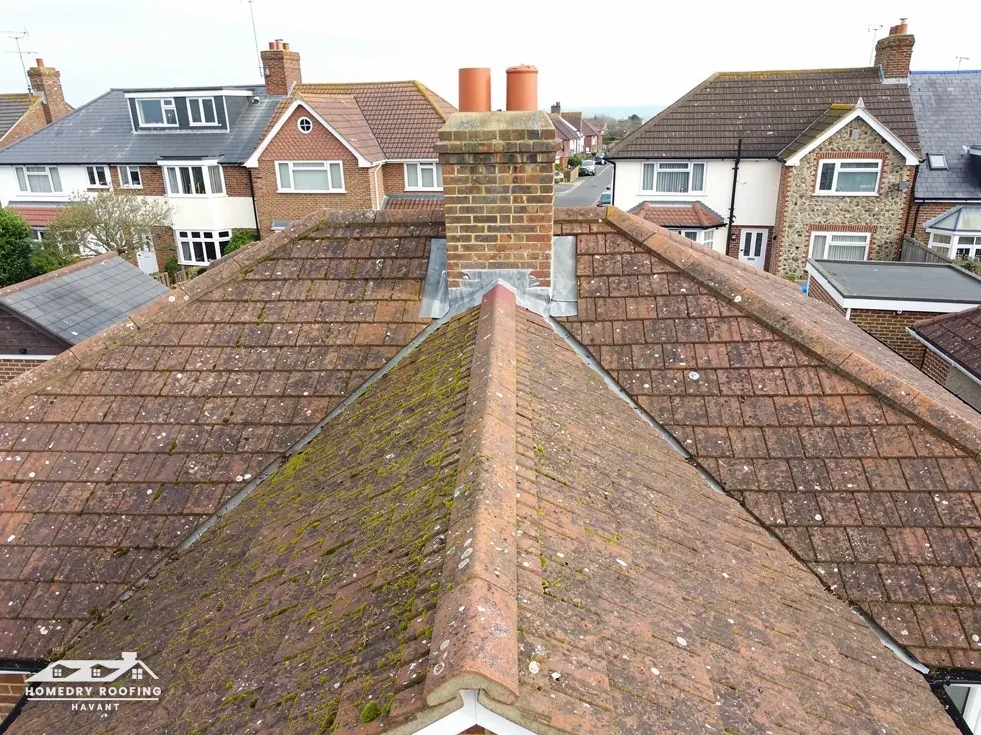
Where a chimney rises out of a Netley slope and its lead skirt meets the brick.
A lifted edge on that lead gives rain a path beside the flue.

Netley is 19.2 road miles west of Havant; the foot of each chimney and the fastenings that pin a covering down are read first, with the cause named before any figure is given.
10-year workmanship guarantee, in writing
Where a chimney rises out of a Netley slope and its lead skirt meets the brick.
A lifted edge on that lead gives rain a path beside the flue.
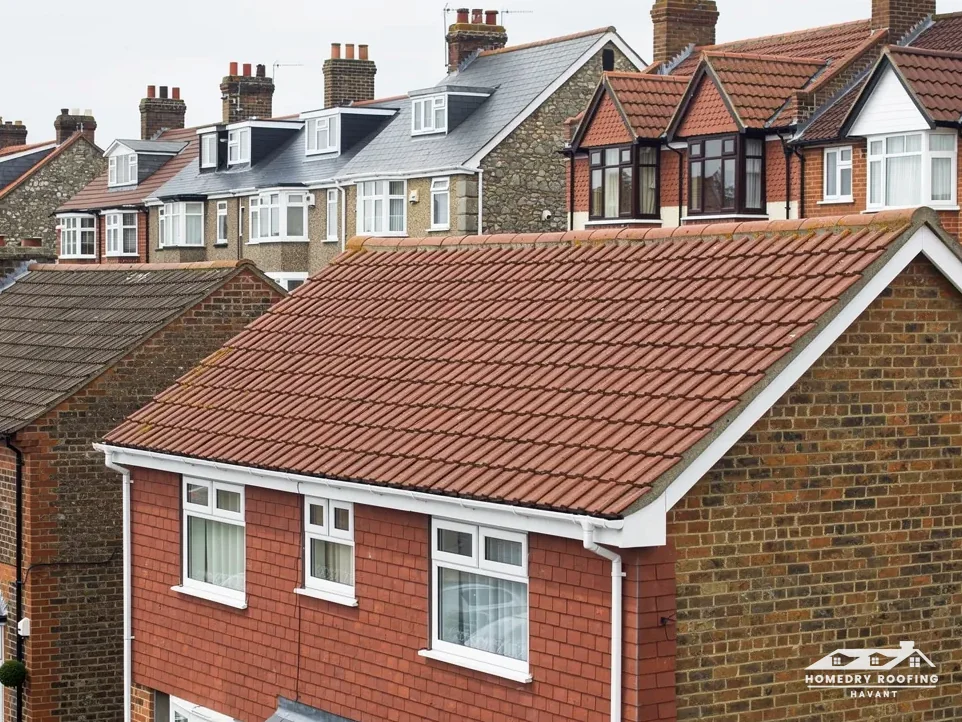
Where a small clip or nail pins each covering unit to a timber batten below.
A clip that has let go lets one unit shift and bare the underlay beneath it.
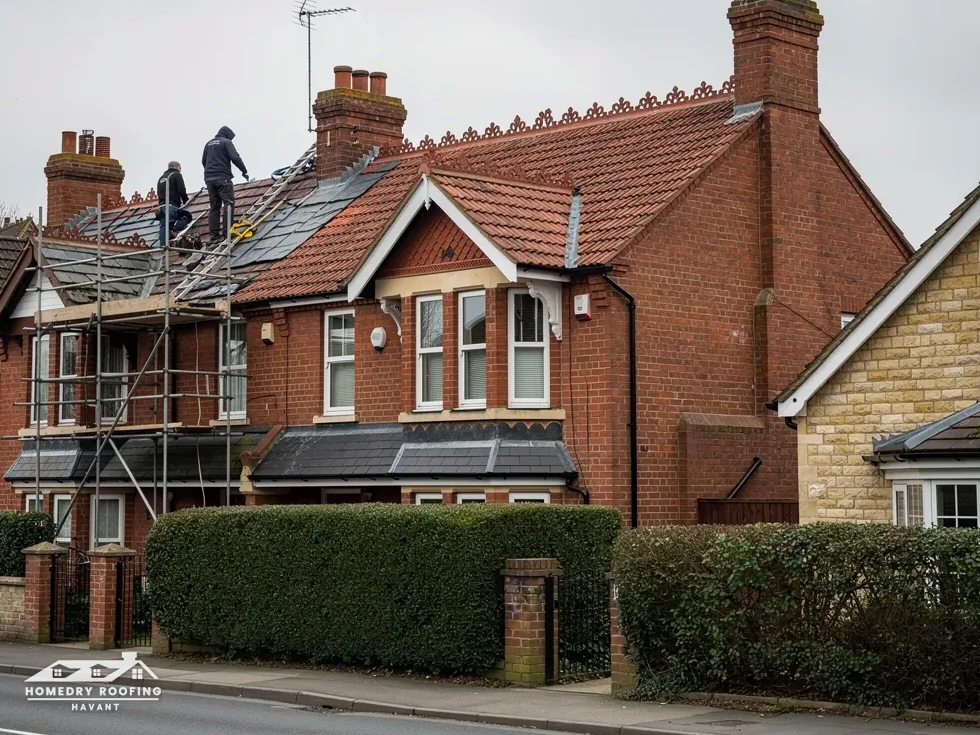
Where the slope stops at a gable and its final row hangs over the wall top.
If that edge works loose, rain drives under it and darkens the masonry below.
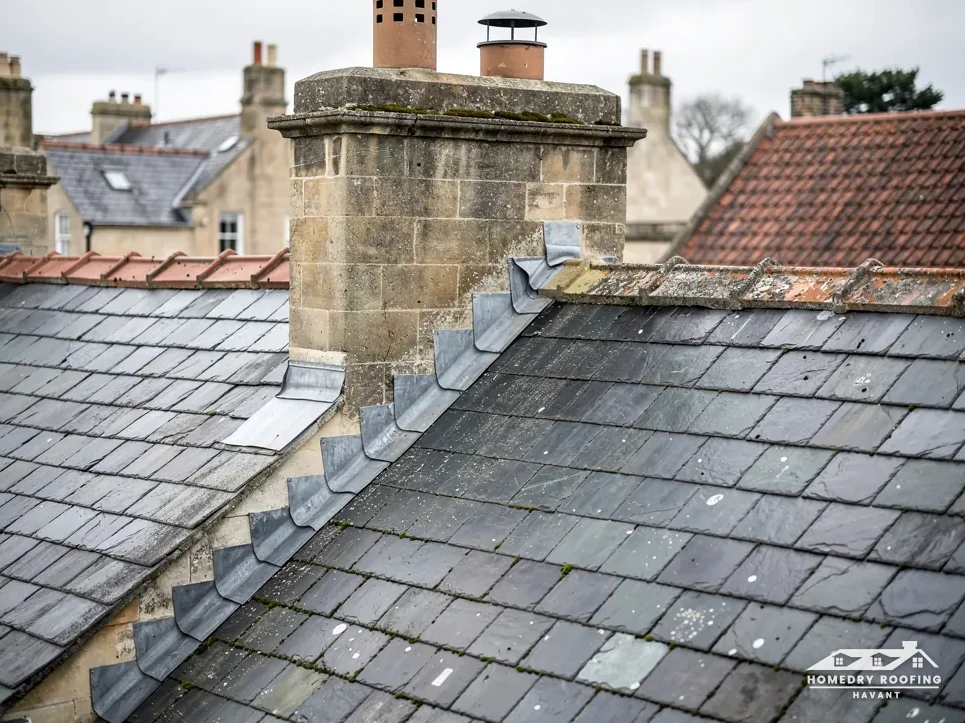
The tallest part of the roof has the longest join to keep tight.
The chimney is the tallest thing on the roof and has the longest seam to keep shut, so the survey starts at its foot. Three details come first: the lead apron and its stepped sides, the mortar bed that holds the lead in, and the flaunching, the cement cap that dresses the pots. Above them we read the brickwork for open joints. A brown bloom on a bedroom wall beside the breast is easy to pin on the tiles nearby, yet the cause can sit at the stack instead. Where only the lead has lifted, the repair is to the lead and the brick is left as it stands. Rebuilding and repointing are described on our chimney repairs page, and the cutting and dressing of flashings on our leadwork page.
Netley Abbey is the conservation area Eastleigh Borough Council holds for the village, and Historic England's list carries Netley Lodge at Grade II. Netley Abbey; Precinct Wall and Moat is a scheduled monument, and scheduled monument consent under section 2 of the 1979 Act on ancient monuments governs works to the monument itself. A listed house is different: listed building consent under section 7 of the 1990 Act covers changes that touch its special character.
An Article 4 direction withdraws chosen permitted development rights from the area it names, so ask Eastleigh Borough Council whether one touches your road and what it would mean before work begins on a slope or a stack, since two roads in the village may be treated differently. Our planning guide for roof work gathers those rules in one place, so they are not set out again here. Whatever the council tells you is written up beside the roof findings, and the choice stays with you.
From the loft we read what the slope hides. A torch shows the breast and the timbers beside it: tide marks, damp brick, rafters gone dark. Those clues say whether the water arrived at the lead, at the cap around the pots or further down the flue. Pictures taken on the slope and in the loft go into your findings, so you can see the exact join we mean and what it needs.
A tea-coloured patch beside the chimney breast upstairs, wider after each long spell of rain.
A gap where lead meets brick, or a cracked cap around the pots, giving rain a route down beside the flue.
The fixing specification is calculated for the site under BS 5534, because a coastal location is graded with higher exposure, says Cupa. We record the grading in the survey notes and describe the result in the quote.
Hidden beneath every covering are the parts that hold it: battens screwed across the rafters, and a nail or a clip at each tile or slate. At survey we open the slope in several spots, mid-slope and along the edges, and read three things: whether the batten is split, whether the nail still bites and whether the underlay is torn. Marley points out that BS 5534 is not a legal requirement, and that mortar "could no longer be relied upon" as the only way to hold a covering. Our pitched roofing page describes a full re-cover, from stripping to the last ridge tile.
Netley sits close to the water, and according to Cupa, a slate maker, a coastal location is graded with higher exposure. On a Netley roof the fastenings are therefore chosen for that site under BS 5534, and the quote names each choice and the reason for it. Exposure belongs to the site, so it is written into the survey notes and is never borrowed from a house down the road. No wind speed is claimed or needed for the grading to make sense. Edges, verges and the rows nearest the ridge are included in the sample, so the picture is not drawn from the middle of the slope alone.
On building regulations, the Planning Portal's test is that no application is normally needed where less than 25 per cent of the building envelope and less than 50 per cent of the roof is touched, with a covering 15 per cent or more heavier requiring approval independently of the area touched. For a Netley address the question belongs to Eastleigh Borough Council's building control, and the council delivers it in partnership with Southampton City Council. We put your address to them before the job is booked and hand you their reply, so the position is settled in writing before any order is placed.
A covering is only as secure as the clip behind each unit.
A single slipped tile tells us little, so we open the slope in several places and photograph each one. Where battens, nails and clips are sound, the work stays small and the rest of the covering is left as it is. Where they are not, the findings mark that section and propose a fixing method for it alone, with the reason set down next to it. The photographs let you judge the same evidence.
Map of Netley and the places around it, with the dashed line of our 30-mile service area from Havant. The same places are listed below the map.
The survey begins where lead meets brick, at the base of the stack. Lifted edges, splits and a crumbled mortar bed all show up there. Then come the cap around the pots, the brickwork above, and the breast seen from inside the loft, where stains and darkened timber trace the route of the water. A mark in a bedroom may come from the join and not from the tiles beside it, so the trace starts at the stack and moves outward. The findings state whether the lead needs resetting, the cap needs renewing or the joints need repointing, with pictures from both sides of the roof.
They are worked out for the house. Cupa, a slate maker, says a coastal site is higher exposure, so the fixing specification is calculated for the site under BS 5534. Marley adds that mortar "could no longer be relied upon" as the only means of holding a covering on. At survey we open the slope at intervals to look at battens, nails and clips, in the middle and along the edges. Sound fixings keep the work small, and weak ones are marked on a photograph with the method we propose for that patch, which shows the extent of the work instead of assuming it and lets you check our reading.
The Planning Portal gives two measures. No application is normally needed where less than 25 per cent of the building envelope and less than 50 per cent of the roof is touched, with a new covering 15 per cent or more heavier needing approval separately. For Netley the route is Eastleigh Borough Council's building control, and the council delivers it in partnership with Southampton City Council. Your address goes to them from us ahead of any booking, and their reply reaches you in everyday language, so nothing is ordered until the position is clear and you have read it.
Section 169 of the Highways Act 1980 means a scaffold obstructing a road or footway must be licensed, and the licensing body for Netley is Hampshire County Council, which says "Scaffolding companies must apply on behalf of their customers." Hampshire County Council charges £211.90 on application for the first 2 weeks and £72 for each additional 2-week period, and the start cannot come sooner than 10 clear working days after the application. We arrange it with our scaffolder, with the date settled between us first. Hampshire County Council gives no extensions; the application must therefore ask for the full length of the job.
Netley Abbey is an Eastleigh Borough Council conservation area. Article 4 directions withdraw chosen permitted development rights, so check with Eastleigh Borough Council whether your road or your house is caught and what is taken away. The council can also say if an address sits inside the boundary. Our planning guide has the national rules. Anything the council says is written into the findings first, so the roof plan and its answer agree, and we would rather you heard it from the council than from us.
Historic England lists Netley Lodge at Grade II. Close by, Netley Abbey; Precinct Wall and Moat is a scheduled monument, which has its own consent route under the 1979 Act on ancient monuments. For a listed house, listed building consent under section 7 of the 1990 Act applies to work that would affect its character, and Eastleigh Borough Council is where to ask. Think your house might be on the list? Search the entry for its address before ordering anything, and forward it to us, and the survey follows it from page one. A scheduled monument and a listed house are separate protections, and one does not stand in for the other.
From the garden, look for tiles sitting out of line, lead along the chimney peeling away from the brick and leaves packed into a gutter. Indoors, watch for a ceiling patch that darkens after rain and spreads over several weeks. A phone photograph taken the morning after a wet night helps a great deal, and binoculars show more than the naked eye. None of these names the cause alone, which is why the survey follows the route of the water from the ridge to the drain before it says whether a repair will do.
Check what it says about VAT and scaffold before looking at the total. Our quote gives the work as a single sum after the survey, and the findings and pictures sit beside it in plain English. Where the existing covering is sound, mending comes first in our advice, and a full re-cover appears only if the findings support it. Should a competing figure leave out scaffold or VAT, have that firm state the position on paper, since a smaller-looking total may simply have left them out. Good and fair is the standard we set for the figure, and the written sum is the one you agree.
You'll get one written total price.
Fill in what you like. It opens WhatsApp with your message ready to send.