
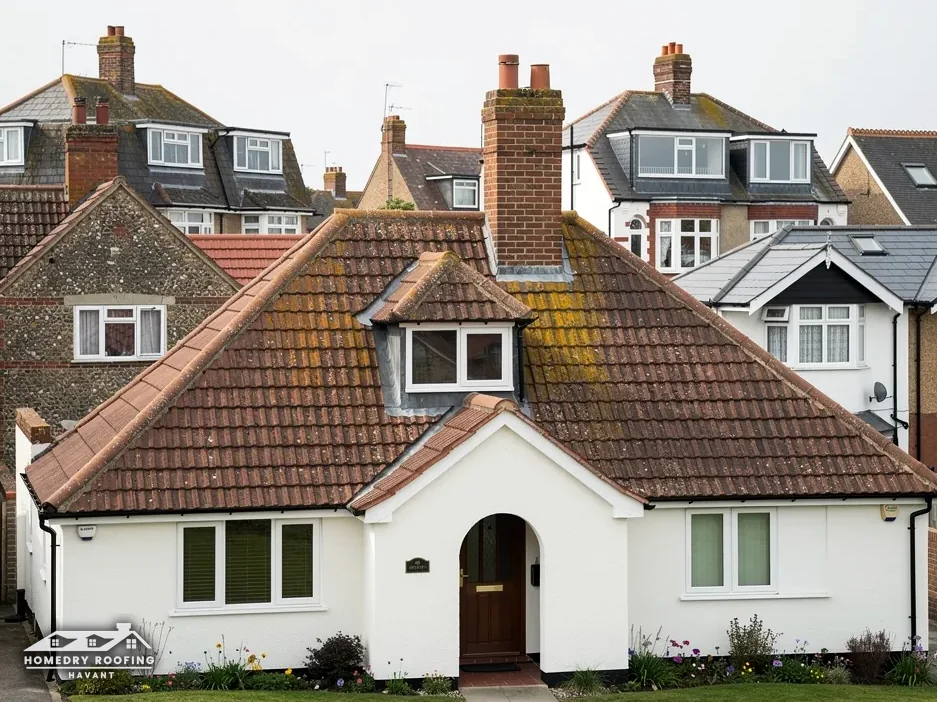
Stacks
Where a chimney pierces the slope with a lead collar hugging its foot.
Once an edge of that collar lifts, rain trickles down the chimney breast.

Lee-on-the-Solent, a district of Gosport, gets its chimney stacks, gable edges and eaves read one after another, with a single written total price after the survey.
10-year workmanship guarantee, in writing
Where a chimney pierces the slope with a lead collar hugging its foot.
Once an edge of that collar lifts, rain trickles down the chimney breast.
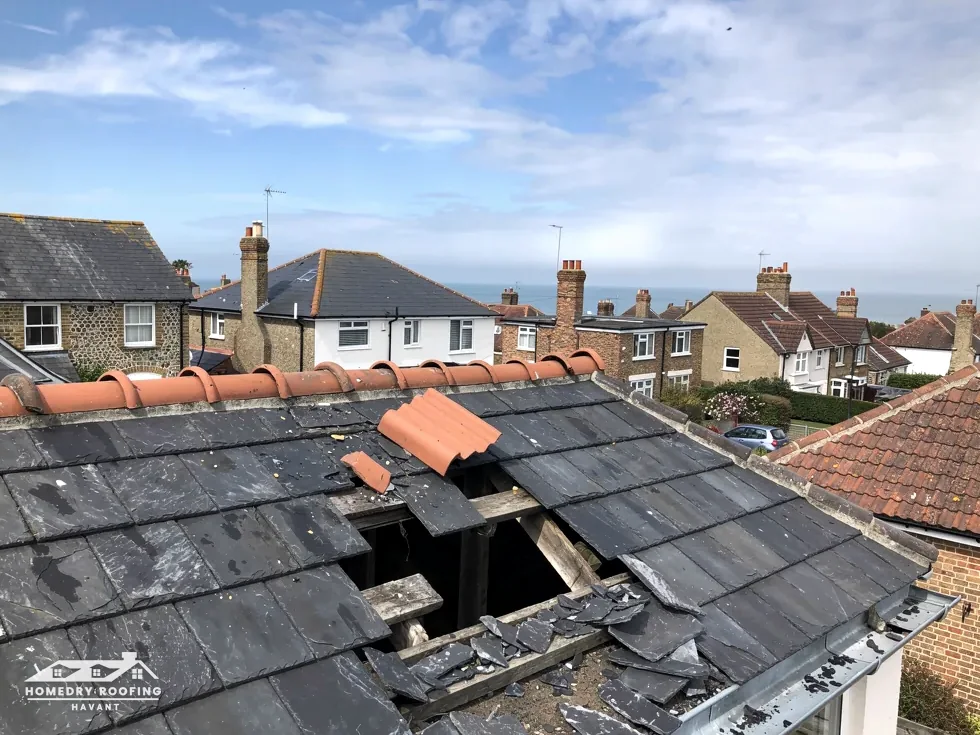
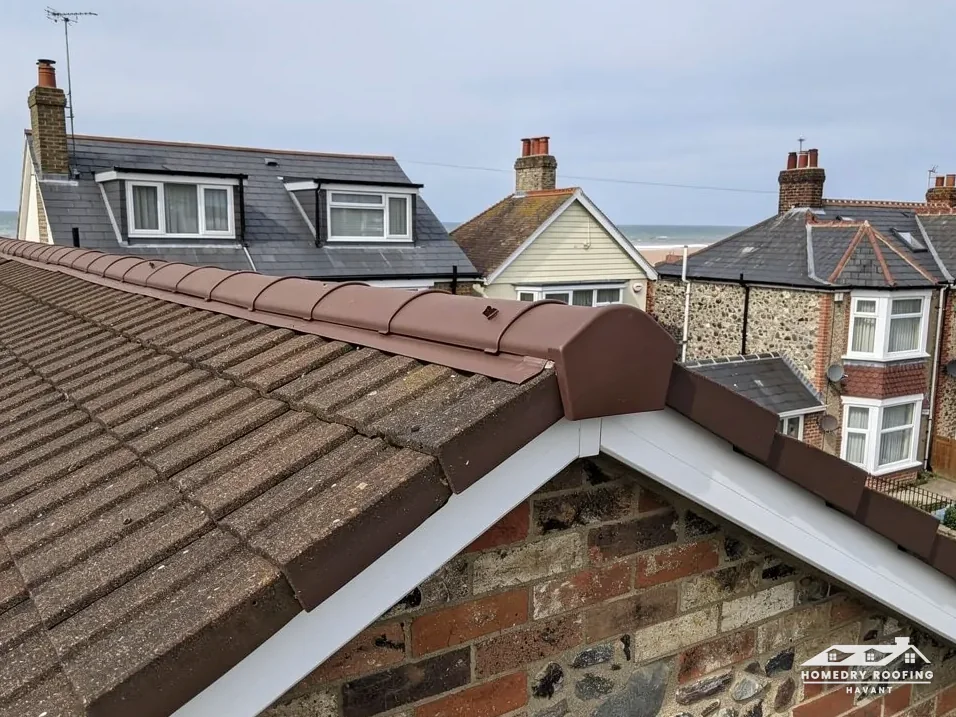
Where the last tiles before a gable wall sit on a bed above the barge board.
A cracked bed lets the edge shift and the top of the wall take on damp.
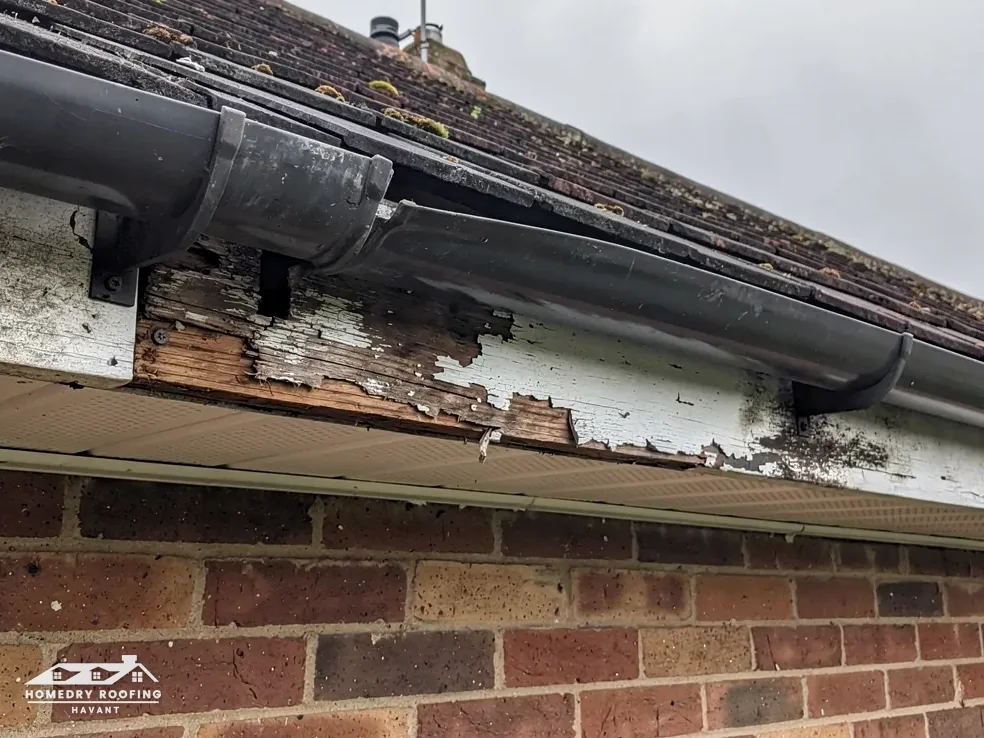
Where a painted board shuts the underside of the overhang at the eaves.
Stains on that board point to a gutter joint or an overspill higher up.
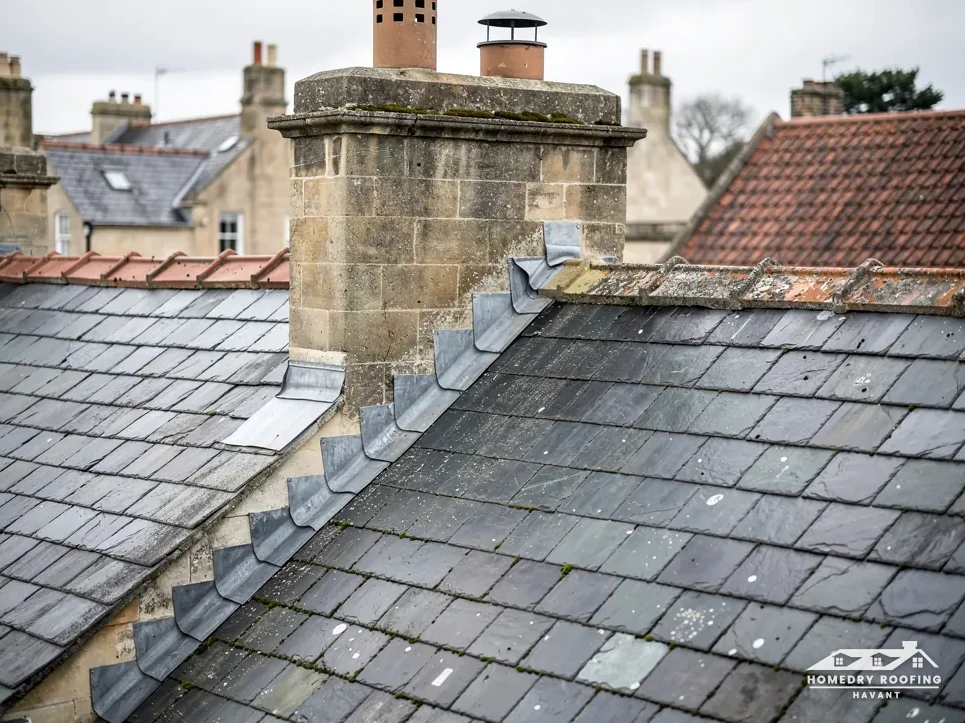
Every join between stack and slope is a place the rain can reach.
A chimney stack interrupts the slope, and each of its faces has to be tied into the covering around it. Our survey therefore begins low on the stack, where a lead flashing wraps it and a soaker, a small folded lead tab, leads the run-off past the join. We check for lifted edges, gaps against the mortar and splits along the folds. Looking higher, we examine the flaunching, the sloping mortar crown that anchors the pots and sheds rain, and the pointing under it. A crack in either lets damp into the stack, and indoors it appears as a tide mark across the chimney breast. A redundant stack gets the same check, because an unused chimney still takes rain at its top, and a capped flue is looked at as closely as an open one. Our chimney repairs page sets out each repair, and the survey notes name the one that suits your stack, with a photograph of the fault beside it.
Lee-on-the-Solent sits on the coast. According to Cupa, the slate maker, buildings in coastal areas "will be graded with higher exposure", so when a stack is rebuilt or a roof re-covered here, the fixing specification is calculated for the site under BS 5534 and written into the notes.
Historic England lists the Church of St Faith and Le Breton Farmhouse, both at Grade II. Work that affects a listed building's character needs listed building consent, while a Church of England church still in use follows the faculty system. For the Daedalus and Lee-on-the-Solent conservation area boundaries, and for any Article 4 direction, Gosport Borough Council is the body to put your address to. Our planning guide for roof work sets those rules out in one place instead of splitting them across town pages.
From the pavement a stack can look sound while the lead around its foot has lifted along one edge. We photograph the base, the flaunching and the pointing from a ladder or the loft hatch, so the notes show you the exact spot. Where the lead is whole and only the mortar beside it has failed, we repoint and dress the lead back down. Where the lead has split, we renew that run and say so in the findings.
A brown stain on the breast of a bedroom chimney, or wallpaper curling in the corner where the stack passes through.
A lifted flashing edge at the join of stack and slope, or a crack across the crown where rain runs down beside the flue.
Marks under the overhang show that water has reached the timber from above. The cause may be a gutter joint that drips, a run that overflows or a gap at the verge. We trace it upward from the mark before deciding whether the board needs replacing.
Along each gable end the roof stops short of the wall, and that strip is the verge. The last row of tiles there sits on a mortar bed or is held by a dry-fix system, and the barge board beneath closes the gap over the rafter ends. We look for cracked beds, edge tiles that have crept toward the drop and boards that have softened or opened at a joint. The notes record how each verge is held, because mending a bed and mending the fixings are different jobs with different prices. Our dry ridge and verge page describes the dry-fixed alternative, and our roof repairs page covers the smaller fixes that rarely need more than a ladder.
The eaves get the same patient look. A sagging soffit or a stained fascia points toward the gutter above it, so each run is sighted for a dropped section, every joint is tested for drips and every downpipe is followed down to the drain. Boards pressed in several places tell us whether the timber behind the gutter has gone soft. We also look at the lowest course of tiles, because one that stops short of the gutter lets its water slip behind the fascia board and miss the run altogether. The notes mark which stretch of gutter is level, which has sagged and which brackets have loosened.
The Environment Agency's flood mapping puts Flood Zone 3 land close to Lee-on-the-Solent. It describes the ground; it is no rule for roofs, and the survey follows the same route either way. Should pavement scaffold be needed, we arrange the licence with our scaffolder, and the scaffold question below has the figures. At the end you are given the findings in everyday words, each fault shown in a photograph, together with one written total price.
The edge of a roof carries the same rain as the middle, with less to hold it.
A gable edge looks simple from the garden, yet three things meet there: the tiles, the board beneath them and the wall. If rain gets in at one, the damage can show at another, as a stain high on the gable wall inside. We work along the whole edge before naming a cause, and the notes show each fault in a photograph so you can see what we describe.
Map of Lee-on-the-Solent and the places around it, with the dashed line of our 30-mile service area from Havant. The same places are listed below the map.
Our survey starts low on the stack, at the lead flashing that wraps it, and checks the folds, the edges and the join with the mortar. Higher up we look at the crown, the pointing and the seating of the pots, then from the loft we examine the breast for damp staining. A stack whose only fault is tired pointing is repointed as that, whereas split lead gets new lead along the run. The findings say which is which, a photograph backs each one, and the written price follows from them, so the cost matches what was found and nothing is added that the survey did not turn up.
Under the Planning Portal's guide, re-roofing does not normally need a building regulations application if it affects less than 25 per cent of the building envelope and less than 50 per cent of the roof; a new covering 15 per cent or more heavier does need approval. Building control at a Lee-on-the-Solent address is the Building Control Partnership, on 01329 824823. We put the route to the Building Control Partnership before work starts, relay the reply in ordinary terms and leave the choice with you, and the survey notes can hold that reply alongside the quote. A covering that would be heavier than the present one is raised with them first.
Under section 169 of the Highways Act 1980 a licence is needed before scaffolding obstructs the highway, and the licensing body here is Hampshire County Council. Hampshire County Council charges £211.90 on application for the first 2 weeks and £72 for each additional 2-week period. Hampshire County Council needs the application in hand with ten clear working days left between its receipt and the licence start. Hampshire County Council's page says: "Scaffolding companies must apply on behalf of their customers." You agree the start date first, and we arrange it with our scaffolder.
Historic England lists the Church of St Faith and Le Breton Farmhouse at Grade II. Section 7 of the Planning (Listed Buildings and Conservation Areas) Act 1990 makes listed building consent the route for any work that would alter a listed building's character. As a Church of England church in current use, St Faith's sees its works go through the faculty system, not listed building consent. If your own house is listed, read its entry and put the question to Gosport Borough Council before you buy anything.
Two conservation areas lie near the centre of Lee-on-the-Solent, Daedalus and Lee-on-the-Solent, and whether your address is inside either is purely a matter for Gosport Borough Council. Ordinary re-roofing is normally permitted development even in a conservation area, but an Article 4 direction can remove further rights, and what any direction here covers is for the council to confirm, so check with Gosport Borough Council before work starts. The planning guide holds the national rules, and the notes for your street can carry its answer.
Cupa, the slate maker, says coastal areas are "graded with higher exposure", so the fixing specification is calculated for the site under BS 5534. The batten sizes, the nails and the way ridge and verge tiles are held are then set for that building and its position instead of being carried over from an earlier job. BS 5534 is a code of practice, not law, and the survey notes lay the specification against your own roof, so you can read what has been chosen, which fixing sits where, and why each suits the spot.
Flood Zone 3 land lies near Lee-on-the-Solent on the Environment Agency flood map, but that is a map of flood risk on the ground, and no roof is read differently because of its position: first the ridge, the flashings, the edges, the gutters and the downpipes, then the loft from underneath. Where a downpipe empties against a wall, the notes say so, since the route water takes on leaving the wall matters whatever the height. Flood protection for the building itself is a separate subject from a roofing survey, and we leave it to those who deal with it.
Expect a single written total when the survey is finished, with the findings beside it. Read it for the covering named, the repairs listed and a line that says if VAT and scaffold are priced in or left on top. A second quote compares fairly only if it treats those items identically, so line the two up on them alone, since a figure that leaves scaffold out will look smaller than it is. Where a repair will do the job, that is what we put forward first, and our pricing is good and fair, covering the work set out in the total.
You'll get one written total price.
Fill in what you like. It opens WhatsApp with your message ready to send.