
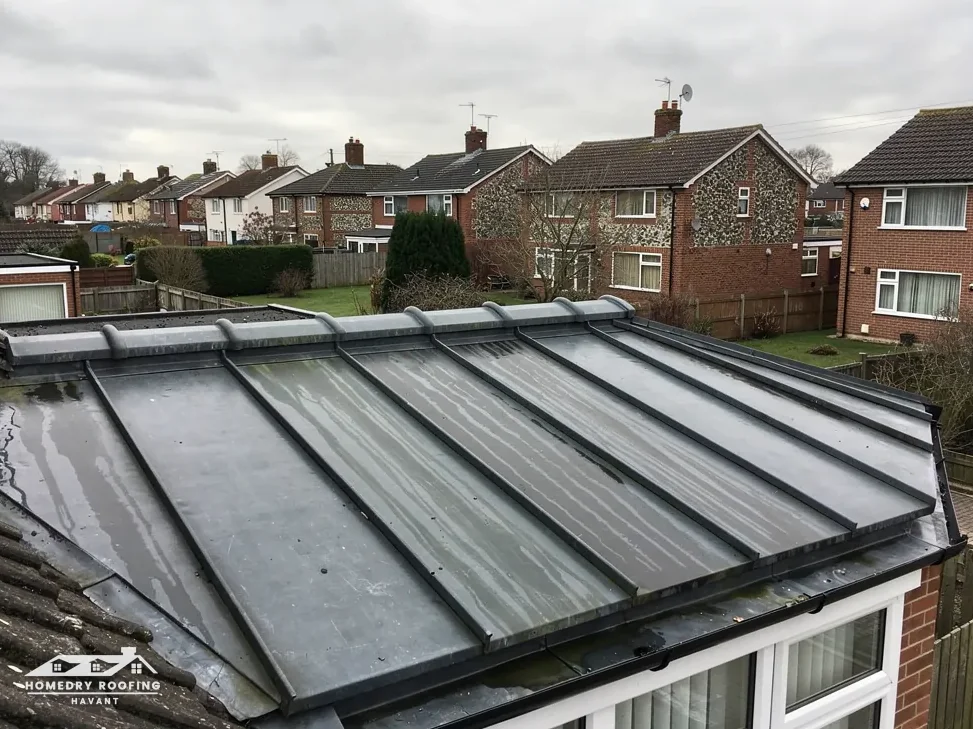
Valleys
Where two roof planes fold together and a single trough takes the rain from each.
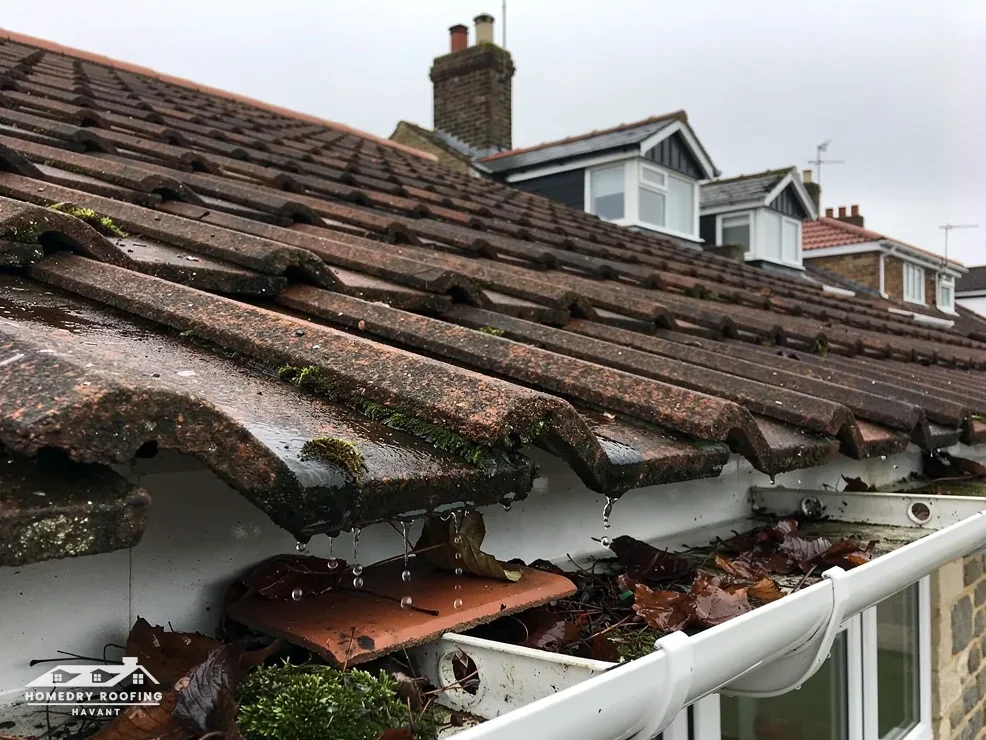
A split or a clogged trough sends the overflow sideways under the tiles.
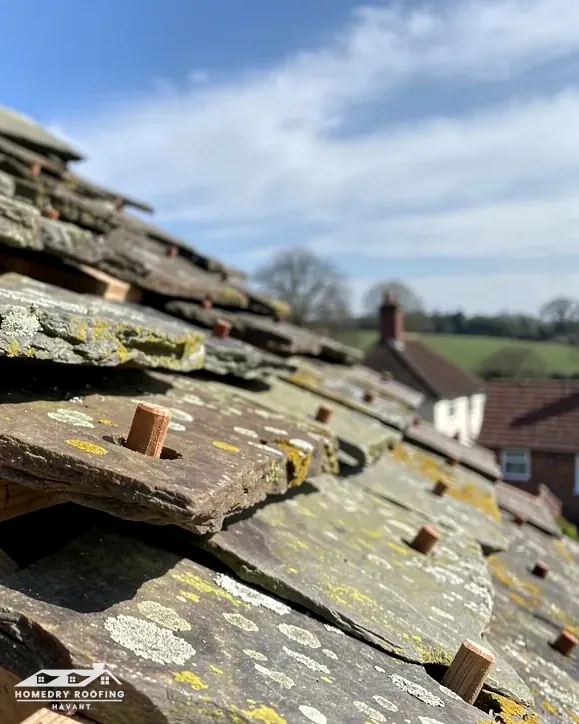
Valleys, lead, gutters and re-roofs in Hambledon, 9.8 road miles north-west of Havant, inside the South Downs National Park, each surveyed before one written total is given.
10-year workmanship guarantee, in writing
Where two roof planes fold together and a single trough takes the rain from each.
A split or a clogged trough sends the overflow sideways under the tiles.
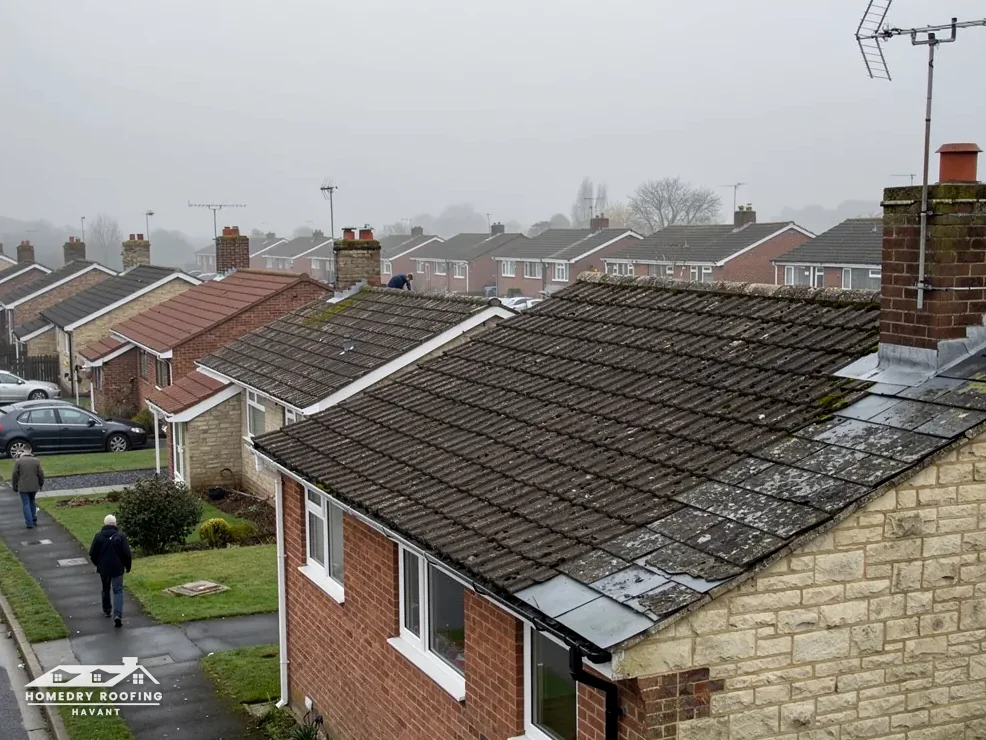
Where roof water drops from the gutter to the ground in a vertical pipe.
A cracked joint or a loose clip drains down the wall in place of the drain.
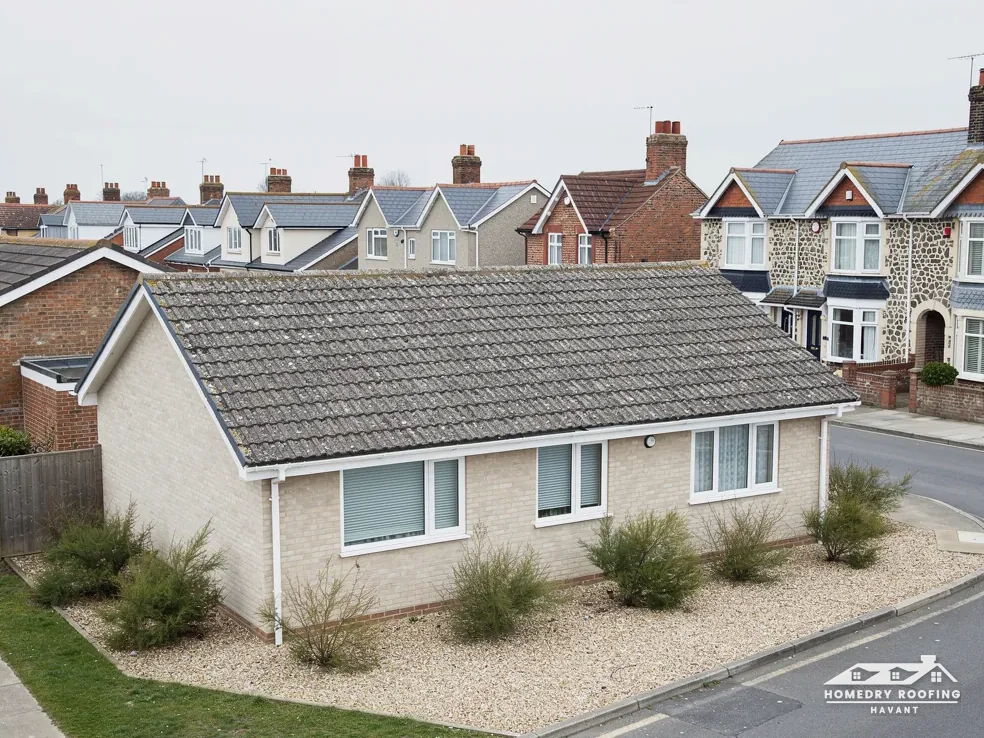
Where a sloping rafter runs down an outside corner beneath a line of capping.
Crumbled bedding lets the capping shift and opens a gap along the corner.

No. Moss and leaves can hide a sound lining, and a clean-looking one can be split beneath the tile ends. We clear the fold first and judge the metal itself, so a lining is renewed only if it has worn through.
Start at the bottom of a valley and work uphill. That is where the trough empties into the gutter, and if the outlet is clogged or the end of the lining has lifted, the whole fold backs up and spills sideways under the cut tiles. From the bottom we follow the lining upward, looking at its seams, at the cut tiles either side for chips and gaps, and at the top end where the two slopes close. Moss and leaves are cleared before the metal is judged, because a layer of debris hides damage and sound lead alike. MyJobQuote says correctly installed lead flashing can last for over 80 years, though that is a flashing figure; for a lining we ask whether it has worn through or only needs cleaning before anyone suggests renewal. A valley that has been relined once already deserves a closer look at the overlap between old and new metal. Inside, we check the timbers beneath the fold from the loft for staining, because a damp mark there confirms the route the water took. Our leadwork page explains how linings and flashings are cut and fixed, and our roof repairs page covers what a mend involves.
Hambledon lies inside the South Downs National Park, where the South Downs National Park Authority holds the planning role. In practice Winchester City Council receives and processes applications on behalf of the Authority, and only a called-in case moves to the Midhurst team. Building control stays with the council, and its team answers on 01962 848 176. Hambledon has a conservation area of its own, and Winchester City Council is the office to ask about an Article 4 direction. Our planning guide for roof work holds the roof rules, and we point to it rather than copy it.
Whatever both slopes shed, the fold must carry, with nothing in reserve.
Two slopes drain into this single strip of metal, so it is asked for more than any stretch of covering around it. Leaves and moss settle in it and keep it damp, and they hide the metal from view. We clear it, record what lies beneath and put the lining in a photograph, so that a local mend or a renewal along the fold is chosen on what was actually seen.
The last metre of the route is the part everyone forgets until it floods.
Rain that has crossed the slope and the gutter still has to reach the ground, and the pipe that carries it is easy to overlook. A hopper at the top catches the run from a gutter or a flat roof and hands it to the pipe; the pipe is held to the wall by clips; at the foot a shoe turns it towards the gully. We check each joint for staining, each clip for a firm hold and the pipe itself for cracks, and where it passes a window or an eave we make sure it is not rubbing or leaning on a loose bracket. Plastic and metal pipes are checked in the same way, joint by joint. The hopper is examined for cracks at its mouth and corners and for leaves packed into its throat, each clip is tested by hand, and the gully gets a look for a blockage, since a blocked outlet at the bottom sends the water back up the system. Brett Martin advises a fall of 1 mm for every 600 mm towards the outlet along the gutter above, and a sagging run will starve the pipe in one place and flood it in another. Our gutters, soffits and fascias page explains what renewal involves.
The National Heritage List gives the Church of St Peter and St Paul as Grade I and Manor Farmhouse as Grade II*. The church is still worshipped in under the Church of England, so its repairs go to that Church's faculty system, and listed building consent from the council does not come into it. Manor Farmhouse takes the other route, because a listed house needs listed building consent for a change that bears on its character. Both entries have pages on the list, and reading them is the first step before any survey date is chosen.
A damp patch low on an outside wall is easy to blame on the ground. A downpipe joint that has parted at head height can be soaking the same brickwork, and a gully that is full pushes water back against the wall's foot. We trace the route from the gutter to the drain before suggesting that the cause lies elsewhere, and the findings say where the water was seen going.
A dark streak on the wall below a joint, a hopper that overflows in a downpour, or a puddle at the foot of the pipe.
A clip that has let the pipe lean, a joint parted at the socket, or a gully clogged with silt and leaves.
The bottom end is where the trough empties into the gutter, so a blockage or a lifted lining there backs the whole fold up and pushes rain sideways under the cut tiles. We clear that outlet first, then follow the lining up the fold, checking its seams, the cut tiles either side and the top end. The loft gives a view of the timbers under the fold, and we read them for marks. The findings say whether the lining can be mended where it lies or needs renewing, with photographs. If leaves were the only fault, we clear them and report the metal as sound.
Planning for Hambledon sits with the South Downs National Park Authority. In practice Winchester City Council receives and processes applications on its behalf, and only a called-in case moves to the Authority's Midhurst team. Building control is a separate matter that stays with the council; the Authority offers none of its own. Ordinary re-roofing follows the usual rules, set out in our planning guide, which also says where each one comes from. Put any question about your own address to Winchester City Council, quote your full postcode, and keep the reply with the survey, so that the answer is on record.
By the Planning Portal's test, work that touches less than 25 per cent of the building envelope and less than 50 per cent of the roof can proceed without a building regulations application in the normal run, whereas a covering 15 per cent or more heavier needs approval. Weight is therefore looked at before a covering is chosen. Winchester City Council's building control team handles Hambledon addresses. Before any strip-off we put the plan to that team, and we keep its reply in writing with the survey, so the route is settled before the first tile moves, and any condition the team sets is known in advance.
Hampshire County Council licenses highway scaffolding under section 169 of the Highways Act 1980, at £211.90 on application for the first 2 weeks and £72 for each additional 2-week period, and the licence cannot start until ten clear working days have passed. Hampshire County Council's page says "Scaffolding companies must apply on behalf of their customers." We arrange it with our scaffolder. Because extra time needs a new application, the length of the job is settled with you first, and the licence is applied for to match it, so the scaffold is not on the road for longer than the work needs.
Yes. Grade I is its listing, and since the Church of England still holds worship there, repairs are put to that Church's faculty system in place of the council's listed building consent. Only the church in use gets that route. A house that is itself on the National Heritage List follows the council route instead, and the entry is worth reading before any date is agreed or any material ordered, because the consent a house needs is a different application from a church's and takes its own time. The Church of England's own contacts can explain its system, which sits apart from the council's.
Manor Farmhouse is a listed house, so listed building consent is needed for a change that bears on its character, which could include a different roof covering or a rebuilt chimney. The planning authority in Hambledon is the South Downs National Park Authority, with Winchester City Council taking enquiries for it, so put the question to that council before work is planned. Close photographs of the roof in its present state, set into a written survey, give that conversation something firm to start from, and it records the covering as it stands today, which matters if the Authority asks what was there before.
Hambledon has a designated conservation area, and planning here sits with the South Downs National Park Authority. Replacing a covering is normally permitted development there too, but an Article 4 direction can remove further rights, and only the planning offices can say whether one covers your road. Check with Winchester City Council, which acts for the Authority here, before booking work, and ask for its reply by email. Our planning guide gives the other roof rules and their sources, so the question you put can be short, exact and quick to answer, and the reply can go straight into the file with the survey photographs. It names the team and the date.
The mapped centre of Hambledon lies in Flood Zone 3 on the Environment Agency flood map. The zone describes land and is not a roofing rule, so it does not change how a covering is chosen, fixed or priced. What matters to the roof is where its water goes, which is why the survey follows it from the valley and the gutter down the pipe to the gully. The survey itself stays with the roof. If the map is part of a mortgage or insurance question, that is a conversation for the lender or the insurer.
You'll get one written total price.
Fill in what you like. It opens WhatsApp with your message ready to send.