
Chimneys
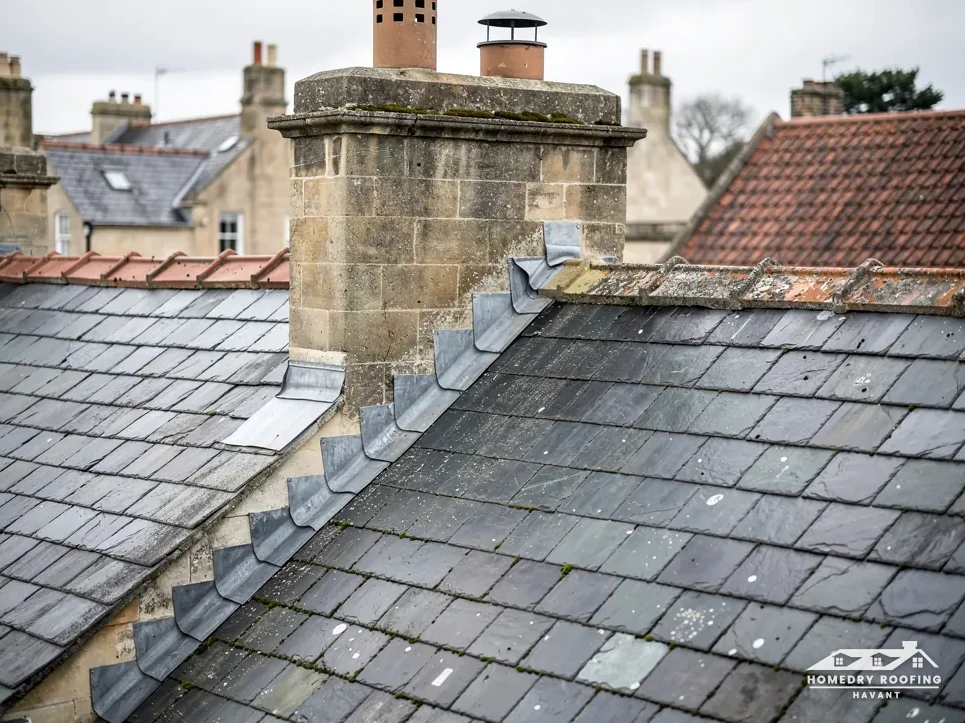
A brick stack that rises through the slope, with lead stepped into its sides.
A lifted flashing or a cracked cap lets rain run in beside the flue.
Botley is 17.6 road miles west of Havant, in Eastleigh Borough. Its chimneys, soffits and gutters are surveyed together, and one written total price follows the survey.
10-year workmanship guarantee, in writing
A brick stack that rises through the slope, with lead stepped into its sides.
A lifted flashing or a cracked cap lets rain run in beside the flue.

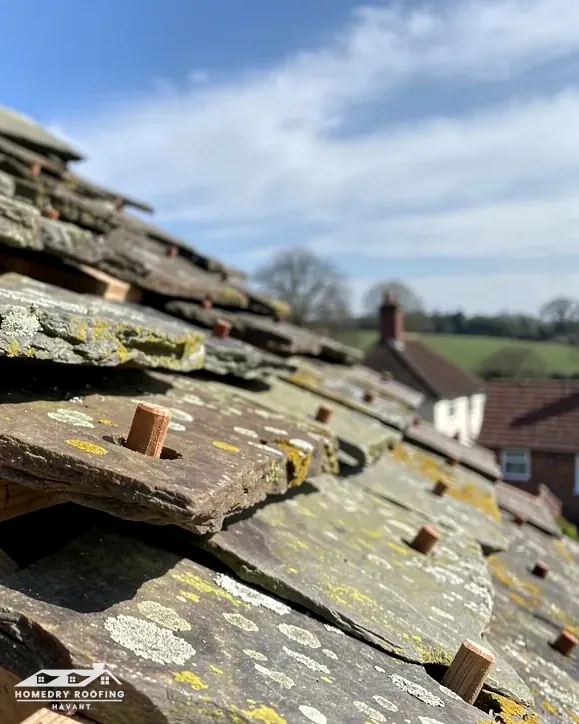
The boards under the roof's overhang, closing the gap between wall and fascia.
Soft or stained boards show rain that has been passing the gutter above.
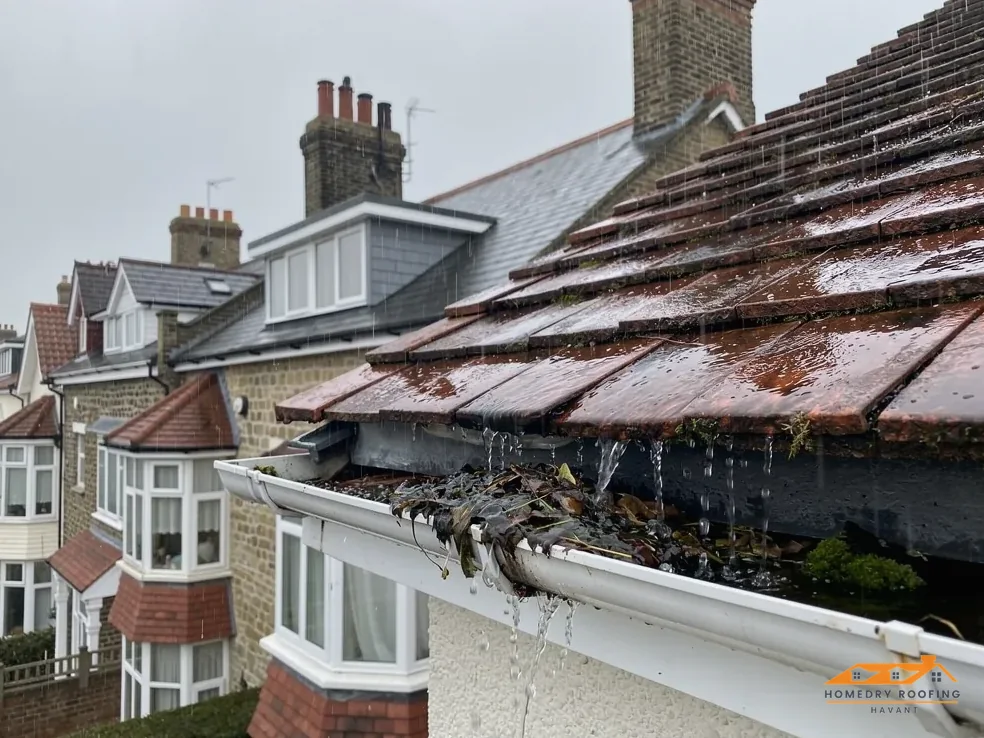
The board running along the roof's foot, which the gutter brackets screw into.
Rot in it loosens the brackets and tips the gutter off its slope.

Where brick meets slope, the lead does the work.
A chimney stack stands in the way of the rain, a small brick tower with the roof sloping into every side of it. Where slope meets brick, lead tucked into the mortar has to carry the join, so at a Botley stack we look at the flashings stepping up each side, the apron across the front and the tray or gutter behind it. Then the brickwork: open mortar joints, spalled faces, a cracked cap, and the flaunching, the sloping mortar bed that holds each pot in place. Indoors, the first sign may be a tide-mark on the chimney breast of a bedroom, or a patch of damp plaster beside it that darkens after rain. Repointing, rebuilding and re-flashing are described on our chimney repairs page.
Botley's Church of All Saints carries a Grade II listing, and the Church of England uses it for worship; works on a church in that position are handled through the faculty system, not by listed building consent. Bugle Inn is Grade II listed too, and for a listed building like that, works that would affect its character as a building of special architectural or historic interest need listed building consent from Eastleigh Borough Council. Historic England's list entry is the place to read what exactly is protected.
The Botley conservation area is designated, and Eastleigh Borough Council holds its boundary. Further permitted development rights can be taken away by an Article 4 direction; whether one reaches your road is for Eastleigh Borough Council to say, so check with Eastleigh Borough Council, and ask before work starts, not partway through. What any direction covers is not set out here, because only the council's own notice can say. The planning guide for roof work carries the rules that do apply, so they are not restated on this page.
A stack and a roof slope are two materials that move by different amounts, and the join between them depends on lead tucked into a cut mortar joint. If that edge lifts or the mortar crumbles, rain runs behind the metal. We look at every step of the flashing, press the apron, tap the mortar line above it and photograph each one, so the findings can say which part of the join needs work.
A brown stain on a chimney breast upstairs, or a damp patch spreading across the ceiling beside it.
A lifted lead flashing, an open mortar joint or a cracked cap, each giving rain a path beside the flue.
Yes, where the boards either side are firm and the fixings are sound. We press the neighbouring lengths before saying so, because new timber beside a soft run only moves the weak point along. The findings show which lengths go and which stay.
Beneath the overhang of a roof a narrow board fills the space between the wall and the fascia board: the soffit. It shows rain that has been getting past the gutter well before a ceiling does. Along a Botley roof we press the soffits and fascias for soft spots, look for flaking paint or dark staining, and check that the gutter brackets are biting into sound timber. Paint that has opened along a joint is marked even where the timber beneath still feels hard, because an open joint lets water reach the wood. Bargeboards at a gable end are pressed in the same way. A short length that has gone can be replaced on its own; where the board has softened throughout, the findings say so and say why. Our gutters, soffits and fascias page covers renewal.
Land near Botley lies in Flood Zone 3 on the Environment Agency's flood map. This is a property of the land, nothing to do with how a roof is built or mended. It is, though, a reason to trace each downpipe to where it discharges, and to record in the findings anything that sends roof water back against a wall.
The Planning Portal sets the national test at less than 25 per cent of the building envelope and less than 50 per cent of the roof, within which a re-roof does not normally call for a building regulations application; approval is needed where a new covering increases the weight of the roof covering by 15 per cent or more, and the Portal advises a structural check in that case. We raise the route before work begins with Eastleigh Borough Council's building control, and it is delivered through a partnership arrangement with Southampton City Council. The council's reply reaches you in plain words, alongside the findings, and the decision stays with you.
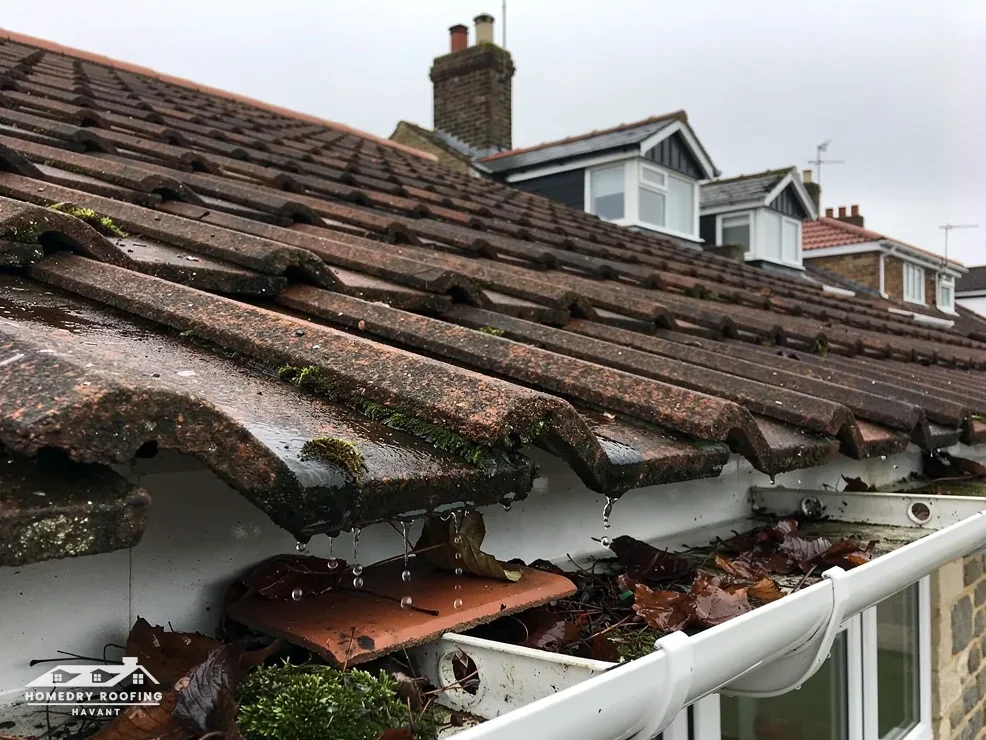
Soft timber at the eaves records where rain has been.
Soft timber behind a gutter shows that the gutter has been leaking for some time. A board that gives under a thumb, paint that blisters in a line, or a bracket that has pulled out of its fixing all point to water passing the gutter. We press the boards along the run, mark the weak lengths and photograph each one, so you can see how far the problem goes.
We start where the roof slope meets the brick, reading the lead flashings that step up each side, the apron across the front and the tray behind. Then the stack itself: mortar joints, the faces of the bricks, the cap and the flaunching under each pot. Indoors, the chimney breast is checked for stains and damp. Photographs of each part go into the findings, so you can see whether the fault is a lifted flashing, open joints or a cracked cap, and whether the pot is firm, and the repair is described in proportion to what was seen, with repointing, re-flashing and rebuilding named separately.
Eastleigh Borough Council's building control team, delivered through a partnership arrangement with Southampton City Council, so that is the team we raise the route with before work begins. The Planning Portal's guide is the national test: a building regulations application is not normally needed where less than 25 per cent of the building envelope and less than 50 per cent of the roof is affected, though approval is needed if a new covering raises the weight by 15 per cent or more. Whatever Eastleigh Borough Council replies is relayed to you in plain words, together with the findings, and the final decision is yours to make once you have both in front of you.
The Botley conservation area is designated, so first find out whether your house sits within its edge. Winchester City Council lists an area of the same name, so an address near the district edge may need that council instead. Eastleigh Borough Council holds that line and can answer from an address. Ring or write to it, and pass the answer to us so it can be recorded with the survey photographs. Houses outside the edge are surveyed in exactly the same way, to the same depth, with the same photographs. The roof rules themselves, with their sources, sit in our planning guide, which is why none of that is repeated on this page.
It could, and Eastleigh Borough Council is the one to say. An Article 4 direction can take away permitted development rights that would otherwise apply, and the notice itself, held by the council, is the only reliable statement of what it covers; this page does not summarise any direction. Check with Eastleigh Borough Council before booking any roof work, because that is the least costly point at which to learn about a restriction. If a direction touches your road, we read the notice with you, and the written price waits until its requirements are plain.
Not in the usual way. The Church of All Saints is Grade II listed, and because the Church of England uses it for worship, works go through the Church of England's faculty system and not through listed building consent. Other listed buildings differ. Bugle Inn and The Dolphin Hotel the Dolphin Public House are Grade II listed, and any work affecting their character would need listed building consent from Eastleigh Borough Council. Whichever applies, read the list entry on Historic England's site ahead of any purchase or booking, and put any remaining doubt to the council.
Hampshire County Council licenses scaffolding on Botley's roads under section 169 of the Highways Act 1980, and it requires that "Scaffolding companies must apply on behalf of their customers." The charge is £211.90 on application for the first 2 weeks and £72 for each additional 2-week period, and its rule is a gap of ten clear working days before the planned start. We arrange it with our scaffolder; the start date is agreed between us and you ahead of the application, so that notice sits in the plan from the beginning rather than arriving as a delay.
The Environment Agency's flood map shows land near Botley in Flood Zone 3, which tells you about the land and adds nothing to what a roof requires. The practical consequence is for the water the roof sheds: each downpipe is traced to its end, and any pipe that is blocked, or that empties onto a wall, is recorded in the findings. A clear route away is worth having wherever the land lies. Questions about flood risk for one property go to the Environment Agency, which publishes the map, and the survey itself is unchanged by the zone, which is why the photographs of gutters and gullies matter as much as the roof above them.
Expect the job, its covering and the fixings to be named, with the VAT and scaffold position stated plainly so that nothing is assumed. The survey comes first, and one written total price follows it, with the findings attached and the repair put first wherever it is sound. We aim for a price that is both good and fair, and the check open to you is to ask every firm quoting to set out identical details on paper, because a lower figure sometimes leaves an item out. Photographs of the roof go with it, so the description can be matched to what is up there.
You'll get one written total price.
Fill in what you like. It opens WhatsApp with your message ready to send.