
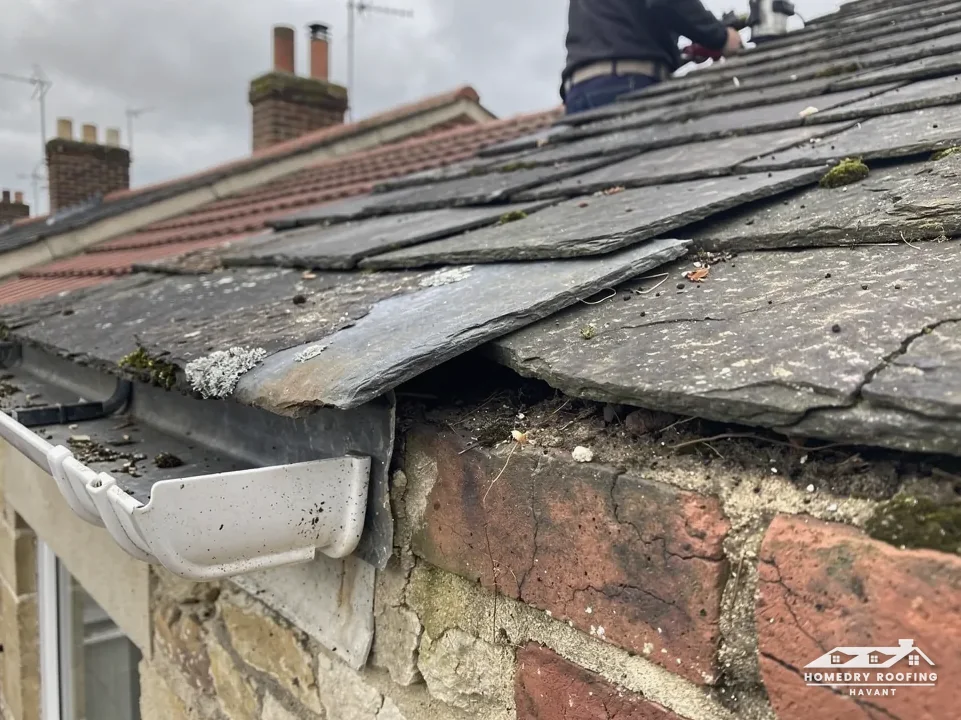
Valleys
Where two Bassett slopes slope inward and meet, and one channel has to carry the run-off of both.
A thinned stretch of lining or a drift of leaves there sends the flow under the neighbouring tiles.

Bassett is a district of Southampton, 23.8 road miles west of Havant. The valley linings and the boards under the eaves are inspected first, then reported in plain language.
10-year workmanship guarantee, in writing
Where two Bassett slopes slope inward and meet, and one channel has to carry the run-off of both.
A thinned stretch of lining or a drift of leaves there sends the flow under the neighbouring tiles.
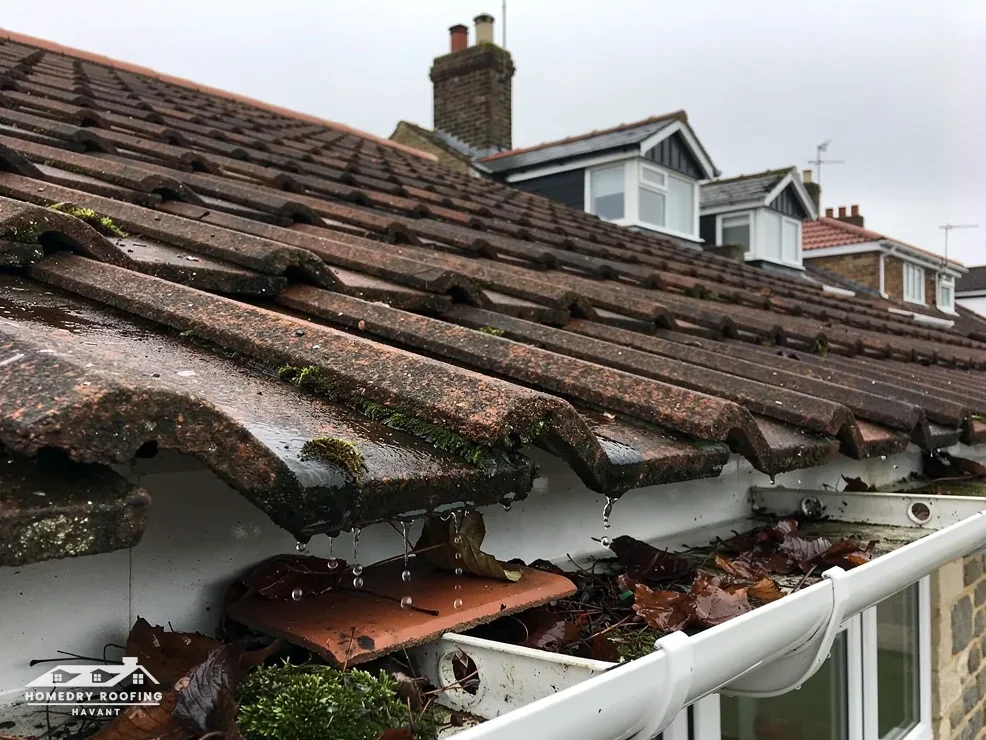
Where the flat board under a roof overhang closes the gap between the wall and the fascia.
A stained or flaking patch on that board points to damp coming from the gutter above it.
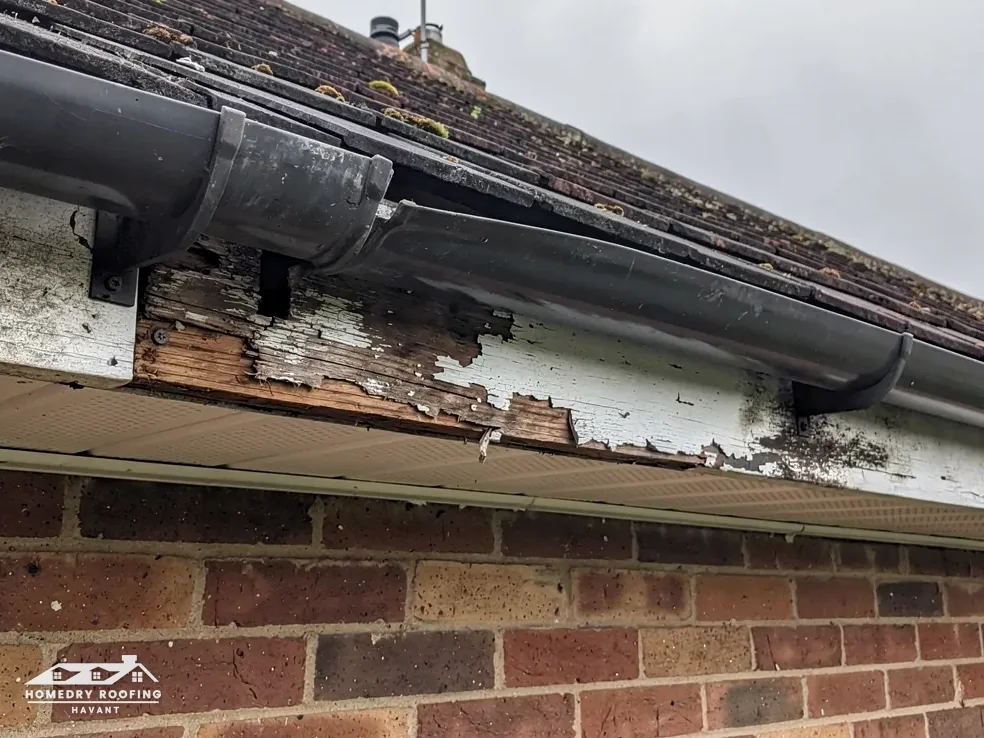
Where the upright board along the foot of the slope takes the screws that hold the gutter.
Once that timber softens, each bracket works free and the run drops out of its fall.
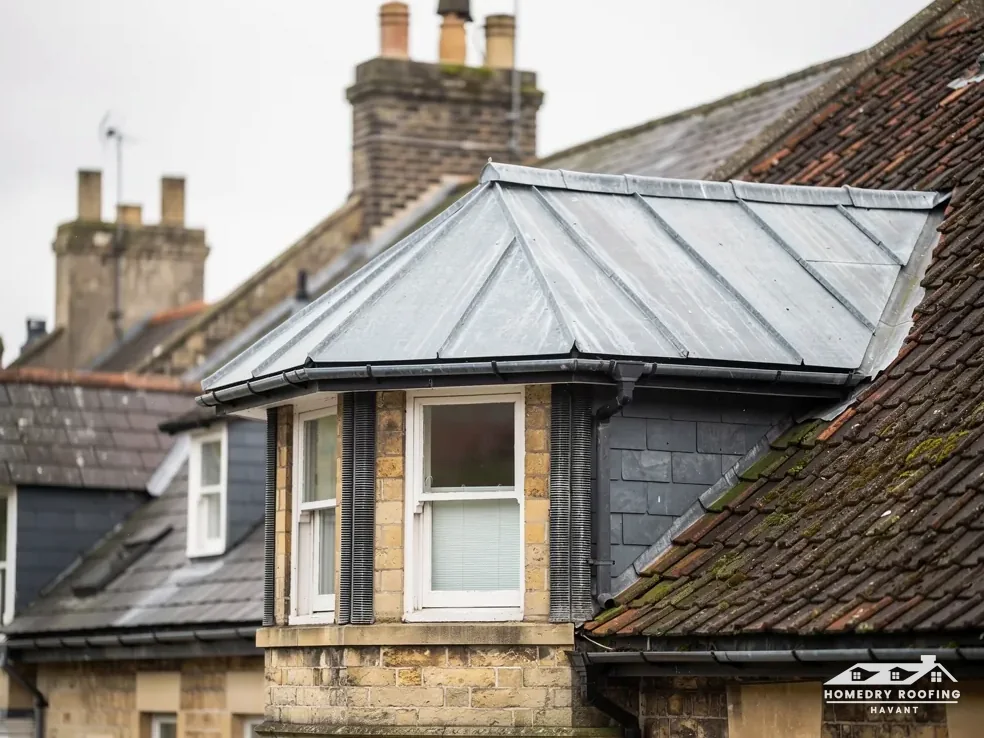
Two slopes drain into one crease, and it must carry both.
Where two Bassett slopes meet at an inward angle, the crease between them takes the run-off of both, and it is the first place a surveyor looks on a roof with more than one pitch. Leaves, moss and grit settle in it, so we clear the crease by hand before judging the lining beneath. Then comes the inspection proper: thin patches in the lining, splits along its centre line, and the tile cuts on each flank, which can slip and let the flow run underneath them. From the roof space we look at the timbers below the crease for darkening. A stretch that has worn thin is relined along its length, and an obstruction is simply cleared, so the pictures show you which case applies. Where the lining rises against a wall at its upper end, that top edge is looked at too. The roof repairs page describes the work, and the leadwork page covers lined valleys in lead.
The Uplands Estate conservation area lies close to the centre of Bassett, and Southampton City Council holds its boundary, so ask the council whether your address sits inside it. The National Heritage List records a listed building close to the centre, and any listed house needs listed building consent for work that would alter its character. Cutthorn, a scheduled monument (list entry 1001914), is a separate class of protection: under AMAA 1979 section 2, works to a scheduled monument are an offence unless the works are authorised.
Southampton City Council also has an Article 4 direction for the Uplands Estate Conservation Area. Rights that would otherwise apply can be removed by such a direction, so check with Southampton City Council before you plan any change to a slope facing the road. The planning guide for roof work carries the national rules, so they are left there.
A valley carries the rain of two slopes in a single channel, so it takes a heavier flow than the plain slope on either side, and leaves and moss collect in it. Standing debris holds damp against the lining and the tiles cut beside it. We clear the crease by hand, then study what lay beneath, and a photograph taken before anything is lifted shows you the condition we found.
A damp patch high on a side wall, or a stain in an upstairs corner that returns every autumn.
A thinned or split stretch of lining, or cut tiles along the crease that have slipped, so run-off travels beneath them.

Only if the timber beneath is sound. Paint over a board that gives under a screwdriver hides the trouble without stopping it, so we press the wood first, and the findings say whether it needs painting, patching or replacing.
Under the overhang of a roof sits the soffit, a flat board that closes the gap between the wall and the fascia. The fascia is the upright board along the foot of the slope, and the gutter is screwed to it. These boards are the first timber a leaking gutter wets, so in Bassett we press them with a screwdriver tip at every bracket, looking for softness, and note any flaking paint, dark staining or a seam that has opened. A board that gives under the tip has been damp for a while. Peeling paint on its own is no reason to renew anything, and the findings record as much whenever the timber beneath is sound. The gutters, soffits and fascias page lists the options from a single new length to a whole line.
Brackets matter as much as boards. Each one is checked to see whether its screws bite or have pulled, because a gutter hung from loose fixings sags between them and collects a pool that was meant to drain. Brett Martin advises a fall of 1 mm for every 600 mm towards the outlet, and we sight along each run against that figure. A run that has dipped may only need its brackets refixed to sound timber. A run with a hump in the middle will go on holding water until it is re-hung to a proper slope, and no amount of cleaning out will change that. Where the end of a run stops short of the downpipe, the shortfall is noted too.
The findings come to you in everyday words, with photographs of any soft board or loose bracket, and the written total price comes after them. If the boards are sound and only a bracket has failed, that is what the quote covers, and nothing larger is proposed than the roof needs.
A sagging gutter can be a soft board speaking up.
A gutter bracket is only as firm as the board it is screwed into. When a fascia softens, the screws pull, the run sags and the sag holds water that was meant to leave. So we press the board at each bracket, count the ones that hold, and tell you whether the fix is one new length of timber or the whole line. Any soft spot is photographed beside the note.
Map of Bassett and the places around it, with the dashed line of our 30-mile service area from Havant. The same places are listed below the map.
We clear the crease of leaves and moss by hand, because debris hides the lining. Then the lining is checked for thin patches and splits, the tile cuts on both flanks are tried for slipped pieces, and the roof space gets a look at the timbers below the crease for darkening. A damp mark on a side wall can trace back to the same crease. The findings say whether the lining needs relining along its length or only clearing, and the photographs show the lining before and after it is cleared, so you can follow the reasoning on the page. Where debris was the only trouble, we report a lining in sound order.
Two separate questions arise. On building regulations, the Planning Portal's guide puts the line at work affecting less than 25 per cent of the building envelope and less than 50 per cent of the roof, inside which an application is not normally required, while a new covering 15 per cent or more heavier is treated differently, because it needs approval regardless of area. Before the start date we put the question to your building control body and report its reply plainly, leaving the decision with you. Planning permission is a different matter, and our planning guide explains what to check for a listed house or one in a conservation area.
Scaffolding over a highway needs a licence under section 169 of the Highways Act 1980, and in Bassett Southampton City Council issues it. Southampton City Council says contractors who hold £10 million public liability insurance may apply for a licence, and its fee is a £496 minimum: a £157 licence fee, £146 for pre- and post-inspections, a refundable £157 deposit and £36 per weekly inspection, renewable weekly at £36 per week. We arrange it with our scaffolder; the dates are agreed with you ahead of the application.
Not directly. Cutthorn (list entry 1001914) is protected under AMAA 1979 section 2, which makes works to a scheduled monument an offence unless the works are authorised, and that protection attaches to the monument itself. An ordinary house roof is governed by other rules: listed building consent for a listed house whose character the work touches, and the conservation area and Article 4 checks below. If your own house is on the list, search the entry by address and send it to us before any covering is ordered, because the entry describes what is protected.
Southampton City Council holds the boundary, so give it your address instead of judging by the street. Ordinary re-roofing is normally permitted development even in a conservation area, but an Article 4 direction can take away further rights, and the council has one for Uplands Estate. Check with Southampton City Council before changing a slope that faces the road. Pass us its reply and we write it into the survey notes with the date, so the roof plan and the council's answer stay together and nothing is left to assumption on either side.
Press a screwdriver tip into the board at a bracket, from a ladder or step that you are comfortable on. Timber that resists is sound; timber that gives, or crumbles, has been wet for some time. Look for paint that bubbles in a line, a dark stain below a gutter joint, brackets that sit crooked and a bare patch where the paint has lifted away in a sheet. If you would rather not climb, send us photographs taken from the garden, and we will say what they suggest and whether a visit is needed. The survey then tests every bracket along the run and records which ones hold.
Walk round after rain. Note any gutter that overflows at a joint or at its middle, a green streak running down a wall, tiles that sit out of line near a valley, and leaves heaped where two slopes meet. Indoors, a ceiling stain that has spread since last month is worth a dated photograph, and so is any new crack in the paint beside a chimney or a roof window. None of this replaces a survey, but a few clear pictures let us say where to start before we arrive, and they give you a record to compare against once the work is done, which is useful if a stain returns.
It should state them. The total on the page ought to say whether VAT is included and whether the scaffold is inside it, and it should come only after a survey of the roof and the roof space. Our quote is one written total price, with the photographs beside it, and these prices are good and fair. When a second quote stays silent on VAT or scaffold, ask for the missing line in writing, and the two totals can then be read like for like, with the same items on each side, without any guesswork about what each one leaves out.
You'll get one written total price.
Fill in what you like. It opens WhatsApp with your message ready to send.