
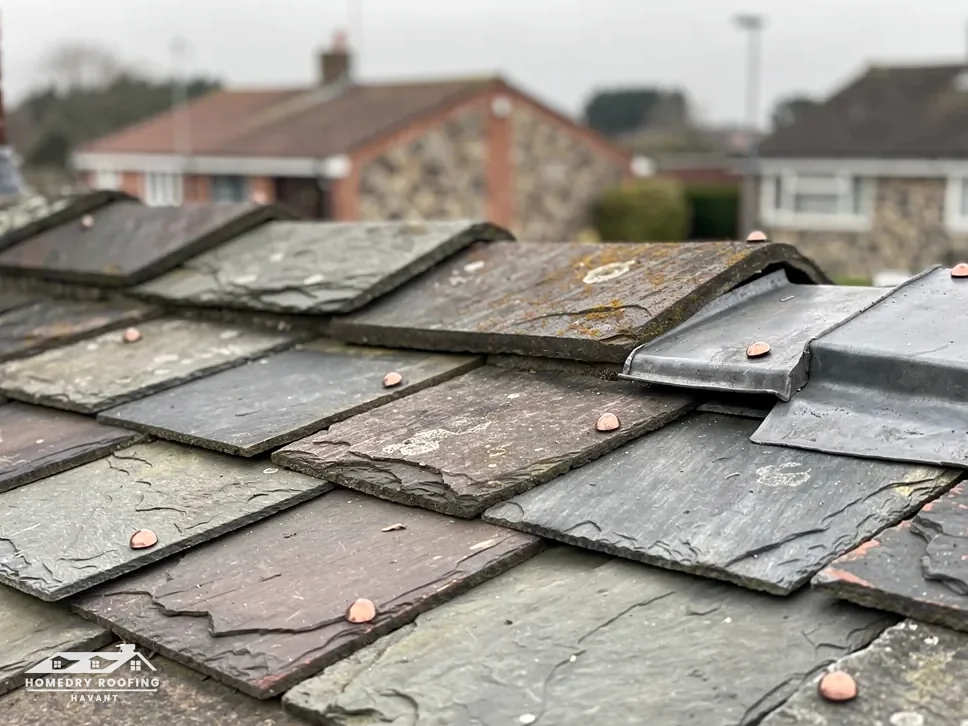
The 20 degree figure and the conditions behind it
Cupa, a slate maker, writes the figure out in full, and the conditions are part of it. It says BS 5534 "also indicates that the minimum roof pitch for natural slate is 20 degrees in the case of a project situated in an area with moderate exposure and with a slate 500mm long and a 115mm overlap".
That sentence describes one combination: moderate exposure, a slate 500mm long and an overlap of 115mm. Each of those can differ on a real roof, and the 20 degrees is stated for that combination only.
Pitch means the angle at which the slope rises from the horizontal. Slate is laid with no sealant between the pieces, so the angle and the overlap do the work of keeping rain out between them, and one cannot be judged without the other.
BS 5534 is a code of practice, and Marley says "Installing to BS 5534 isn't required by law". It is still what the maker is quoting, so it is what a specification is read against. A roof surveyed at, say, 30 degrees leaves a comfortable margin on this figure, while one close to 20 degrees leaves almost none, and the difference decides how carefully everything else has to be checked.
How exposure and slate size move the number
Cupa's own wording on exposure shows why no one figure fits every house. It says "Most significant is the environment, with the two main factors being exposure to wind and rain." It goes on to say that "Buildings positioned on slopes, hills or coastal areas as well as tall buildings will be graded with higher exposure." A house on the Hayling Island shore, or on a rise inland, is therefore not assessed in the same way as a sheltered one in a valley.
The slate itself matters as well. A 500mm slate with a 115mm overlap is one case, and a shorter slate or a different overlap is another. For the overlap and the part it plays, read our answer on slate headlap.
For all these reasons, the number in a general guide is only a starting point. The calculation for your roof belongs to the specification, and the data sheet from the maker of the product you are buying settles the pitch question. A figure remembered from a conversation, or from a forum, is not a substitute for that document, and a quote should be able to point to it.
Hook fixings and the 25 degree line
The method of fixing has a limit of its own. Cupa says "hook fixings should not be used on any pitch below 25º", which is steeper than the 20 degrees quoted for the slate itself.
That gives two thresholds, and a roof can sit between them. At 22 degrees, for instance, natural slate falls within the figure Cupa quotes, but a hook fixing is ruled out, so the slates would have to be held another way. A roof measured at 18 degrees would fall outside both lines, and no choice of fixing would change that.
| What | Pitch |
|---|---|
| Minimum, moderate exposure | 20 degrees |
| Hooks not to be used below | 25 degrees |
The table shows the two numbers and nothing more, since conditions such as slate length, overlap and exposure sit behind them. Neither figure should be taken off the page and applied to a roof without those conditions being checked against the maker's data. Our answer on slate hooks or nails looks at what each fixing does and how a specification chooses between them for a given roof.
A roof shallower than the slate allows
If the pitch you measure falls below the slate's minimum, the roof is not a candidate for that slate as specified. That is a finding about the roof, not a failing by anyone, and there are two sensible ways forward. Neither involves forcing a slate onto a slope that cannot support it, since a covering laid below its minimum pitch is laid outside the maker's own conditions.
- keep the covering the roof was built for, and repair or re-cover it in that material
- choose a covering whose maker publishes a lower minimum, and read its data sheet
Makers publish very different figures. Marley's concrete tiles, for example, run from 12.5 degrees for one Mendip product up to 35 degrees for its plain tile, so the minimum belongs to the product and not to the material class.
The pitch is measured on the survey, and the data sheet is read before anything is specified, so a covering is never ordered and then found to be wrong for the slope. If you are weighing a change of covering, our answer on replacing concrete tiles with slate covers the other checks that go with it. Our slate roofing page describes the rest of the service.