
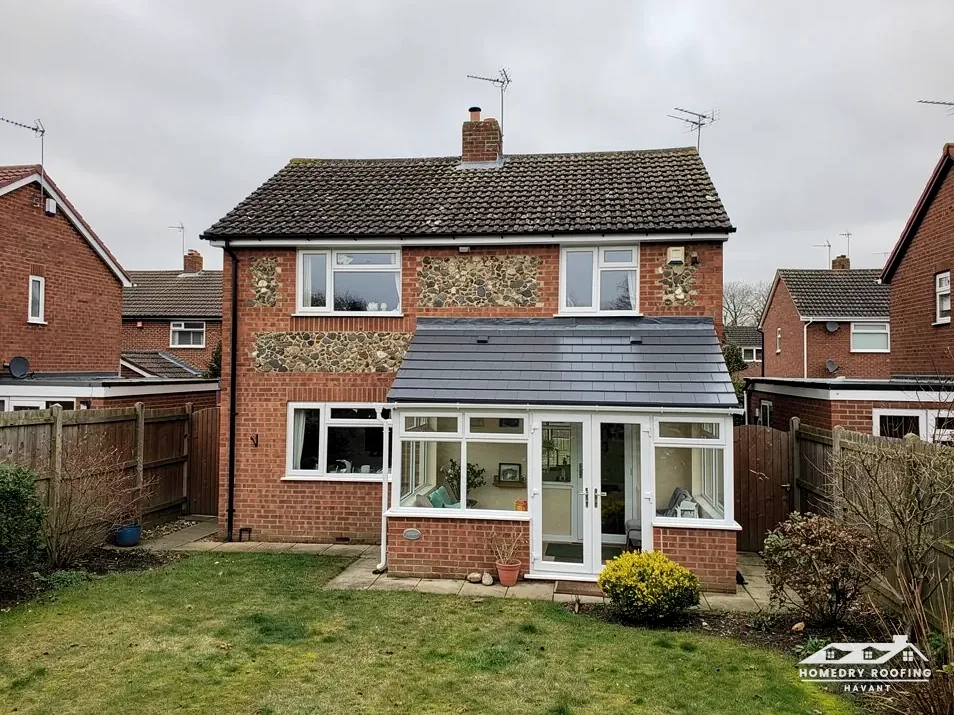
Glazed conservatory roofs come in two main kinds. Polycarbonate sheets are a plastic glazing, light in weight and carried on bars across the frame. Glass units are heavier and carried in the same way. Both can be repaired, both can be replaced like for like, and either can be swapped for a solid roof. Which of those is sensible depends on what is wrong and what you want from the room.
This guide starts with how to read the roof you have, then looks at polycarbonate and glass in turn, sets the three options side by side, and explains how the rules and the frame change the choice. It ends with how we reach a decision at a survey.
Our conservatory roofs page covers the whole service. This guide is for the moment before that, when you are looking up at a roof and wondering what it needs. It makes no assumption that the roof has to come off; sometimes the sensible answer is a small repair and a few more years.
Reading the roof you have now
Start from inside the room, then go outside, because the two views show different faults. Indoors you see stains, drips, condensation and any gap where the roof meets the wall. Outdoors you see the surface, the bars and the gutter. Take photographs as you go; they are useful at the survey and for your own records.
- Identify the covering: twin-wall polycarbonate sheets, single glass panes or sealed glass units.
- Look at the bars that carry the covering, and at the caps that cover them.
- Check where the roof ends against the brickwork of the house.
- Look at the gutter along the front, and at any outlet or hopper.
- Note where the water marks are, and whether they follow a seam.
A stain tells you where water arrived, not where it entered. Rain can travel along a bar or behind a cap before it drops, so the mark on the ceiling or window may sit a metre from the fault. We follow the route back, from the drip to the opening, before saying what the roof needs.
Stay off a conservatory roof. Polycarbonate and glass are not made to carry a person. HSE's position is that roofs are to be handled as fragile until a competent person has shown otherwise, and a glazed conservatory roof is the clearest case. A ladder and a pair of eyes at the gutter line tell you a good deal without any weight on the roof, and a phone photograph from the garden shows more than you expect.
A mark on the ceiling shows where the water landed. The opening is somewhere further along its route.
Polycarbonate roofs and how they age
Polycarbonate is a plastic sheet, usually in twin-wall form with ribs between two skins. It is light, and it is carried on aluminium or uPVC bars that clamp the edges of each sheet. The bars and their seals matter as much as the sheet itself.
HomeBuilding gives a polycarbonate roof a typical lifespan of 10 years. That is a published typical figure, not a limit, and the real age of a roof depends on its exposure, its fixings and how it has been looked after. Sheets can discolour or crack, seals along the bars can shrink, and the end caps can lift. Each of these is a small opening, and a conservatory roof has a great many edges.
The Planning Portal observes that many homeowners choose a solid tiled roof in place of the old polycarbonate one, for better thermal efficiency. That describes a choice some owners make, and it is not advice that everyone should follow; the room, the frame and the budget all weigh in.
- If a single sheet is damaged, a replacement sheet of the same thickness can be fitted.
- If the seals are failing along many bars, resealing may buy time but not change the roof.
- If the whole roof is at the end of its life, replacing the covering is the real choice.
Our short answer on repairing a polycarbonate panel sets out what a panel repair involves.
Glass roofs: weight, seals and what fails
A glass conservatory roof is made of panes or sealed units that sit in a bar system, and the glass carries real weight. The glass itself is only one part of the question. The seals, caps and bars around it can give out, together with sealed units whose seals have lost their grip and let moisture between the panes.
The managing director of Roofing Megastore, quoted by HomeBuilding, says a glass conservatory roof will likely last in excess of 30 years. Roofing Megastore is a supplier, so this is a trade view rather than a test result, but it sets a sensible expectation that glass outlasts polycarbonate where the system is sound.
That longer life has a consequence. A glass roof deserves a repair before it is condemned, because the units and the bars may still be in good order while a seal or cap has failed. A new unit or a new cap costs less than starting again, and the remainder of the roof stays as it was. The survey is where we separate a failed part from a failed roof.
Glass has one more trait worth knowing. Because it is heavy, any change of covering must take its weight into account. Replacing glass with a lighter material reduces the load on the frame, which can help an older frame that has begun to move. Replacing it with a heavier material is a structural question, covered in the section on rules and the frame below, and a survey has to answer it first.
Repair, like for like or solid roof
These are the three real options, and each suits a different roof. The table sets them side by side so you can see what stays, what changes and what to ask. Whatever the choice, the gutter, the outlet and the line at the wall are looked at as part of it.
| Option | What changes | What to ask |
|---|---|---|
| Repair | A sheet, unit, seal or cap | Is the fault local, or a sign of the whole roof ageing? |
| Like for like | The covering, on the existing frame | Does the frame suit the new covering? |
| Solid roof | The covering, the roof build-up and the room's insulation | Can the frame take it, and does it comply? |
A sound repair comes first with us. A local fault on a roof with years left is a repair job, and replacing the whole roof for it would spend money on the wrong thing. If the fault is a symptom of general age, a repair can still be fair, but we tell you it is a short-term step.
A like-for-like swap keeps the room much as it is: same light, same look, the same frame. A solid roof changes the room. It is quieter in rain, it holds heat differently and it shades the interior, and it brings the rules described next into play. Our guide to tiled or lightweight solid conservatory roofs compares the two solid options.
What the rules and the frame add
A repair leaves the existing roof in place, so fewer of these questions arise. A replacement is a new roof, and a solid one brings them forward most of all. The Planning Portal's guidance on replacing a conservatory roof says the new roof has to meet building regulations on structure, energy and ventilation, and that covers a solid roof. We check with building control first. In Havant that means your building control body.
The energy exemption is the other half. The energy exemption is narrow. It covers a ground-level conservatory of up to 30 m² with Part K glazing, and it holds only while a wall, door or window keeps the room separate from the house and the home's heating stays out of it. A solid roof does not alter that by itself, but the roof has to comply in its own right.
Then the frame. Under the Planning Portal's test, a covering that makes the roof heavier by 15 per cent or more needs building regulations approval, and Approved Document A treats a load increase of more than 15% as significant. A frame built for polycarbonate may not carry a tiled build-up without strengthening.
- Light to heavy: a structural check, and possibly work to the frame.
- Glass to glass: a similar load, so the question is the bars and seals.
- Any solid roof: building control, before work starts.
These are checks, not obstacles, and a good survey makes them early, before any money is committed to a covering that the frame cannot carry. Our conservatory roof replacement cost guide shows how they feed into a price.
The covering is the visible choice. The frame and the rules decide whether that choice is possible.
How we decide at a survey
At a survey we read the roof from the inside, from the outside and from the wall, and we explain what we find without jargon. The decision comes from the roof, not from a preferred product. Polycarbonate, glass and solid roofs each suit some houses, and the survey is where we find out which one suits yours.
- We identify the covering, the bars and the seals, and test the visible joints.
- We trace any stains back along the route of the water, tracking from the mark indoors to the opening outdoors.
- We look at the frame and the line at the house wall for movement or gaps.
- We ask how you use the room, because that changes what the roof should do.
- We say whether a repair, a swap or a solid roof is the sensible next step, with the reasons laid out for you to weigh.
You then get one written total price, with the covering, the insulation and the scaffold stated, so you know exactly what it includes. Where a repair will hold, we advise the repair, even though a replacement would be the bigger job. A smaller job that does the work is the right size of job, and the written price will say so.
You can help before we arrive, and it costs nothing. Photograph the room and the roof from outside, note when drips occur and in what weather, and find any paperwork from the original installation. That history can show how the roof was fixed, and it saves time on the day.