
The three published figures
All three figures come from HomeBuilding's conservatory roof cost guide. The first is HomeBuilding's own. The other two are the words of the managing director of Roofing Megastore, a supplier, which HomeBuilding quotes. They carry a seller's perspective rather than a test result, so the table credits each figure to the person who gave it.
| Roof | Wording | Said by |
|---|---|---|
| Polycarbonate | "They have a typical lifespan of 10 years." | HomeBuilding |
| Glass | "A glass conservatory roof will likely last in excess of 30 years." | Roofing Megastore's managing director |
| Tiled | "A tiled conservatory roof will typically last in excess of 50 years with little maintenance being required." | Roofing Megastore's managing director |
Each wording carries its own hedge, and the hedge is part of the claim. Dropping "likely", "typically" or "little maintenance" would turn an opinion into a promise, which none of these sources made.
Polycarbonate is the figure to watch, because it is the shortest. A roof of that kind that has passed the published age is not failing by definition, but it deserves a closer look at its sheets, seals and fixings than a younger roof would.
What a lifespan figure leaves out
A conservatory roof is more than the covering you can see. Under and around the sheets, glass units or tiles sit the frame, the seals, the wall flashing, the gutter and its outlet, and each of those ages in its own way. A covering with years left in it can sit on a joint that has failed, which is how a roof can leak while its covering is sound.
The flashing against the house can be done in lead. MyJobQuote says correctly installed lead flashing can last for over 80 years, and the words "can last" and "correctly installed" are part of that claim. A lifespan describes a material that has been fitted properly and kept in order. It is not a date on which a roof stops working.
None of the figures in the table is a promise, and none belongs to a particular roof. They are a place to begin asking questions, and the survey supplies the answers for the roof that is actually there. Ask also what has been done to the roof already, because earlier repairs and replacement parts follow their own timetable.
Tile makers and the tiled roof
A tiled conservatory roof carries the same kind of tile as a house roof, so the tile makers' own figures are worth reading beside the supplier's. Marley says: "Typically, roof tiles are expected to last for around 60 years", and adds "This is not a guarantee or warranty of its longevity." For clay tiles Marley says the BRE determined a minimum life expectancy of 60 years, and that figure belongs to clay only.
HomeBuilding's cost guide gives 60 to 80 years, approximate, for clay and 40 to 50 years for plain concrete tiles, so the sources differ and both are named. Neither says why the numbers differ, so read each one with its source.
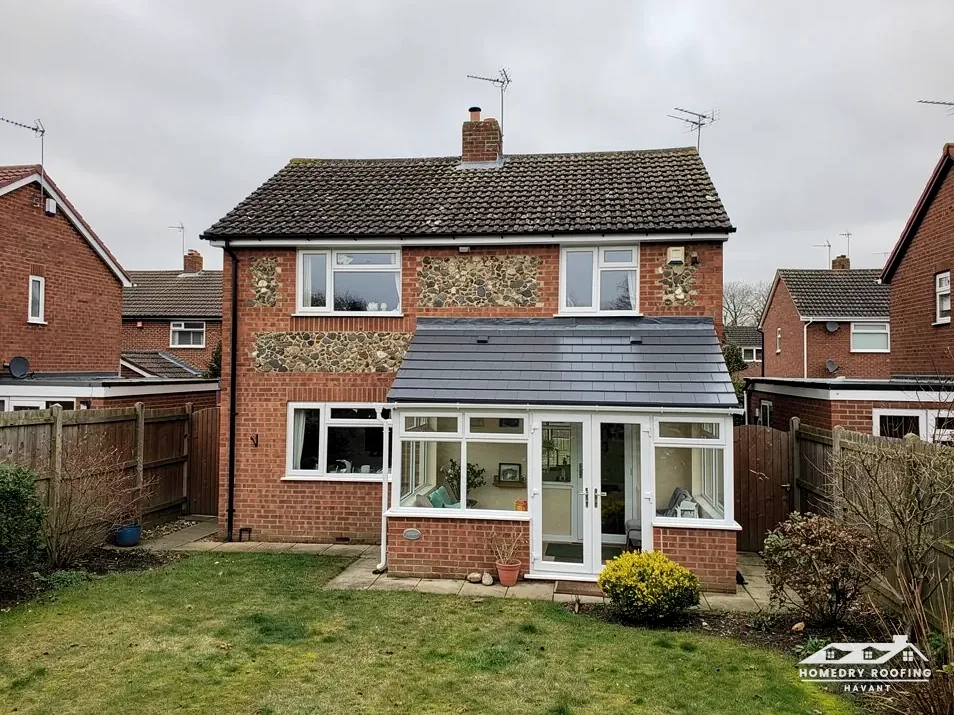
The supplier's figure for a tiled conservatory roof is a separate statement about the whole roof, and it carries the hedge "with little maintenance being required". Maintenance here means the gutter outlets, the flashing and the sealed joints being looked at from time to time.
Whichever figure is quoted, ask what it assumes. A roof that is cleared of debris, whose outlets run freely and whose sealed joints are checked has a better claim on a long life than one that is left alone for decades, and the published wording says as much.
Repair or replace at the survey
Age alone is a poor reason to replace a roof. A survey looks at the covering, the seals, the frame, the wall junction and the gutter, and sets out what needs doing and why. If the covering and its supports are sound, repairing them comes first, and the survey says plainly when a roof has run its course.
The reasons come with the recommendation. You see what was found, where it was found and why it points to a repair or to a new roof, so the decision rests on the condition of your roof and not on a number printed in a guide. That is the reason a survey is worth having before any figure in this answer is used to make a decision.
For one cracked sheet, see can one polycarbonate panel be replaced. For what a replacement is published to cost, see the tiled roof cost answer, and for how a price is built up, the replacement cost guide. The wider choices are on the conservatory roofs page. Whichever way the survey points, the cost is written down as one amount for the whole job.