
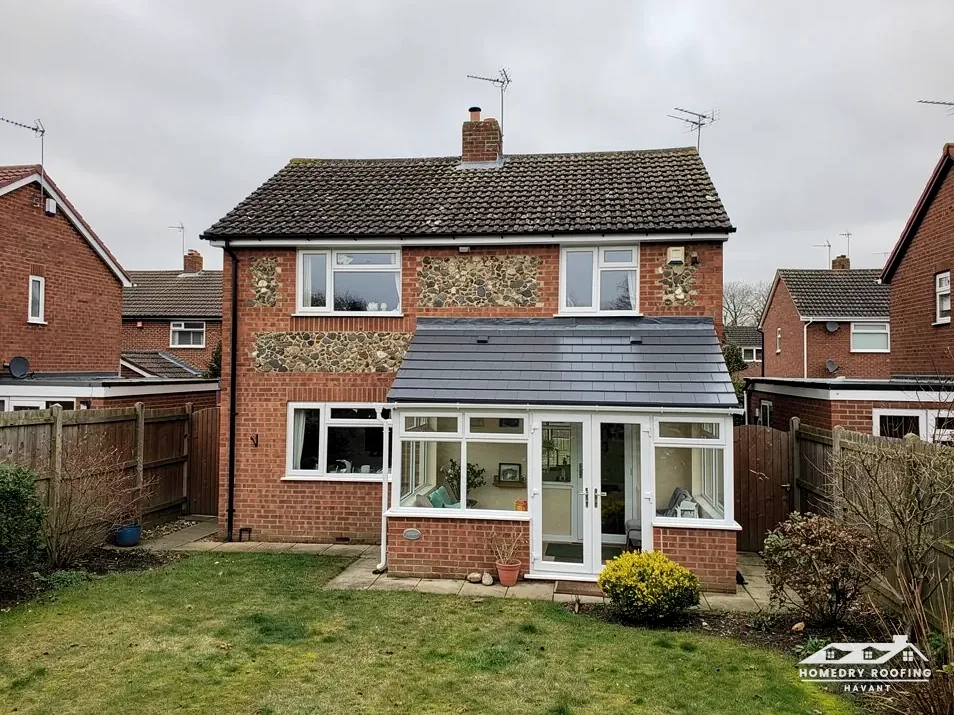
A conservatory roof covers a room people use every day, so the cost question arrives with another one: what is actually being replaced? New polycarbonate or glass units over the old frame are one job. A tiled or solid roof built on that frame is a different job, and the published figures reflect the gap between them.
This guide sets out two third-party UK ranges with their sources and dates, then the things that move a price inside a range. It goes on to the frame and walls, which decide what can be fitted at all, the rules that touch the work and how long each type of roof can last. The figures belong to the cost guides that publish them and none is our price.
For the full picture of what we do on these roofs, see our conservatory roof replacement page. Here the subject is money, and what stands behind the numbers.
The two published ranges and their dates
Two pages on MyJobQuote cover this job, and they give different ranges, one for the average conservatory roof replacement and one for tiled conservatory roofs. Each page carries its own date, and neither states whether VAT is included, so read both as rough guides to scale and not as quotes. The dates matter, because building costs move and an older page may describe last year's market.
| Roof | Range | Source and date |
|---|---|---|
| Average conservatory roof replacement | £3,200 to £6,000 | MyJobQuote, page dated 20 October 2026 |
| Tiled conservatory roof | £6,000 to £15,000 | MyJobQuote, page dated 23 September 2026 |
The first page says that in 2026 the average conservatory roof replacement costs between £3,200 and £6,000. The second says the cost of a tiled conservatory roof replacement typically ranges from £6,000 to £15,000. The two ranges meet at £6,000, and the tiled range stretches much further at the top. MyJobQuote does not explain the width, so read it as a sign to ask what your own roof involves.
Neither page is about a Havant home or a Hampshire price list. They are national guides, and they cannot see your frame, your walls or the height of your eaves. Treat the range that matches your plan as the outer edges of the question, then let a survey narrow it. The price that applies to your roof is the one written down after that survey, as a single total.
A published range describes roofs in general. Only a survey can place yours inside it.
What moves a price inside a range
Two conservatories with the same floor area can sit at opposite ends of a range. These are the things that push a price one way or the other, and a good survey asks about every one of them.
- The covering chosen: sheets, glass units, a lightweight solid roof or a full tiled build-up.
- The footprint and shape, including a lean-to, a hipped end or a faceted front.
- The state of the frame, and whether it needs work before it can take a new roof.
- How the roof meets the house wall, which decides the lead work along that line.
- The gutter and outlet arrangement, including any box gutter.
- Access, and whether scaffold or a hoist is needed to reach the roof safely.
- The insulation and ceiling finish indoors that go with a solid roof.
- Building Regulations work, where a solid roof brings it in.
None of these is a surprise charge. Each is a question the survey answers once, so that the price already allows for it. A tiled roof can raise most of them at once.
Ask what a price covers before you ask what it totals. Check that the quote spells out scaffold and VAT, and that it names the covering, the insulation and the lead at the wall. Two totals only compare fairly when they describe the same roof, built the same way, with the same things left in or out.
Frame and walls come before the covering
A conservatory frame was built to carry what its first roof weighs. A new roof can weigh more, and the frame, the base and the house wall all have to accept that load. So the covering you can afford is only part of the question. The other part is what the structure beneath it can carry, and a survey has to answer that before it can name a price.
The Planning Portal sets a test for this. Approval under the Building Regulations is needed where a new covering material increases the weight of the roof covering by 15 per cent or more, and it recommends taking advice from a structural engineer or surveyor before the work begins. Approved Document A defines a significant change as one where "the loading upon the roof is increased by more than 15%". A covering that much heavier needs approval and a structural check, whatever it is made of.
- Look at the frame for movement, rot or open joints at the corners.
- Check the base and walls for cracks that suggest settlement.
- Find out how the existing roof is fixed to the house wall.
- Compare the weight of the proposed build-up with the one coming off.
If the frame needs strengthening, that work is part of the price, so the figure is settled before work starts and not during it. A survey that skips the frame cannot give you a price you can rely on. Our guide to tiled and lightweight solid conservatory roofs looks at how the two kinds of solid roof compare on this point.
Where the rules touch the price
Rules affect cost because they decide what the new roof has to achieve. In England, a ground-level conservatory of up to 30 m² with Part K glazing is exempt from the energy rules in Approved Document L, but only while two conditions hold. A wall, door or window still separates it from the house, and the heating system of the dwelling is not extended into it.
A new solid roof changes the position. The Planning Portal says a new roof has to comply with building regulations, so that it is structurally safe, energy efficient and properly ventilated. We check with building control first, and for a Havant address that means your building control body. Building control is carried out by the council's building control team or by a registered building control approver.
| Question | What decides it |
|---|---|
| Is the conservatory exempt from the energy rules? | Approved Document L 2021, paragraph 0.14 |
| Does a new solid roof comply? | Building regulations, through building control |
| Is the covering 15 per cent or more heavier? | Planning Portal test, with a structural check |
This work is not a tax on the job. It is the design and paperwork that show the roof is safe and sound, and it is simpler to settle before the first tile is laid than after. Our guide to conservatory roof building regulations goes through the questions in order.
Settle the rules at the survey. An answer found after the roof is on costs more than asking first.
How long each roof can last
Cost means more when set beside lifespan. A cheaper roof that needs replacing sooner is a different bargain from a dearer one that lasts longer, and the published lifespans are worth knowing even though none of them is a promise. Each comes from a different voice, so the table names who is speaking.
| Roof | Published lifespan | Who says so |
|---|---|---|
| Polycarbonate | A typical lifespan of 10 years | HomeBuilding |
| Glass | Likely to run past 30 years | Managing director of Roofing Megastore, quoted by HomeBuilding |
| Tiled | Typically past 50 years, with little maintenance needed | Managing director of Roofing Megastore, quoted by HomeBuilding |
The two MyJobQuote ranges above have no separate row for polycarbonate or glass, so these lifespans cannot be matched to them one for one. How far a longer life justifies the difference depends on how long you plan to stay, how you use the room and what the existing frame will take.
Roofing Megastore is a roofing supplier, and the second and third figures are its managing director's view as quoted by HomeBuilding, not a test result. Treat all three as typical figures for a roof that has been fitted correctly and looked after. A frame that moves, or gutters that are left blocked, can shorten the life of any covering, so the maintenance a roof gets belongs in the sum alongside its price. A polycarbonate roof replaced every decade and a tiled roof left alone for far longer are not the same purchase.
Getting one written total price
After a survey we give one written total price for the job. That total follows from the checks described above, and it is the one number that belongs to your roof. We say plainly whether the old roof can be mended or must come off, give the reasons, and put a sound repair ahead of a replacement.
Before you compare any two totals, put the same questions to each:
- Which covering is it, and what insulation sits under it?
- Does the price include scaffold, and does it include VAT?
- Is the lead at the house wall part of the job?
- What happens to the gutter and the outlet?
- Is any frame work needed before the roof goes on?
- Who deals with building control, and when?
A price that answers all six is a price you can compare. A price that is silent on them leaves room for the answers to arrive later, when they cost more to deal with. Clear answers early save that trouble. It also helps to ask how long the work is expected to take, and what will be done about the room while the roof is off, since a conservatory open to the weather is awkward to live beside.
If the old roof is still sound, our guide to what to do with an old polycarbonate or glass roof explains the options short of a full replacement, and where each one can fall short. Bring photographs of the roof and the room to the survey if you can; they speed up the talk about what you want from it, and they show us the existing roof before we climb to it.