
What rain does to a roof job
A wet roof is a poor place to work. Tiles and slates turn slick, boards and ladders get wet, and every layer taken off leaves the house open to whatever the sky does next. That is why a re-roof is planned in stages: the underlay and the battens (the timber strips the tiles or slates hang from) are dealt with as the work moves across the slopes, never all at once.
Rain also reaches parts of the house you cannot see from the garden. A stripped slope lets water onto ceilings, loft insulation and stored boxes, so the plan should cover the open area when the crew leaves each evening, and the loft contents should be cleared before work begins.
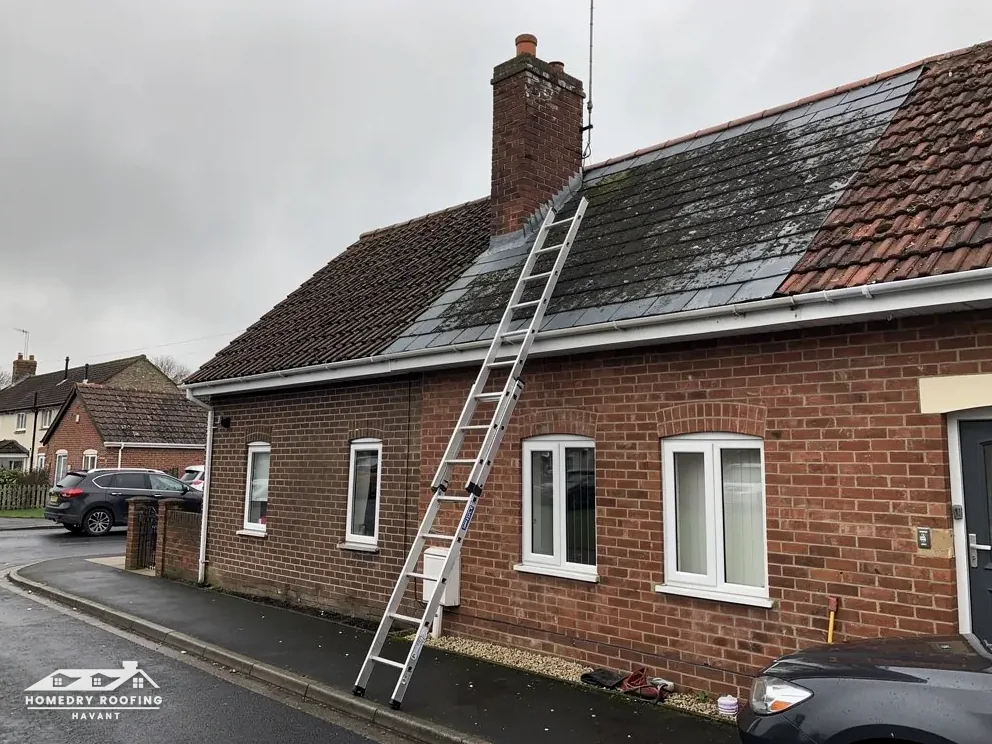
If you are tempted to look at the roof yourself, stay off it. A wet surface adds to the danger of any fall, and the climbing is best left to a roofer with the right access equipment. A roofer can show you photographs of what the survey found, which is a safer way to see the problem than a ladder in the rain.
Ask, too, who is responsible for the cover over the opening if the weather turns while you are out at work.
Cold spells and the product data sheet
Winter brings its own questions, and the answer for each product sits in the maker's data sheet rather than in a general rule. The sheet for a membrane, an adhesive, a sealant or a mortar says what it needs from the surface and from the air around it, and a roofer works to it. A cold morning may suit one product and rule out another used elsewhere on the job.
That is why a flat roof is a different question from a pitched one. A pitched roof of tiles or slates is laid course by course, each course overlapping the one below, so every row covers the last as it goes on. A flat roof depends on a continuous covering, such as EPDM (a rubber sheet), GRP (glass-reinforced plastic, often called fibreglass) or felt, and the data sheet decides when that covering can be laid.
Ask which products are going on your roof, and ask what each data sheet says about damp surfaces and low temperatures. A roofer who has read it can answer in a sentence. One who has not should go and look before they book you in, and the answer should come to you in writing, not as a promise at the door.
Questions to ask before a wet-season job
You do not need a weather forecast to judge a plan. These questions show whether the job has been thought through:
- How much of the roof will be open when the crew leaves each evening, and what covers it overnight?
- Which products are going on, and what does each data sheet say about damp surfaces and cold?
- What happens to the start date if the forecast turns, and does the written quote say so?
- Who is clearing the loft, and who is covering what cannot be moved?
- If work stops partway for weather, who tells you, and when does it restart?
- Is there a named person you can call if water comes in while work is under way?
A good answer names a person and a plan. If the reply is vague, ask again in writing and keep the answer with your quote. The questions cost nothing, and the replies tell you more about how a roofer works than any promise about the weather could.
A short list like this also helps when you compare two roofers, because the one who has already thought about rain will answer quickly and the other may not.
Dates, notice periods and the quote
The price and the dates are two separate things. The written quote gives one total price after the survey, while a start date is better treated as a window, because the weather can move it. Get both in writing, and ask what the paperwork says if work stops partway through. A roofer who has thought about the weather will not mind putting the answer on paper, and the reply tells you how the job will be run.
Notice periods set some of the dates before the weather has any say. A scaffold that stands over a public footway or carriageway needs a highway licence. Hampshire County Council wants ten clear working days between applying and starting, and West Sussex County Council asks for at least 10 working days' advance notice. We arrange the licence with our scaffolder, so the start date is fixed weeks ahead and the weather can then move it.
Money is worth settling before the dates are, so read our answer on paying a roofer upfront and the checklist for what a written quote should include. The full range of roofing work is described on the HomeDry Roofing Havant homepage.