
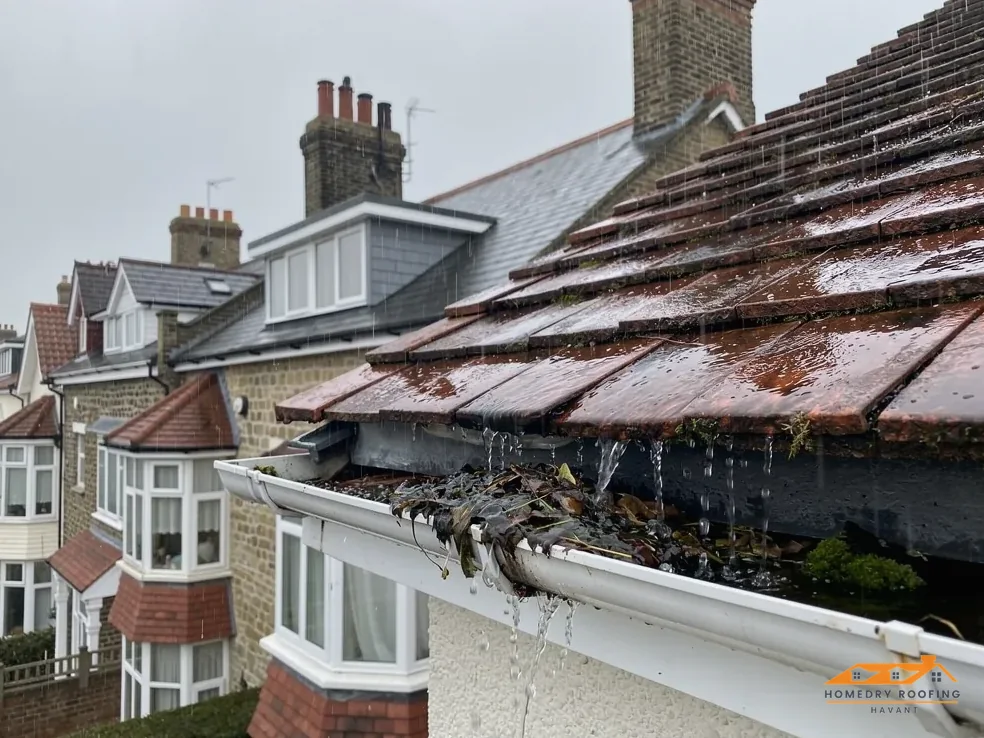
People tend to look at the edge of their roof only when something drips, stains a wall or hangs loose. The edge deserves attention sooner, because it is where the rain from the whole roof gets collected, carried and released, and the parts that manage this are easy to overlook from the garden path.
Three parts share the work. A gutter takes the rain off the lowest row of tiles. Behind it sits the fascia, a board that carries the gutter and finishes the rafter ends. Beneath the overhang sits the soffit, a panel that shuts the opening between the brickwork and the board. Follow one raindrop from the tiles to the drain and you pass all three in turn, each one handing the water to the next.
This post walks that route, explains each term as it turns up, and finishes with what a roofer looks for on a roofline and how to read a quote for the work. These figures come from the cost guides named beside them, and none is our price.
The route a raindrop takes off the roof
Rain that lands on a pitched roof runs down the slope, over the lowest row of tiles or slates, and into the gutter. From there it travels along the channel to an outlet, drops down a downpipe and ends up in a drain or a soakaway. Every stage has to hold, because water that leaves the route ends up somewhere it should not be.
That is why the roofline repays a proper look. A cracked tile near the ridge lets water in at a single spot. A failed gutter can spill the rain from the entire roof down the face of the wall, over the board and into the brickwork below. Both faults can look equally small from the ground, yet they send water to very different places.
The route, stage by stage:
- The roof slope carries the water down to the lowest row of tiles.
- The eaves are the bottom edge, where the roof overhangs the wall.
- The gutter collects the water along the whole edge.
- The downpipe delivers it to ground level.
- The drain or soakaway takes it away from the foundations.
Fascias and soffits belong to the eaves stage, and they are not decoration. One carries the gutter and the other shuts the overhang. If either has failed, the gutter cannot do its work, even when the gutter itself is perfectly good.
A fault at the eaves is also harder to spot than one on the slope, because it shows as a stain, a drip or a sag rather than as a missing tile. A slow leak from a joint can run for a long time before anyone connects the mark on the wall with the board above it.
What a gutter does and the fall it needs
A gutter is a channel fixed along the edge of the roof. Its purpose is to gather the water from the whole slope and move it steadily to the outlet where the downpipe starts. It cannot do that if it keeps a pool of water in it, which is why it is fixed with a slight slope, called a fall, towards the outlet.
Brett Martin, a guttering manufacturer, gives the installation fall as 1 mm for every 600 mm of run, sloping down towards the outlet. Across a 6 metre run that is a drop of 10 mm between the high end and the outlet, hardly visible from the ground. A gutter fixed dead level, or one with a sag halfway along, keeps a pool of water. The pool gathers leaves, loads the brackets and spills over the front lip.
Gutters also need clearing. Which? Trusted Traders put the clearing of front and rear gutters together at £75 to £350, from a survey of 11 traders in November 2025, excluding VAT. A blocked gutter overflows, the overflow runs down the board, and the clearing and the board are therefore linked jobs. A season of overflow can turn a small clearing visit into a boards-and-gutters repair.
Outlets and downpipes
The outlet and downpipe deserve the same attention as the channel. A gutter with a perfect fall still overflows when the outlet is choked, because the water has nowhere left to go. After a downpour, watch where the water leaves the gutter as well as where it lands.
For the full list of causes, our answer on why gutters overflow goes through them one by one.
The fascia: the board that holds the gutter
The fascia is the horizontal board nailed across the rafter ends. The board has two jobs. It hides the rafter ends so the edge looks finished, and it gives the gutter a solid face to be screwed to.
The second job is the one that matters for water. Gutter brackets bite into the board, so the board carries the gutter and whatever water is in it. If the timber is soft or split, the brackets loosen, the gutter sags and the fall is lost. A sagging gutter and a rotten board can be one fault seen from two sides: the gutter hangs from the board, and the board stays wet when the gutter spills. Treating only the visible half leaves the cause in place.
Fascias are made in timber and in plastic. The plastic kind is uPVC, a rigid plastic made as boards. Between 20 and 40 years is the range one retailer gives: correctly installed uPVC boards, it says, can typically maintain reliable performance for that long. That is a seller's figure, and a seller has an interest in the answer, so treat it as a rough guide and not a promise.
When a roofer inspects a fascia, these are the points that count:
- Whether the board is firm at every bracket
- Whether the joints between lengths are open or stained
- Whether the gutter sits at the right height against the roof edge
- Whether dark patches show where a gutter joint has leaked
Timber boards can be repaired where the damage is local, and a local repair is what we price first. Where a long run has softened, replacement is the sound answer, and the written quote says why.
The soffit: closing the gap under the eaves
The soffit is the panel on the underside of the overhang. It runs from the top of the brickwork out to the back of the board, filling an opening that would otherwise lead straight into the roof space. Without it, wind, rain and birds would get into the eaves.
A soffit can be more than a cover panel, and on an older house that matters. Some roofs breathe at the eaves, so that air moves through the roof space and carries moisture out. Marley, a tile maker, sets out eaves ventilation where a high-resistance underlay sits under a cold roof: 25 mm for pitches of 15° or less, and 10 mm above 15°. A solid panel can close that gap, so ask about ventilation before anything is fitted.
Two further points belong here. The first is wildlife. Under the Wildlife and Countryside Act 1981, a person who intentionally destroys or damages a wild bird nest commits an offence once that nest is in use or being built. A nest tucked into the eaves is therefore a reason to pause the work, and the soffit stays untouched until the birds have gone.
The second is asbestos. HSE says to assume asbestos is present if a building was built or refurbished before 2000, and its list of locations includes white asbestos insulating board soffit panels under the roof eaves. Licensing applies to work on that material unless a risk assessment shows the job to be of short duration. Our guide on asbestos in soffits explains what to do first.
Materials, lifespans and what the figures mean
Gutters, fascias and soffits come in plastic, metal and timber. Published lifespans for these parts are thin, and it is better to say that than to fill the gap with a confident number.
What exists is one retailer's range for plastic boards, the 20 to 40 years above, and a few cost guides. A cost guide gives a typical figure for a typical job. It cannot know the length of your roofline, how high it sits or what state the timber behind it is in. The table lists each published figure with its source:
| Work | Figure | Source |
|---|---|---|
| Gutter replacement | Average around £1,000 to £1,600 | MyJobQuote, October 2026 |
| Capping fascias and soffits | Average around £800 | MyJobQuote, September 2026 |
| Clearing all gutters | £75 to £350 | Which? Trusted Traders |
MyJobQuote states no VAT basis, while the Which? figure leaves VAT out. That difference matters when two quotes sit side by side, so find out which basis each uses. These figures are third-party ones, not ours. Once we have surveyed, one written price covers the job, and it states whether scaffold is part of it.
Access moves a roofline price too. A bungalow eaves can be reached from a ladder or a low tower, whereas a three-storey front needs scaffold, and scaffold standing on a public pavement has to be licensed. We arrange the licence with our scaffolder, and the cost is already inside the written price when it reaches you.
What a roofer checks and how to read a quote
A proper look at a roofline starts on the ground and works up. A roofer traces the path the rain takes along the roofline and notes where it leaves that path. Staining on the brickwork below a gutter joint, a green streak down a downpipe, a gutter that holds standing water after rain and a board that feels soft all mark places where the route has broken.
The survey is the basis of the work. If the fault is a loose bracket, the right repair is a bracket. If the board behind it has gone, the job is a new board, because a new gutter on rotten timber just repeats the fault. Where a repair is sound, the survey recommends that before any replacement, and the quote explains why.
When a quote arrives for roofline work, a few questions make it easier to set beside another:
- Will the existing boards be removed, or covered by new plastic?
- Is the gutter being replaced along with the boards?
- Has the soffit been identified, in case it is asbestos insulating board?
- Does the quote state if VAT and scaffold are inside the figure?
- Is the total written down, rather than mentioned in passing?
The whole set of roofline jobs sits under our gutters, soffits and fascias service. The guide on replacing fascias and soffits explains what replacement involves, step by step. If a problem is visible from the ground, a daylight photograph with the damaged part in the frame gives us a useful starting point before the survey.
Filed under Gutters, soffits & fascias