
Natural slate carries a reputation for quality that is more feeling than measurement, and a feeling is not a reason to spend more on a roof. The better questions are practical ones. What does slate cost to fit, how long is it expected to last, what has to be right for it to reach that age, and what does keeping it going involve?
This post sets out the numbers that can be stated, and the limits on them. The cost figures come from MyJobQuote and HomeBuilding, and the lifespans from HomeBuilding, each named and dated. They are third-party figures, not ours and not promises, and neither source has seen your roof.
It also covers the part people skip, which is the fixing. A slate roof earns a long life only when it is laid to a specification that suits the site, and the same stone can fail early if it was not.
What slate costs, from the published figures
Two sources give a slate figure. They are not like for like, so each is shown with what it states it covers.
| Source | Figure | Covers |
|---|---|---|
| MyJobQuote | Around £7,800 | The average cost of fitting a slate roof, no VAT basis stated |
| HomeBuilding | Might reach £18,000 | Welsh slate, three-bedroom semi with a 65 m² roof, September 2025, with labour, scaffolding and insulation |
HomeBuilding's comparison is the more useful of the two. It prices a standard three-bedroom semi with a 65 m² roof in plain concrete tiles at between £10,000 and £15,000, and says the same property in Welsh slate might reach £18,000. Set side by side, the gap is the premium slate commands on a comparable roof. HomeBuilding also says labour rates are higher in London and the South East.
MyJobQuote's single average cannot be lined up against HomeBuilding's, because the house and the scope are not described in the same way. Both are published figures, and neither is a quote for your house.
The stone itself is part of the story. Welsh, Spanish and man-made slate come at different prices and carry different lifespans, which our comparison of Welsh, Spanish and man-made slate sets out in detail.
A third point is what a figure includes. HomeBuilding counts scaffolding and insulation in its range, so a quote that leaves either out is not comparable with it, whatever the headline total says. One further caution on reading these numbers. A price is the cost on the day, with the scaffold, the stripping of the old covering and the fixings all inside it. It says nothing about the years of use you get from what is installed, which is the next question.
How long slate is expected to last
Cost is half the sum. The other half is the number of years the covering is expected to give, and HomeBuilding publishes approximate lifespans for the main coverings.
| Covering | Approximate lifespan |
|---|---|
| Welsh slate | 100+ years |
| Spanish natural slate | 75-100 years |
| Reclaimed Welsh slate | 50-80 years |
| Clay tiles | 60-80 years |
| Plain concrete tiles | 40-50 years |
The column is headed approximate in the source, and that is how it should be read. Notice the plus sign on Welsh slate and the ranges on every other row: neither is a measurement, and neither should be quoted back to you as a guaranteed result. Each figure describes a material that has been well fitted and looked after. It is not a promise, and nothing in a cost guide can promise it for a given roof.
Two points follow. First, the figure belongs to the covering, not to the roof: the battens, the nails or hooks, the underlay and the flashings beneath and around it all have lives of their own, and the slate can outlast some of them. Second, a long expected life helps only if you stay long enough to use it, or if you expect to hand the house on.
Arithmetic that divides a price by a lifespan looks tidy and misleads, because the two numbers rest on different bases. Use the table to see the order of magnitude, and use a survey to see the roof in front of you.
What fixing and pitch have to do with it
A slate roof depends on its specification. BS 5534 governs slating and tiling work, and BSI lists it as current. Marley notes that compliance with BS 5534 is not a legal duty, and that mortar cannot now be trusted as the sole way of fixing the covering. For slate, the standard sets the fixing, and the fixing decides how the roof copes with wind.
Cupa, a slate maker, writes "Most significant is the environment, with the two main factors being exposure to wind and rain." It adds "Buildings positioned on slopes, hills or coastal areas as well as tall buildings will be graded with higher exposure." That grading drives the headlap, which is the overlap of one course of slates over the next, and the fixing chosen. For a house near the sea, the fixings are calculated for the exposure of that site, to BS 5534.
- Pitch: Cupa quotes BS 5534 as giving a 20-degree minimum for natural slate where exposure is moderate, for a slate 500mm long laid with a 115mm overlap.
- Hooks: Cupa also advises against hook fixings on a pitch below 25 degrees.
- The maker's data sheet for the chosen slate has the last word on both.
Underlay and battens belong to the specification too. A new slate laid on old battens that cannot hold a fixing has a short future, so ask which battens go on and whether they are new.
Ask any roofer quoting slate which exposure grading they used and which headlap and fixing follow from it. A written answer shows that the specification was calculated, not assumed. The maker's guidance and the specifier's calculation should agree, and the roofer should be able to show both.
Looking after a slate roof once it is on
Slate asks little of you, but it does ask. The work is to notice small changes early, before a slipped slate becomes a wet ceiling.
- After a storm, scan the roof from the street, using binoculars if you own a pair, for slates that have slipped, cracked or gone missing.
- Keep gutters and valleys clear, since water that backs up can get under the covering.
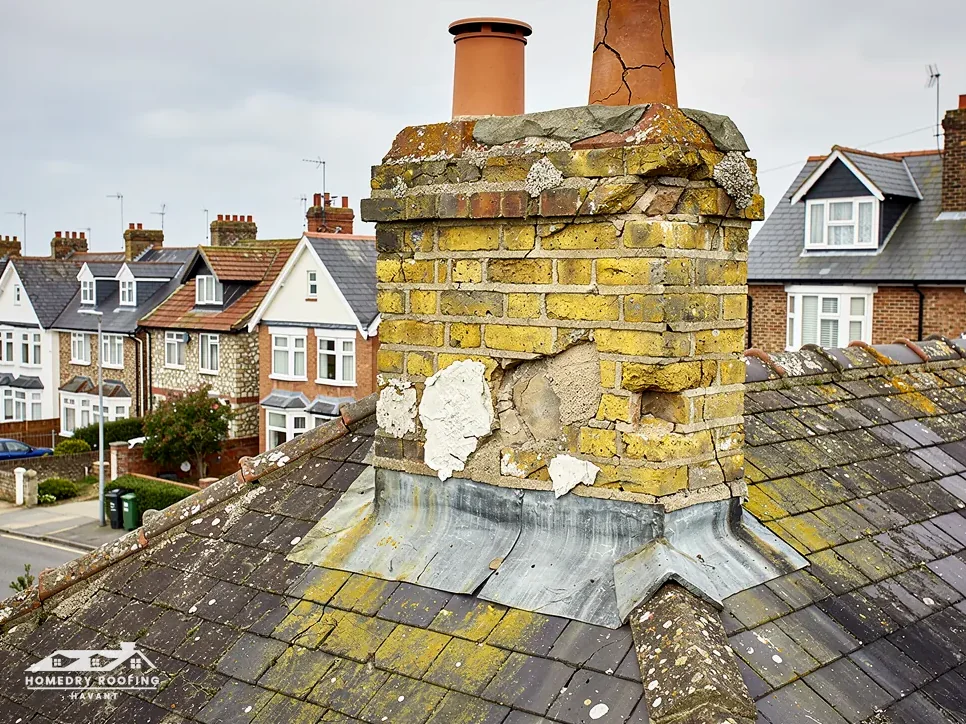
- Have flashings and the lead around chimneys looked at when the roof is inspected. MyJobQuote says correctly installed lead flashing can last for over 80 years, but only where it was correctly installed.
- Do not walk on the roof. HSE says all roofs should be treated as fragile until a competent person has confirmed they are not.
For cleaning, jet washing is the method to avoid. Marley does not recommend powerful jet washing, which can harm the surface of slate or tile and so shorten its expected life considerably. A roofer can describe a lighter method before starting.
If you do find a slipped slate, the reason matters more than the slate. A slate that has dropped because its fixing failed is a sign of the nail or hook, not of the stone, and our post on nail sickness and why good slates slip explains the mechanism.
Keep a short record: the date of each look, what you saw and any photograph. A roofer asked to quote later can see at once whether a change is new.
Photograph any damage before it is moved. The Financial Ombudsman Service says it will usually look at expert reports and photos of a property's condition if an insurance claim is disputed.
Listed, conservation area and older roofs
Protected buildings have their own rules. For a house in England, Class C of the General Permitted Development Order covers roof alterations of this kind, re-roofing included, so swapping the covering needs no application as a rule. A flat, or a house divided into flats, has no such rights.
Two checks sit on top of that.
- If the house is listed, it keeps Classes B and C, but listed building consent is also required, whatever the class, wherever a change would touch the building's special interest. A different slate, size or fixing can do that.
- In a conservation area, ordinary re-roofing is normally still permitted development, but an Article 4 direction may take rights away, so the council should be asked first.
These are reasons to ask, not to avoid slate. They are reasons to put the question to the council before choosing a slate, a size or a fixing, since a change that looks minor on a drawing can be the one that needs consent. A written reply from the council protects you if the work is questioned later, and it should name the roof slope and the work, so the answer fits the job you are planning and not a general case.
If you do not know whether the house is listed, or lies within a conservation area, the council can tell you. It is a quick check, and cheaper than finding out after the old slates have gone.
Our guide to slate roofs on listed and conservation homes sets out who to ask first and what to ask them.
Deciding whether slate suits your house
Slate is worth the money when the things that make it last are in place and when you will be there to benefit. The published figures say it costs more to fit and is expected to last longer. They do not say it is right for every house.
Put these questions to yourself and to the roofer.
- How long will you keep the house? A long expected life pays only to those who stay or hand it on.
- What is the pitch, and does it meet the minimum for the slate and fixing proposed?
- How exposed is the site, and has the fixing been calculated for it?
- Is the structure under the roof sound enough to carry a new covering for decades?
- Is there a listing, a conservation area or an Article 4 direction to check?
If the roof is not yet failing, a survey can say whether a repair is sound, and a sound repair comes first. If the roof has run out its life, the survey sets out what re-slating would involve, and the written price is one total.
Slate is one of the coverings we fit as part of our slate roofing work. The answer to whether it is worth it starts with the roof you have, not the one in a brochure, and with a figure you can compare like for like.
Write down the answers as you go. A short page of notes, kept with the quote, shows later what was agreed about pitch, exposure and fixings.
Filed under Slate roofing