
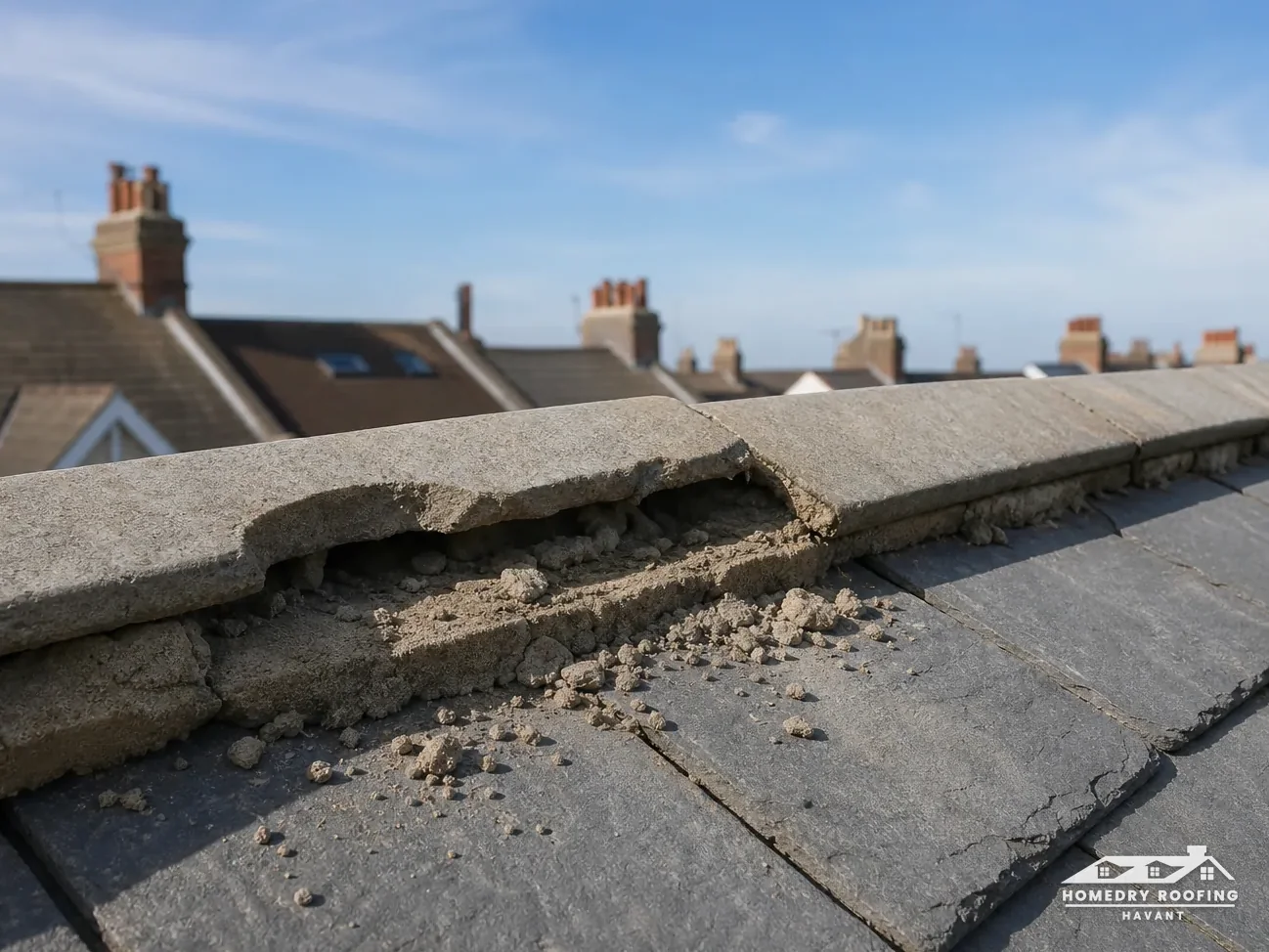
Gables
Where a slope ends at a wall that carries on upward to a point.
Water that tracks along the edge meets whatever bedding holds the last tiles.
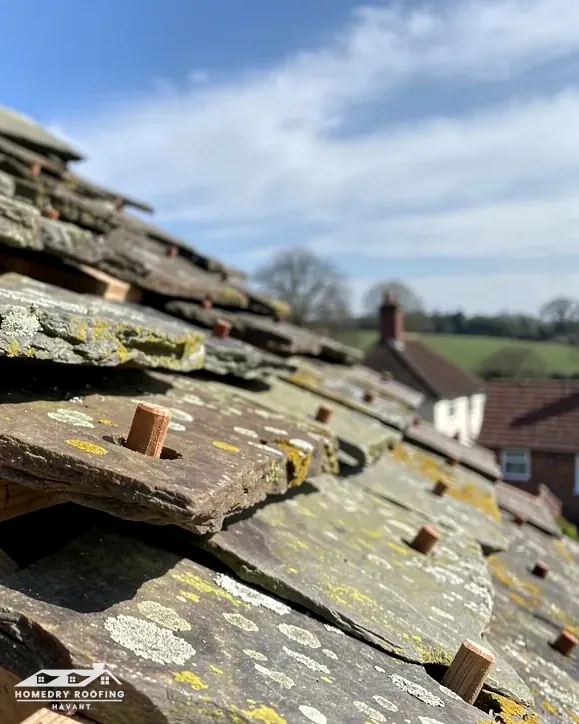
Otterbourne is 27.5 road miles north-west of Havant, and its roofs are followed from the edge tiles down to the valley linings; the price is set down in writing afterwards, as a single total.
10-year workmanship guarantee, in writing
Where a slope ends at a wall that carries on upward to a point.
Water that tracks along the edge meets whatever bedding holds the last tiles.
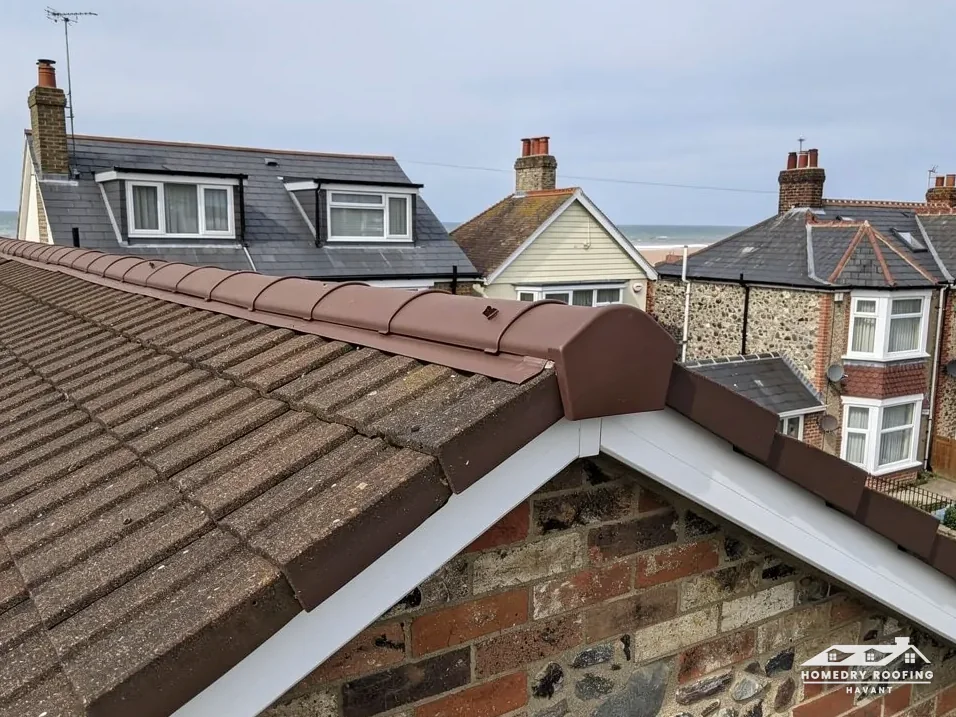
At a gable's end the final row of tiles hangs over the wall as a tidy edge.
Mortar that has crumbled underneath lets the edge tiles lift and the wind in.
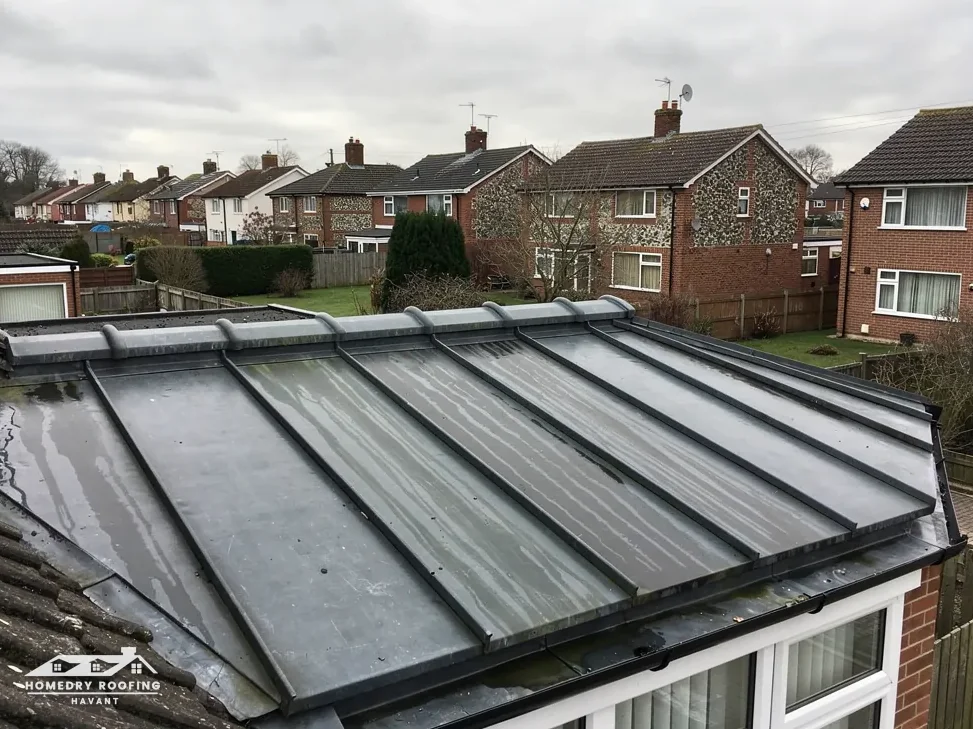
Two roof planes meeting at an angle share a single run between them.
A thin lining there carries the rain of both slopes, so one flaw does double damage.
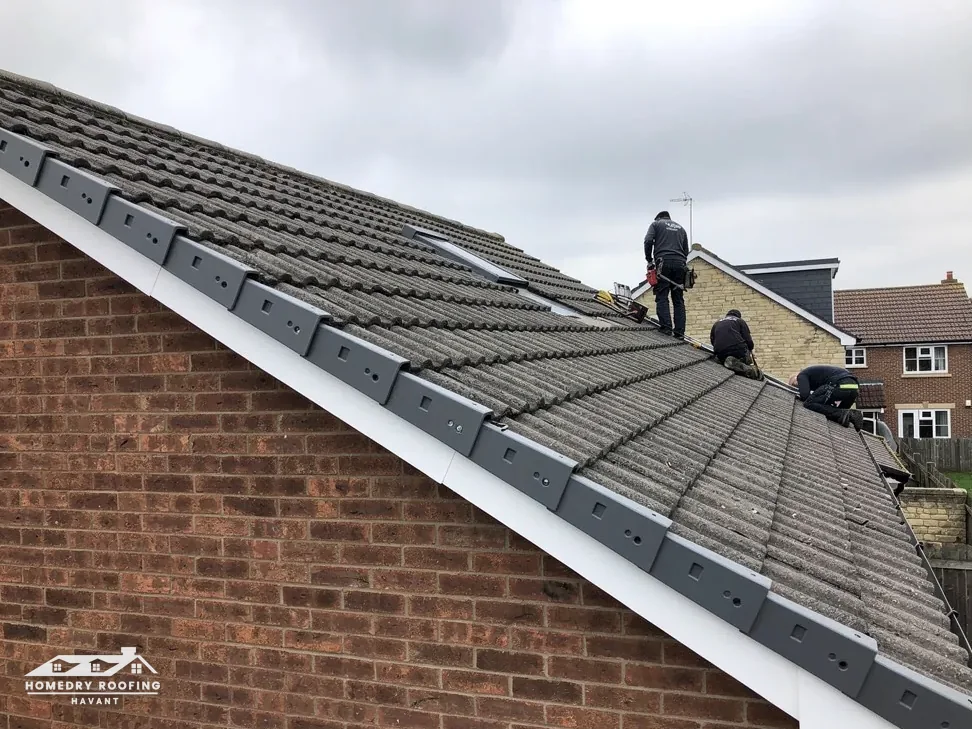
If the tiles are whole and just the bedding has failed, the edge can be re-bedded or fixed mechanically. A verge whose tiles have cracked or slipped along its length needs relaying. The survey shows which, with photographs.
A gable end is the point at which a slope finishes and the masonry keeps rising. The tiles along that edge, the verge, are held by mortar bedding or by fixings, and the survey looks at both. We check for a loose or missing edge tile, for mortar crumbling out from under the row, and for daylight between a tile and the wall. From the loft side a torch shows whether any of that has let rain onto the timber behind it. Where the verge is finished with a board under the overhang, we press that too, since a soft board tells us water has been reaching the edge. Photographs go with the written findings, and a few tiles re-bedded is a small repair, which is how it is described when that is all it is. Our dry ridge and verge page describes the mechanically fixed alternative to mortar, and the roof inspections page explains what a survey writes down.
The Church of St Matthew, Grade II*, is a Church of England place of worship still in use, so changes to it are decided through the Church's faculty system and the council's listed building consent does not apply. Otterbourne House is listed Grade II, and a listed house is a different case: listed building consent is needed for any roof work that changes what makes the house special, and its list entry sets out what the listing covers.
The Twyford conservation area lies not far from Otterbourne, and Winchester City Council is the place to find out if a boundary covers your address and whether an Article 4 direction applies, so check with Winchester City Council before a roof is planned. The planning guide for roof work sets out the national rules, which is why this page does not try to. For a listed address, the photographs go to the council.
A gable is the spot at which the roof finishes and the wall climbs on.
From the road a verge can look sound while the mortar beneath it has gone. If you can see a gable end safely from the garden, look for gaps under the edge tiles, for green growth running down the wall from the verge and for any tile that sits out of line. Send a photograph with your address, and the survey can start at that spot, with the loft behind the gable read at the same time.
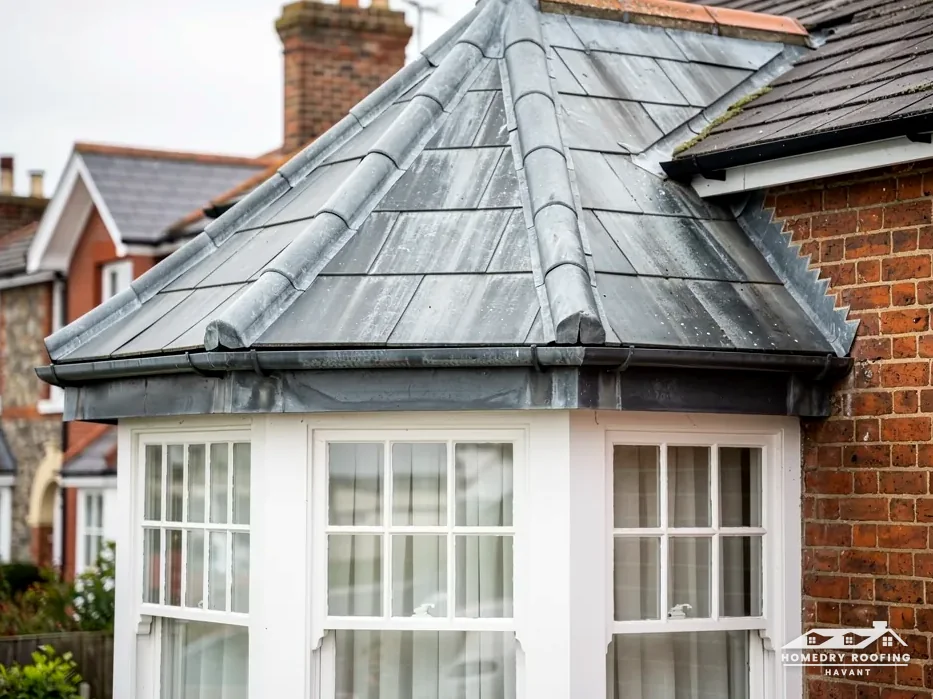
A valley is where two slopes drain into one run.
Two roof planes that meet at an angle leave a join, and the join becomes a channel. A valley collects water from both slopes, so a fault there carries more than a fault on open slope. We look down the length of the lining for splits, thinning and any place where it has pulled away from the boards, and along each flank at the tiles cut to meet it. Hips are the raised version of the same join, running out to the eaves, and their ridge tiles and fixings are read in the same visit. Leaves and moss packed into a valley hold water against the lining, so they come out first. A valley that has been patched before is read with extra care, because a second patch laid over the first can hide the original failure. Our leadwork page covers the lead used in valleys and around abutments.
Lead that covers the join between a roof and a wall, or round a chimney, is checked by eye and by hand: its top edge should sit tight in the mortar joint. If it has lifted, rain runs behind it onto the wall below, and the stain indoors can appear some distance from the break. For that reason we trace damp back along the timber in the loft instead of treating the first mark we are shown as the cause.
Land near Otterbourne has been mapped by the Environment Agency as Flood Zone 3. That is a mark on a map of the ground. No roofing rule hangs on it and nothing in the survey bends to it, though a downpipe that empties close to the house wall is worth moving wherever the zone line falls. Once the survey is finished the findings are written plainly, a repair is put forward first where it is sound, and the site is left clean.
Damp inside a house does not always sit under the hole in the roof. Water that gets past a valley or a flashing can run along a rafter or a board before it drips, so a ceiling mark may be some distance from the cause. In the loft we follow wet timber back along its length, and the survey records the spot where the trail begins, with a photograph of the board or rafter and the roof above it.
A damp patch well away from any wall, or a stain that grows after heavy rain.
A thin or split valley lining, or lifted lead along a flashing, where water runs under the covering.
Map of Otterbourne and the places around it, with the dashed line of our 30-mile service area from Havant. The same places are listed below the map.
Water that gets past a valley, a flashing or a verge does not drip at the point of entry. It runs along a rafter or a board first, so the ceiling mark can lie a good distance from the break. In the loft we follow the wet timber back along its length until it stops, then climb to the roof above that point. The findings show both ends of the trail in photographs, and the repair goes where the water got in, not where it showed. That is why a ceiling stain is a clue to follow, not a spot to fill. A patch over the stain would leave the source untouched.
The Church of St Matthew carries a Grade II* listing and remains a working Church of England church. Changes to a building of that kind are decided through the Church of England's faculty system, and the council's listed building consent is not the route. A listed house such as Otterbourne House is different: roof work that changes its special character needs listed building consent from Winchester City Council. Read the list entry for the building first, and take any doubt about the listing to the council. Our findings can be handed to either body, with photographs of the roof beside them.
Building regulations and planning are separate. The Planning Portal's thresholds are less than 25 per cent of the building envelope and less than 50 per cent of the roof; keep inside both and an application is not normally required, though approval is needed for any covering 15 per cent or more heavier. Winchester City Council's building control team (01962 848 176) is the body to ask. Our planning guide covers planning for a house re-roof, and each route is confirmed with the body concerned before work starts, with the answers passed on to you.
Yes, when it obstructs the highway: section 169 of the Highways Act 1980 requires one, and in Otterbourne the licensing body is Hampshire County Council. Hampshire County Council says: "Scaffolding companies must apply on behalf of their customers." Hampshire County Council charges £211.90 on application for the first 2 weeks and £72 for each additional 2-week period, and the licence start must be at least ten clear working days away from the application. Should the job overrun, a fresh application is made, because extensions are not offered. We arrange it with our scaffolder, and you will know the start day before the application goes in.
The Twyford conservation area lies some way from the village centre, but still close enough to ask about. Winchester City Council can tell you whether your own address falls within one. Within a conservation area an ordinary house re-roof remains normally permitted development, and any Article 4 direction that removes further rights is something to check with Winchester City Council for Otterbourne. Our survey notes can carry the council's answer alongside the photographs, so everyone is working from the same facts. Even an address outside every boundary gets the usual checks, and our planning guide sets out each rule with its source, so none of it rests on memory.
No. Flood Zone 3 on the Environment Agency's map covers land near Otterbourne, and that describes land, not roofs. Roofs are mended where the water got in. The one useful connection is drainage: we note where every downpipe discharges, and if one empties against the house wall the findings record it. A gutter that overflows is looked at from its outlet, then its joints, then its fall, in that order, before anything is replaced. Nothing in the findings changes because of the zone, and the photographs show where each pipe ends so you can see for yourself.
Yes, where the tiles themselves are sound. A few that have lifted can be re-bedded, or the edge can be fixed mechanically in place of mortar. If the tiles along the verge are cracked or have slipped out of line for its whole length, relaying that edge is the sensible repair. We go into the loft behind the gable to see whether water has reached the timber, then report the finding in writing with photographs, so the choice between the two is made on evidence, and the edge is photographed before and after the work.
The work, the covering and a clear statement of whether VAT and scaffolding are counted in the total, all given once someone has inspected the roof. You get one written total price alongside the findings, and our figures are good and fair. Where scaffold or VAT is missing from a second quote, have it added in writing before you compare, since a lower number can hide a smaller scope, and the difference surfaces later as an unplanned bill. The scope names what is renewed and what is left alone.
You'll get one written total price.
Fill in what you like. It opens WhatsApp with your message ready to send.