
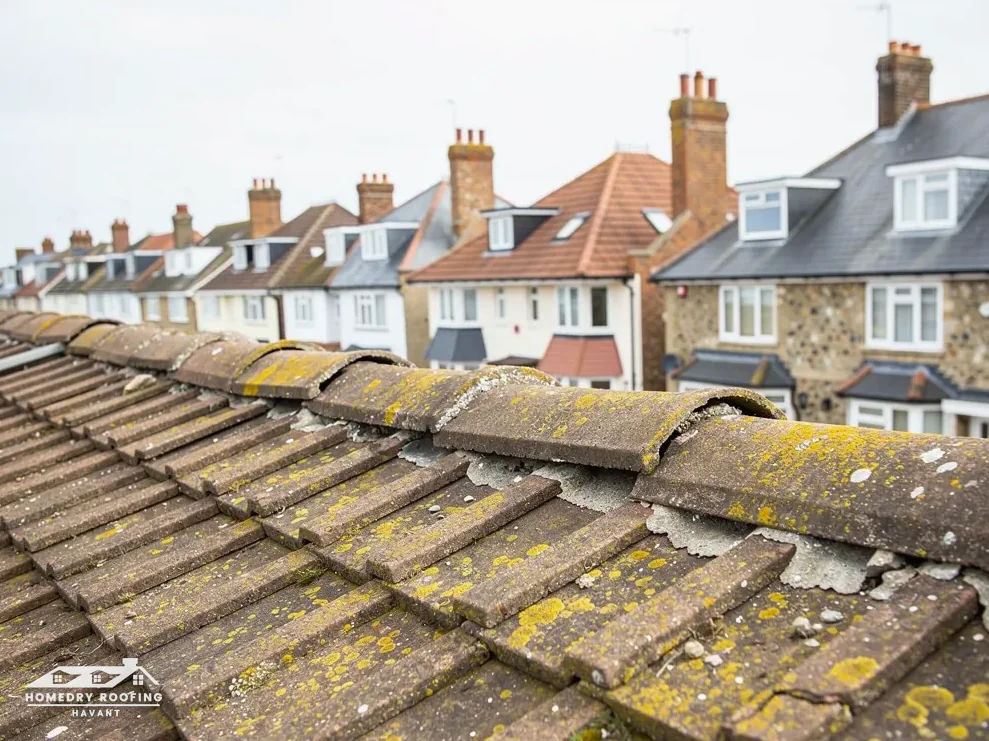
Ridges
Along the apex of a Bishopstoke roof, where a row of capping tiles covers the join between slopes.
A cap that rocks, or bedding that has crumbled beneath it, opens the highest line to rain.

Bishopstoke is 24.6 road miles north-west of Havant; ridges, hips and verges up top and the gutters and gullies below are each traced to their cause, then priced as one written total.
10-year workmanship guarantee, in writing
Along the apex of a Bishopstoke roof, where a row of capping tiles covers the join between slopes.
A cap that rocks, or bedding that has crumbled beneath it, opens the highest line to rain.
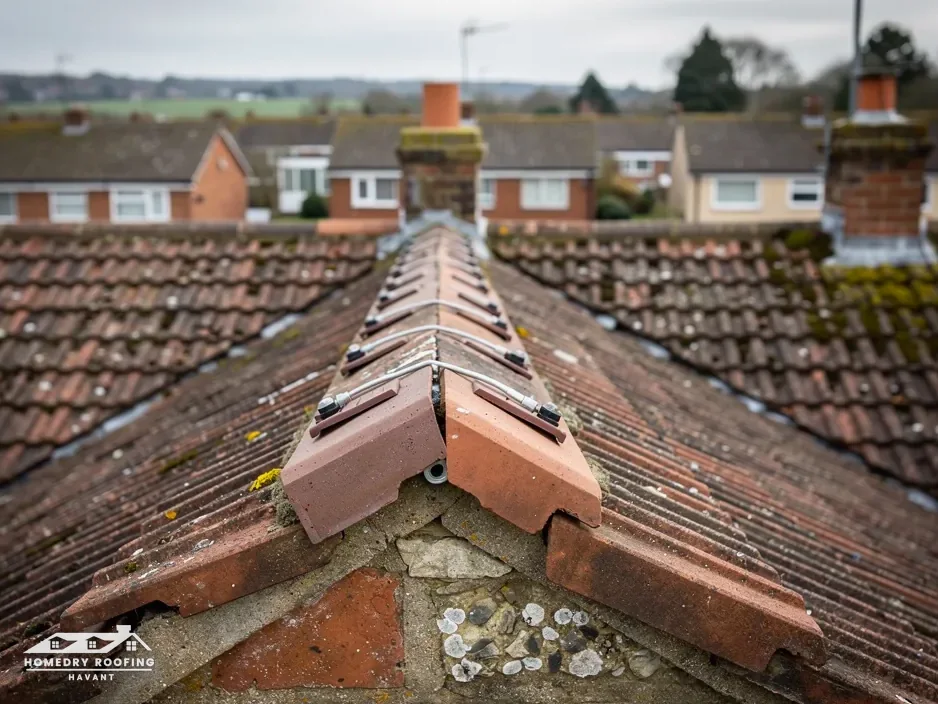
Where a gable roof ends at the wall and a course of edge tiles finishes the slope.
Pointing that has fallen out leaves those tiles loose and the roof edge open to the weather.
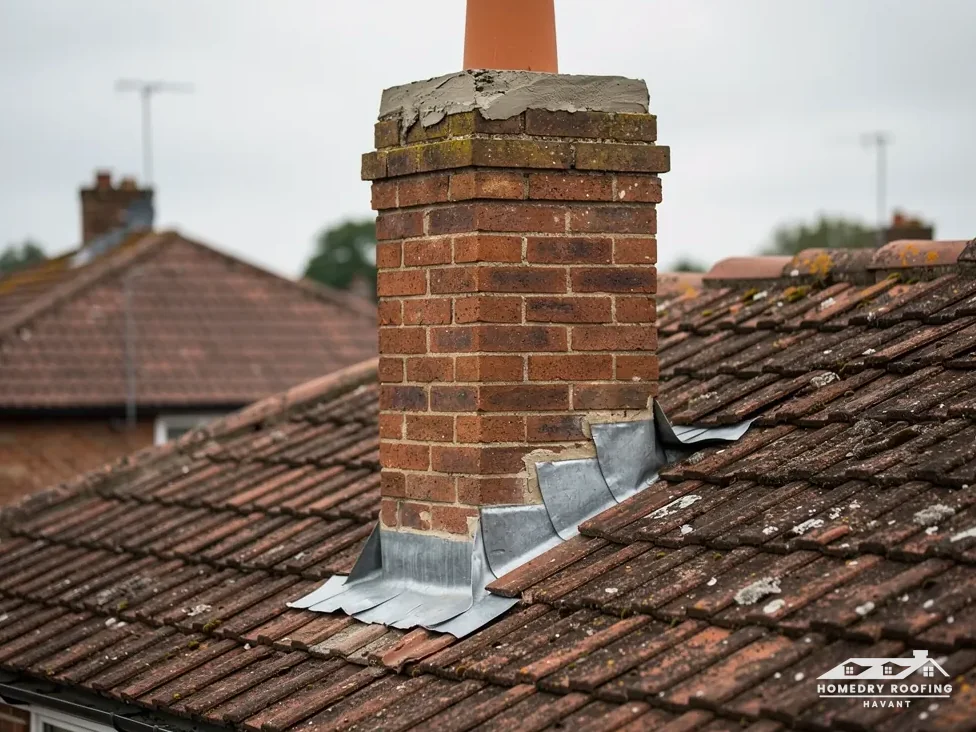
At the bottom of a Bishopstoke downpipe, where it empties into a grating set in the ground.
Silt in that grating leaves rain with nowhere to go, and it backs up the pipe.
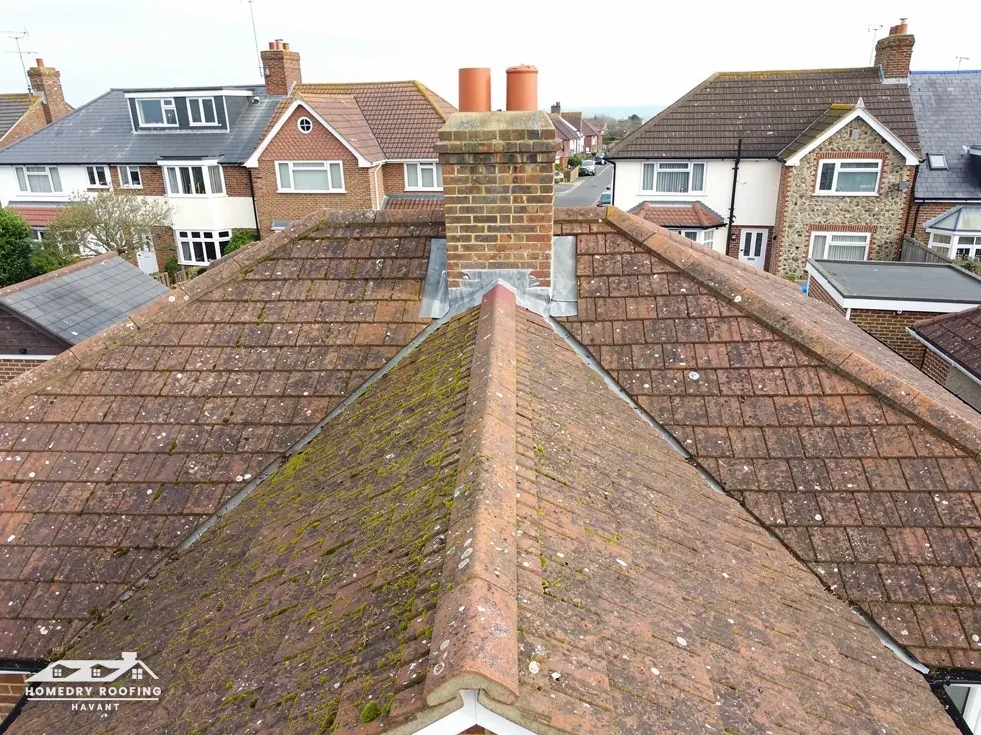
Yes. Rain that gets in at the top can run down a rafter and show itself lower down, so the stain and the loose tile may be several metres apart. We trace the route from the stain back up the slope before saying where the fault sits.
The ridge is the first thing a surveyor reads and the last place rain should reach. In Bishopstoke we sight along it from the road for a dip or a gap, then climb to look closely at each capping tile, each hip end and the line of the verge where a gable stops at the wall. We also look just below the top, at the first few courses of tiles either side of the ridge, where a cap that has moved can leave its neighbours unsupported. We want to know whether the bedding beneath the caps is sound, whether any piece rocks under a gloved hand, and whether the edge tiles along a gable are still held down and pointed. Loose pieces up there let rain in at the very top of the roof, so a stain on the landing ceiling can begin with a single cap. Our pitched roofing page covers the slopes beneath.
The Bishopstoke conservation area is designated, and Eastleigh Borough Council holds the boundary, so any question about your road goes to that council. An Article 4 direction takes away rights that would otherwise apply, so check with Eastleigh Borough Council before work starts, and ask whether one reaches your address. Old Rectory has a Grade II entry on the National Heritage List, and a house with a listing of its own needs listed building consent for any work that affects its character.
A re-roof's Building Regulations route runs through Eastleigh Borough Council's building control, delivered through a partnership arrangement with Southampton City Council, and the planning guide for roof work holds the rest of the rules, so they are not repeated here. None of this changes how the roof is read from the ladder, but it does change who you need to ask first.
The top line of the roof meets the weather before anything else does.
Water that gets in at the ridge or a hip end runs down inside the roof and shows itself lower down, at a spot that can look nothing like the cause. Starting at the top lets us rule the high points in or out before time is spent on the slope below. Each loose cap or open joint is photographed, so the findings show the exact tile and not just a general area.
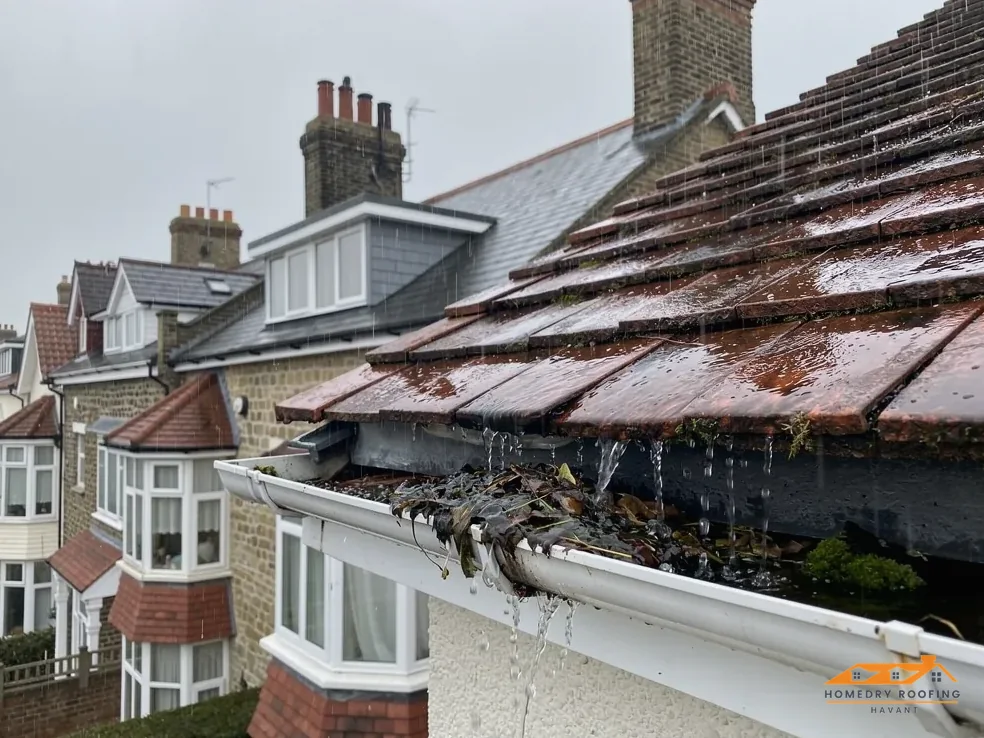
Rain has done its work only once the gully has taken it.
Once rain leaves the slope it has a second journey, along the gutter to the outlet, down the pipe and into the ground. We walk that route in order, looking for a fall that has been lost, a joint that has opened, a bracket that has pulled out and a hopper stuffed with leaves. A gutter that spills at one corner is sometimes blamed on its size, but a blocked hopper or an opened joint produces the same spill, so those are checked before anything larger is suggested. The gutters, soffits and fascias page covers the options, from refixing one bracket to a whole new run.
The Environment Agency's flood map shows Flood Zone 3 land near Bishopstoke. The zone is a statement about land, and it sets no rule for roofs. It is still a sound reason to follow each downpipe to where it ends and write down what is there. A pipe that stops short of its gully, a gully clogged with silt, or a path that slopes back towards the wall all hand the roof's water back to the house. A pipe that leaks at a joint, or throws water against the wall, gets the same attention as the gutter above it. To check your own address, use the Environment Agency's map.
The boards behind the gutter get a screwdriver test, since timber that gives way under it has been wet for some time. When the whole route has been read, you learn whether the roof should be mended or covered anew, with the reasons and photographs from the ladder and the loft, and a repair is put first where the covering is sound. The roof repairs page sets out what that involves, and any quote carries the findings with it.
Timber that dents under a thumb, or a soffit tinged brown at one edge, tells you the water has been arriving for some time. Candidates include a leaking joint, a bracket that has slipped and tiles ending short of the gutter lip. We record which, so replacement boards do not end up under the same fault, with a photograph attached to the note in the written findings.
A dark streak down the wall beneath the gutter, or a patch of green at the foot of the downpipe.
An opened joint, a slipped bracket or a hopper full of leaves, each letting the water over the edge instead of along the run.
Map of Bishopstoke and the places around it, with the dashed line of our 30-mile service area from Havant. The same places are listed below the map.
From the ground first, sighting along the line for a dip or a gap, then from the ladder, where each cap is tested with a gloved hand for movement. Beneath the caps we check the bedding for cracks and crumbling, then the hip ends where two slopes meet, then the verge tiles along a gable. Inside, a torch in the loft shows whether rain has already run down the timbers from the top. Anything loose is shown in a photograph taken where it sits, so the findings point to the exact tile. Rebedding a few caps is a small job, while failed bedding along the whole ridge is a bigger one.
Treat the two as separate. For Building Regulations, the Planning Portal says a re-roof touching less than 25 per cent of the building envelope and less than 50 per cent of the roof does not normally need an application, while a new covering that adds 15 per cent or more to the weight needs approval, however small the area. The body to speak to is Eastleigh Borough Council, whose building control is delivered through a partnership arrangement with Southampton City Council, and we raise it with you before work begins. Planning permission is covered in our planning guide, including what to ask if your house is listed or in a conservation area.
Hampshire County Council licenses scaffolding on the highway, and its page says who applies: "Scaffolding companies must apply on behalf of their customers." The charge is £211.90 on application for the first 2 weeks, then £72 for each additional 2-week period, and ten clear working days must separate the application from the start. We arrange it with our scaffolder once the survey is accepted, so you are not left filling in forms. No extension is offered, so a long job needs its full period requested at the outset, and we settle the likely length with you beforehand.
Old Rectory holds a Grade II entry on the National Heritage List (list entry 1203917), and that entry covers the building it names. If your house is on the list in its own right, you need listed building consent before work that would change its character, and that holds whichever firm does the work. Whether an entry exists for your address can be checked on the list by street and name, and Historic England publishes the entry text. A doubtful case goes to Eastleigh Borough Council before any materials are ordered, because ordering first and asking afterwards is the costly order.
An Article 4 direction takes away rights that would otherwise apply, so check with Eastleigh Borough Council. Ask whether your road lies inside the Bishopstoke conservation area, whether any direction reaches your house, and whether roof work is among the rights it removes. Ordinary re-roofing is normally permitted development, but the council's answer comes first, so ask for it in writing and we will carry the reply into the survey notes. If it names a direction for your road, we go over the notice together and the price waits until its terms are clear. The roof rules themselves live in our planning guide.
No part of the roof is laid or fixed any differently. The Environment Agency's flood map shows Flood Zone 3 land near Bishopstoke, and the zone is a statement about the ground, not the slope above it. It does matter to the ground-level part of the visit: where each downpipe empties, how clear its gully is, and what the rain does after that. Those observations are filed with the roof findings and photographed too. Anyone wanting to know about a single address can look it up on the Environment Agency's map before planning work near the ground.
It can, over time. A gutter that overflows soaks the fascia board behind it, and the wet reaches the soffit and the rafter ends. That is why the survey presses the boards and looks along the underside of the eaves, not just at the gutter itself. A blocked hopper is cleared on the spot where it is the only fault. Soft timber is traced back to the joint, bracket or tile edge that let the water in, and the repair deals with that cause before any new board is fitted.
Findings in plain English, with the photographs behind them, taken from the ladder and from the loft. One written total price follows, covering the whole job, and it says whether VAT and scaffolding are in the total, so you can lay a second quote alongside and compare the two like for like. Where a repair will do, that comes first, and a replacement is proposed only if the roof needs it. Prices are good and fair. When the work ends the site is cleared, and the drive and garden are checked for tile ends and dust.
You'll get one written total price.
Fill in what you like. It opens WhatsApp with your message ready to send.