
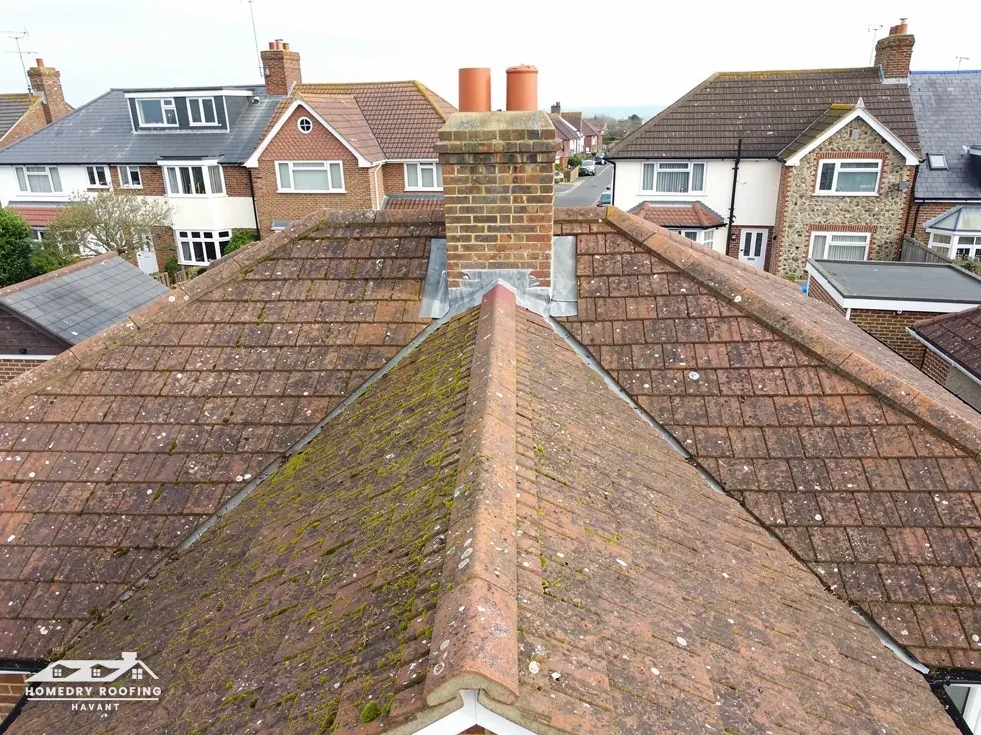
Battens
Where thin timber laths run across the rafters and every tile in the slope hangs from them.
When a nail head lets go, one tile drops a few millimetres and the underlay takes the rain.

Millbrook is a district of Southampton, 29.1 road miles west of Havant. What holds the tiles down and what closes the gable edge are checked before anything else.
10-year workmanship guarantee, in writing
Where thin timber laths run across the rafters and every tile in the slope hangs from them.
When a nail head lets go, one tile drops a few millimetres and the underlay takes the rain.
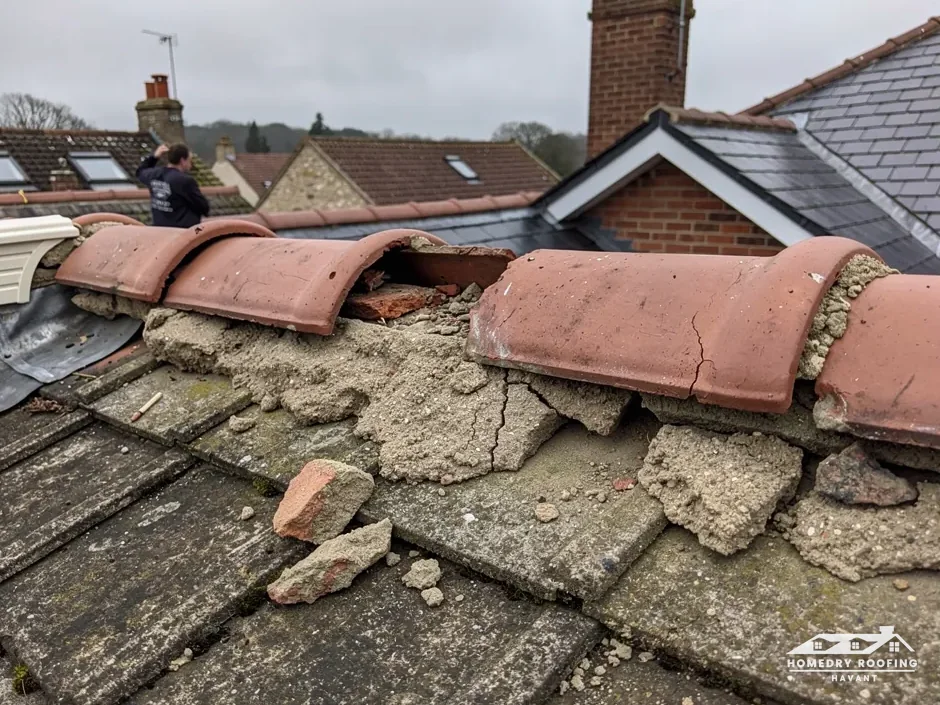
Where a Millbrook gable slope ends and its edge tiles overhang the head of the gable wall.
A loose edge there lets a gust get underneath, and rain follows it onto the timber.
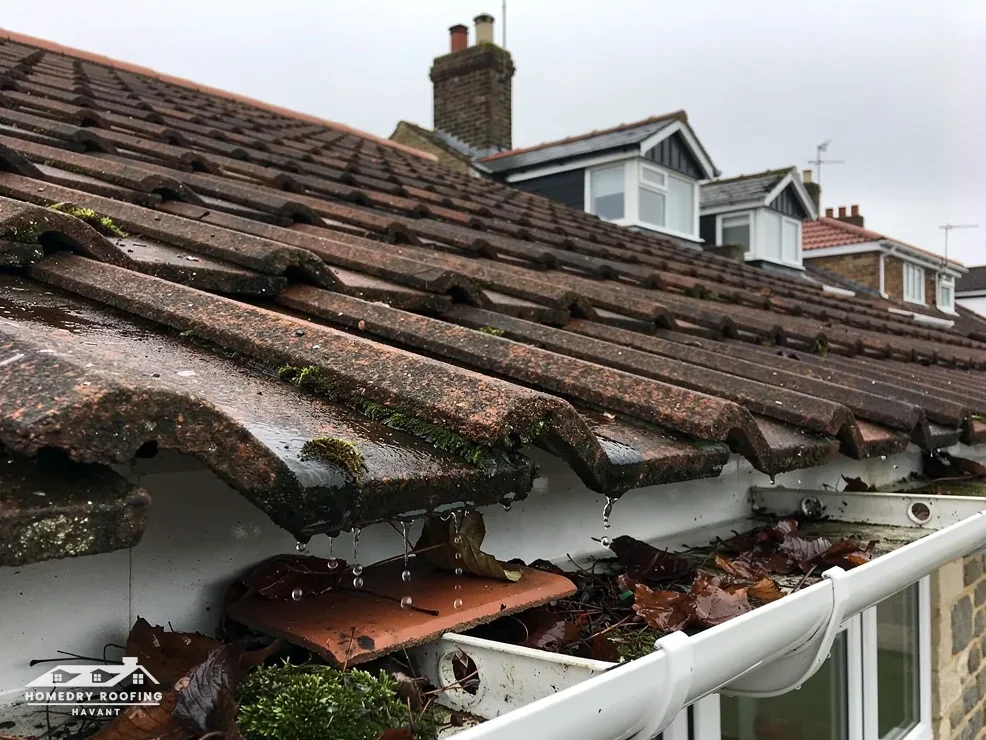
Where the foot of each Millbrook slope pours its run-off into a length of guttering.
A joint that has parted or a bracket that has dropped sends the flow down the wall face.
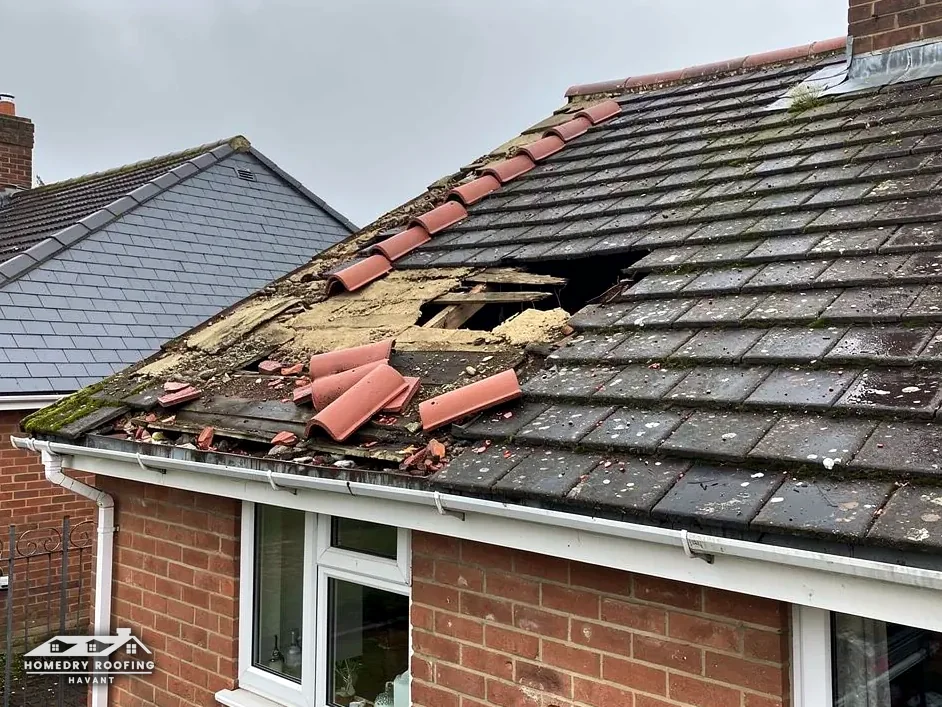
A tile stays up for as long as its fixing does.
Every tile on a pitched slope hangs from a timber lath called a batten, laid across the rafters over an underlay, and a tile stays put only while its nail or clip still grips that lath. When a Millbrook tile slips, the question is what let it go. We lift the neighbouring tiles, look at the batten beneath for splits and softness, check the nail heads and clips, and read the underlay for tears and stains. A hand pressed on the next course shows whether it is loose as well, and the loft side of the slope is read for daylight or damp patches under the gap. If the whole course has shifted, we follow it along the slope until the tiles sit firm again. Marley describes BS 5534 as covering batten selection, methods of fixing, wind uplift formulas and a means of calculating fixing specifications, which is why the fixings get as much attention as the tiles themselves. A single slipped tile belongs to our roof repairs work; a slope with failed battens throughout points toward a new roof.
List entry 1339986 covers the Church of the Holy Trinity in Millbrook, graded II, where Church of England worship continues. Because of that, roof work on the building is decided under the faculty jurisdiction and is not a matter for listed building consent. A listed house stands differently: the council's listed building consent is the hurdle for anything that alters the building's character, and Historic England's list shows whether an address has an entry.
A street name cannot tell you whether a roof sits inside a protected area, and the council's records settle it, so put your address to Southampton City Council ahead of any plan for a front slope. Our planning guide for roof work covers the national rules.
A slipped tile looks like a small fault, and from the pavement it is. What matters is why it moved. If a nail has sheared, its neighbours may be about to follow. If the batten has rotted, a whole row hangs from timber that will not hold it. So the survey lifts a few tiles either side of the gap, photographs what it finds, and sizes the repair to the cause.
A tile lying in the garden after a windy night, or a gap in the course that was not there last month.
A sheared nail, a batten gone soft, or an underlay torn beneath the gap so that rain reaches the rafters.
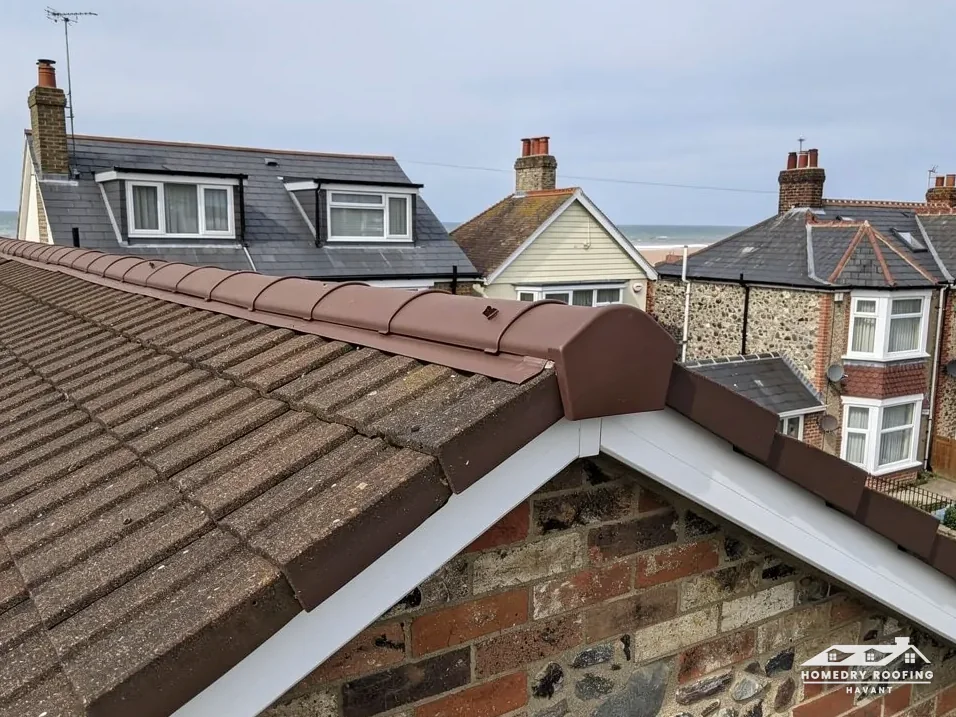
Not always. A mortar bed is one way to hold them and a dry-fixed system is another, and Marley's view is that mortar "could no longer be relied upon" as the only fixing. The survey looks at how your verge is held and says which repair suits it.
At a gable the slope ends and the wall rises to meet it, and the verge is the strip where edge tiles overhang the top of that wall. It is the one edge of a pitched roof where a gust can get underneath, so a loose verge is dealt with promptly. We sight along it from the ground first, then check each edge tile for movement, the bed holding the tiles for cracks and loose crumbs, and the clearance where the final tile meets the gable wall. The wall below is looked at too, because a darkened patch under the edge tells us rain has been passing for some time. Where the line has loosened along its length, our dry ridge and verge page sets out the dry-fixed alternative to a mortar bed.
A conservation area is a matter for the council that holds its boundary. Southampton City Council's St James Road lies near Millbrook, and beyond the city boundary New Forest District Council holds Eling and Royal Naval Armaments Depot (Marchwood (R.N.A.D.)). For a Millbrook address, the question goes to Southampton City Council. Before work on a street-facing slope or gable, ask Southampton City Council which permitted rights, if any, an Article 4 direction has withdrawn.
At the close of the survey you get a clear account of the roof: what needs mending, what does not, and why. If the verge is the only trouble, the quote covers the verge, and the covering, battens and underlay beside it are left alone. Where a gable has needed attention once, we note the condition of its opposite end as well, and a ladder is set up against the wall below so the underside of the edge can be seen as well as the top. Questions are welcome before and after the written total price arrives, by phone or WhatsApp, whichever suits you better.
The edge of a slope is the first part a gust can reach.
The middle of a roof is sheltered by the slope around it, but a verge is open to the air on its underside. A gust can then get beneath a loose edge tile and lift it further, with rain riding in behind. Once the first tile has gone, the ones beside it are exposed too. We photograph the loose length, state how far it extends, and recommend a repair that fits that length and no longer.
We lift the tiles either side of the gap and look at what they were hanging from. A sheared nail points at the fixing, a split or soft batten points at the timber, and a torn or stained underlay shows where water has already passed. One slipped tile with sound timber behind it is a repair. A slope where several battens give is a different job, and the photographs say which you have. The quote is sized to that finding, so a small fault does not turn into a large bill, and the roof space is read at the same visit so the underlay is not missed.
The Planning Portal gives the building regulations test for a re-roof: under 25 per cent of the building envelope and under 50 per cent of the roof means no application is normally required, while a covering 15 per cent or more heavier is a different test, because it needs approval in itself. Your building control body decides how a given house is treated, so we ask it before work is booked and send you what it says. Planning permission is a separate route, and the planning guide lists the checks for listed and protected houses, so read it before ordering any covering that differs from the one on the roof now.
A licence under section 169 of the Highways Act 1980 is needed before scaffolding goes over a highway, and for Millbrook the body is Southampton City Council. Southampton City Council's page lets contractors who hold £10 million public liability insurance apply for a licence, and Southampton City Council charges a £496 minimum that breaks into a £157 licence fee, £146 for pre- and post-inspections, a refundable £157 deposit and £36 per weekly inspection, with the licence renewable weekly at £36 per week. We arrange it with our scaffolder, with the timing agreed with you in advance, so the scaffolder is not booked until the dates suit you and the highway licence is in hand.
No. List entry 1339986 gives the church Grade II status, and while Church of England services continue there its works fall under the faculty system, not the council's listed building consent. That consent applies to listed houses and to other listed buildings outside the exemption. If you look after the church, ask the Church of England about the faculty process before any contractor is approached. For a house, search the list by address first, since the entry decides which route applies, and forward a copy to us, so the notes we write respect the listing.
St James Road is Southampton City Council's, while Eling and Royal Naval Armaments Depot (Marchwood (R.N.A.D.)) are New Forest District Council's, over the city boundary. Boundaries are held by the council whose area an address falls in, and for a Millbrook address that is Southampton City Council, so put your house number to it. Roof coverings on houses normally fall within permitted development, conservation area or not. An Article 4 direction is the exception that matters, so ask the council before touching a front slope, and file the reply with the survey notes, because a reply given by phone is easily forgotten when the work starts.
A verge is open to the air along its underside, so a gust can lift a loose edge tile, and rain then rides in behind it onto the timber. The next tile in the line loses its neighbour's support, which is why a short loose stretch can grow. We photograph the loose length and state how far it runs, and the repair suits that length: a handful of edge tiles rebedded, or the whole verge taken down and fixed again where the bed has failed along its run. Nothing larger is proposed than the length we photographed.
Stand back and look along each slope for a tile that sits lower than its row, a gap in a course or a verge tile that tilts out from the wall. Check the gutters for joints with a drip hanging from them. In the loft, a torch beam on the underside of the slope can show daylight where a tile has gone or a damp mark on a rafter. Photographs of any of these give us a first idea of where the survey should start, and you can send them by WhatsApp.
A price given from the pavement is a guess. After a survey we know what the battens, fixings and verges are doing, and the written total price reflects that: one figure, with VAT and scaffold stated, and the photographs beside it. The price is good and fair, and it is set once, after the survey and not before it. If a rival figure arrives with no survey behind it, ask what it assumes about the timber under the tiles, since that is where a low quote is likely to be revised later on.
You'll get one written total price.
Fill in what you like. It opens WhatsApp with your message ready to send.